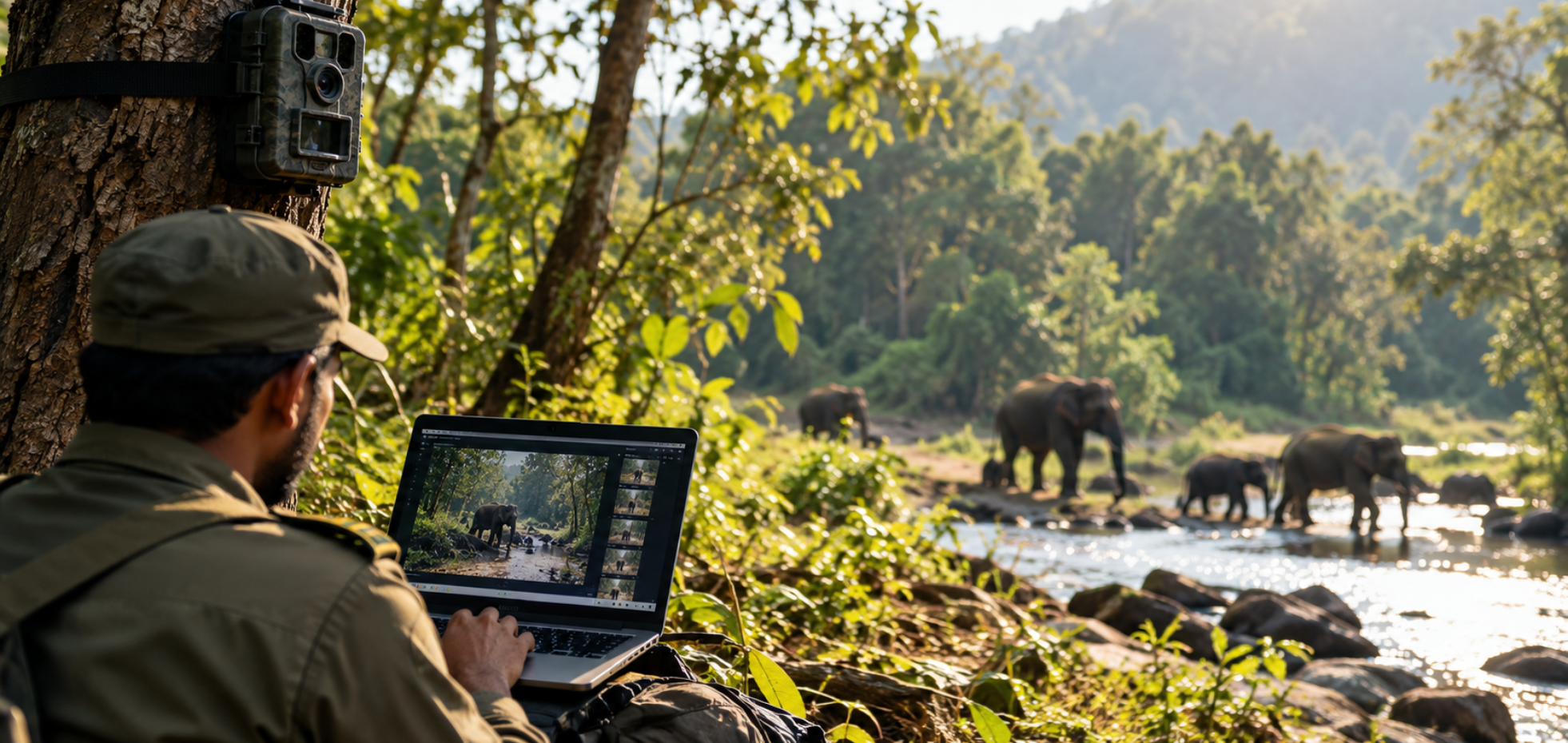
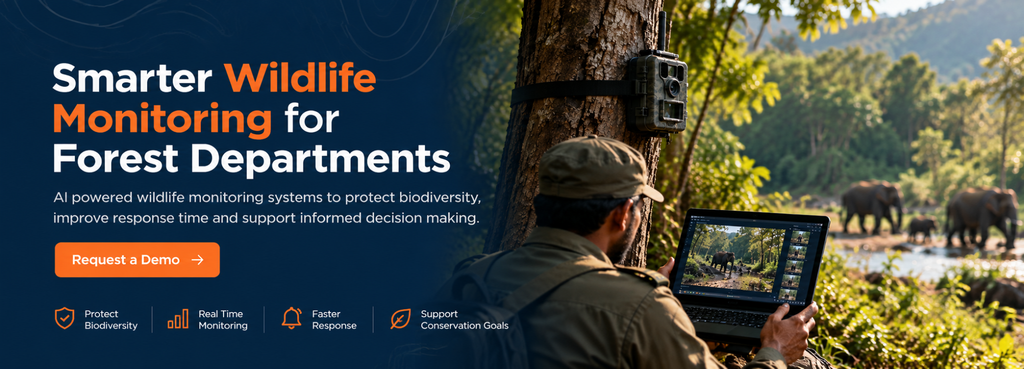
A wildlife monitoring system for forest departments uses cameras, artificial intelligence, alerts, and data analytics to monitor wildlife and human activity across forest areas. It can detect animals in real time, identify supported species, detect human intrusion, send alerts to field teams, and help forest officials understand wildlife activity.
Traditional wildlife monitoring often relies on camera traps, field teams, manual observation, and reports. These methods remain useful, but they can make real time responses difficult. An AI based wildlife monitoring system adds continuous monitoring and automated detection to the process.
For Forest Departments managing large forests, wildlife corridors, tiger reserves, forest boundaries, and areas close to human settlements, this technology can help teams respond to important events faster.
Wildlife EYE & IQ from Valiance Solutions combines real time wildlife detection with a data and analytics layer designed to turn wildlife sightings into useful conservation intelligence.
What Is a Wildlife Monitoring System for Forest Departments?
A wildlife monitoring system is a technology platform used to observe wildlife, people, and activity across forests and conservation areas.
Modern systems can combine:
- AI enabled cameras
- Wildlife species detection
- Human intrusion detection
- Real time alerts
- Mobile notifications
- Night vision
- Geofencing
- Edge AI
- Solar powered systems
- Wildlife data analytics
- Centralized monitoring dashboards
The purpose is not simply to record animals.
A modern wildlife monitoring system can help answer important questions:
- What animal was detected?
- Where was it detected?
- When was it detected?
- Is a person entering a restricted area?
- Is wildlife moving close to a village or other high risk zone?
- Does the field team need to respond?
Wildlife EYE is designed around a four stage process: detect, classify, alert, and prevent.
Why Do Forest Departments Need Modern Wildlife Monitoring?
Forest areas can cover large distances, making continuous manual monitoring difficult.
Wildlife also does not follow fixed schedules.
An animal may pass through a forest boundary at night. A herd may move close to a village. A person may enter a restricted forest area. A field team may not know about the event until someone reports it.
This creates a gap between what happens in the forest and when officials become aware of it.
Technology can reduce this gap.
A camera placed at a strategic location can monitor an area continuously. AI can analyse the camera feed and identify defined events. An alert can then reach the people responsible for the area.
For human wildlife conflict prevention, this time difference can matter.
Wildlife EYE is designed around real time detection, classification, alerts, and preventive action.
Key Features of a Wildlife Monitoring System
A wildlife monitoring system can include several technologies depending on the requirements of the Forest Department.
1. Real Time Wildlife Detection
One of the most useful features of an AI wildlife monitoring system is real time animal detection.
Instead of waiting for someone to review camera footage, AI can analyse the video feed and identify a detected animal.
Wildlife EYE supports real time detection and classification of species such as tigers, leopards, and bears. The platform states a detection time of under three seconds for supported wildlife detection workflows.
This can be particularly useful in areas where fast notification is important.
For example, if wildlife is detected close to a forest boundary, the system can generate an alert instead of waiting for a field team to discover the event later.
2. Wildlife Species Identification
Detecting an animal is only the first step.
Knowing what animal was detected can make the information more useful.
AI based species detection can classify supported wildlife from camera footage.
This can help Forest Departments maintain better records of wildlife sightings and understand where specific species are being detected.
Wildlife EYE supports species classification as part of its AI based detection workflow.
3. Human Intrusion Detection
Wildlife monitoring is not only about animals.
Human activity near protected areas can also require attention.
An AI wildlife monitoring system can detect unauthorized human movement in monitored zones and send an alert to the relevant team.
Wildlife EYE supports human intrusion detection alongside wildlife detection.
This can be useful around:
- Forest boundaries
- Protected areas
- Wildlife corridors
- Restricted zones
- High risk wildlife areas
4. Real Time Alerts
Detection becomes much more useful when the information reaches the right person quickly.
A wildlife monitoring system can send alerts when an animal or unauthorized person is detected.
Wildlife EYE supports mobile alerts for field teams and officials.
The system can detect an event, classify the subject, generate an alert, and provide the information needed for the responsible team to respond.
5. 24/7 Monitoring
Wildlife movement does not stop after sunset.
Many animals are active during the night, and some human wildlife conflict events can also occur during low light conditions.
A wildlife monitoring system should therefore support continuous monitoring.
Wildlife EYE includes 24/7 monitoring and IR night vision capabilities.
This allows the system to continue monitoring when normal daylight cameras may not provide enough visibility.
6. Virtual Wall and Geofencing
Forest boundaries can be difficult to monitor using physical infrastructure alone.
A virtual wall creates a digital boundary around a monitored area.
When a detected person or animal crosses the defined boundary, the system can trigger the appropriate response.
Wildlife EYE uses a camera based virtual wall concept for perimeter monitoring and crossing detection.
This can be useful around:
- Forest boundaries
- Village edges
- High risk zones
- Wildlife corridors
- Restricted areas
The objective is simple: know when something crosses a defined boundary.
7. Edge AI
Forest monitoring locations may not always have reliable internet connectivity.
Sending every video stream to a remote cloud server can also create additional network requirements.
Edge AI allows processing to happen closer to the camera or monitoring location.
Wildlife EYE uses edge AI processing as part of its wildlife monitoring architecture.
This makes edge processing useful for remote forest environments where connectivity, power, and response time need to be considered together.
8. Solar and Off Grid Deployment
Many wildlife monitoring locations are far from regular power infrastructure.
A monitoring system designed for forests therefore needs to consider how the equipment will operate in remote areas.
Wildlife EYE supports solar and off grid deployment, along with low energy AI models designed for such environments.
This allows monitoring equipment to be placed in locations where connecting the system to conventional power infrastructure may not be practical.
How Does an AI Wildlife Monitoring System Work?
The process can be understood through four main stages.
Step 1: Detect
Smart cameras monitor the selected area.
The camera captures wildlife and human activity within its field of view.
Step 2: Classify
The AI analyses the captured video and identifies the detected subject.
Depending on the supported model, this can include specific wildlife species or human intrusion.
Step 3: Alert
When a relevant event is detected, the system sends an alert to the responsible people.
Alerts can reach forest officials, rangers, village heads, or other designated teams depending on the deployment.
Step 4: Prevent or Respond
The responsible team can then take appropriate action.
This could mean:
- Warning nearby communities
- Sending a field team
- Monitoring the animal’s movement
- Restricting access to an area
- Coordinating with local officials
- Taking other preventive measures
The technology does not replace field teams.
It gives them information sooner.
AI Wildlife Monitoring for Human Wildlife Conflict
Human wildlife conflict is one of the most important areas where real time wildlife monitoring can help.
Conflict can occur when wild animals move into or near human settlements, agricultural areas, roads, or other places where people and wildlife come into close contact.
The longer it takes to know about the animal’s presence, the harder it can be to coordinate an early response.
AI wildlife monitoring can help by creating an early detection layer.
For example, when wildlife approaches a monitored boundary, the camera can detect the animal. AI can then identify the species and generate an alert for the relevant team. Officials can use that information to coordinate preventive action.
This is the core idea behind using AI for human wildlife conflict prevention.
Wildlife EYE is specifically designed around real time wildlife detection, human intrusion detection, alerts, and preventive action.
Wildlife Monitoring System for Forest Boundaries
Forest boundaries can be difficult to monitor continuously.
There may be roads, farms, villages, railway lines, water sources, or other human activity close to the forest.
A forest monitoring system can use cameras at selected points to watch these areas.
AI can then identify:
- Wildlife movement
- Human intrusion
- Boundary crossings
- Activity in high risk zones
A virtual wall can add another layer by creating a digital boundary and triggering alerts when a monitored subject crosses it.
This can help Forest Departments focus field resources on locations where an event has actually been detected.
AI Wildlife Detection in Remote Forest Areas
Remote deployment creates different challenges from normal security monitoring.
There may be:
- Limited electricity
- Poor network connectivity
- Difficult terrain
- Long distances between monitoring points
- Limited access for maintenance teams
This is why hardware and software architecture matters.
Wildlife EYE supports fixed deployment, solar and off grid setups, mobile setups, and intelligent camera traps.
The platform also uses edge AI and low energy models to support remote monitoring requirements.
AI Camera Traps vs Traditional Camera Traps
Traditional camera traps are useful for recording wildlife activity.
The challenge is that someone may need to collect or review the footage before the information becomes useful.
AI enabled camera traps can add real time analysis.
| Traditional Camera Trap | AI Wildlife Monitoring |
|---|---|
| Captures wildlife footage | Captures and analyses footage |
| Data may be reviewed later | Detection can happen in real time |
| Limited immediate response | Real-time alerts |
| Manual review may be required | AI can identify supported species |
| Mainly provides recorded evidence | Can support detection and response |
| Less suited to immediate alerts | Designed for real-time notifications |
The two approaches do not have to be treated as competitors.
Traditional camera traps can still provide valuable wildlife records.
AI monitoring adds the ability to analyse selected events immediately.
Wildlife Data Analytics for Forest Departments
Detection tells the Forest Department what happened.
Analytics can help answer what is happening over time.
This distinction matters.
If a system records thousands of wildlife sightings, the data can be used to understand patterns such as:
- Where animals are being detected
- Which species are appearing in an area
- Where wildlife activity is increasing
- Which areas have more human intrusion
- Where conflict events are concentrated
- How wildlife movement changes over time
Wildlife IQ provides the analytics layer of the Wildlife EYE & IQ offering, turning sightings and detection data into conservation intelligence.
The platform interface includes a command dashboard, maps, wildlife and human violation alerts, species density maps, conflict maps, reports, camera status, and an AI chatbot.
This gives Forest Departments a broader view than individual camera alerts.
Benefits of a Wildlife Monitoring System
Faster Response
Real time detection and alerts can reduce the delay between an event and awareness of that event.
Better Human Wildlife Conflict Prevention
Early detection can give forest teams more time to coordinate preventive action when wildlife approaches a high risk area.
24/7 Monitoring
AI monitoring can continue during the day and night, including environments where manual observation is difficult.
Better Wildlife Intelligence
Recorded detections and analytics can provide useful information about wildlife activity and movement.
Better Field Coordination
Alerts can reach the people responsible for responding to events.
Monitoring in Remote Areas
Solar, off grid, and edge AI capabilities make it possible to deploy monitoring systems in locations where conventional infrastructure may be difficult.
Scalable Monitoring
A digital monitoring platform can support multiple cameras and locations, allowing Forest Departments to expand coverage as requirements grow.
Wildlife EYE & IQ is designed around these capabilities, including real time alerts, 24/7 monitoring, edge AI, solar deployment, field coordination, and wildlife analytics.
Wildlife Monitoring Use Cases for Forest Departments
A wildlife monitoring system can support several Forest Department activities.
Forest and Conservation Intelligence
Monitor wildlife activity and build a more complete picture of animal movement across selected areas.
Human Wildlife Conflict Prevention
Detect animals near villages, farms, and other high risk locations and send alerts to responsible teams.
Forest Boundary Monitoring
Monitor selected boundaries and detect wildlife or human movement across virtual zones.
Wildlife Movement Tracking
Use repeated detections and analytics to understand movement patterns.
Species Monitoring
Identify supported species and maintain a record of sightings.
High Risk Zone Monitoring
Focus cameras and AI detection on locations where wildlife and human activity are more likely to overlap.
These use cases are part of the Wildlife EYE & IQ platform’s stated applications.
How Forest Departments Can Deploy Wildlife Monitoring
There is no single deployment model for every forest.
The right setup depends on terrain, connectivity, power availability, monitoring objectives, and the size of the area.
Fixed Monitoring
Cameras can be installed at important locations such as forest boundaries, wildlife corridors, roads, or high risk zones.
Solar Monitoring
Solar powered systems can support locations without reliable grid power.
Mobile Monitoring
Mobile setups can be moved according to changing monitoring requirements.
Intelligent Camera Traps
AI enabled camera traps can monitor selected wildlife locations and analyse detected activity.
Wildlife EYE supports these deployment approaches.
What Should Forest Departments Look for in a Wildlife Monitoring System?
Choosing a wildlife monitoring solution requires more than checking the camera specifications.
The complete system should be evaluated.
Real Time Detection
Can the system identify wildlife and other defined events quickly?
Species Detection
Which animals can the AI identify?
Human Intrusion Detection
Can the same system monitor unauthorized human movement?
Alert System
Can alerts reach field teams quickly?
Night Monitoring
Does the system support low light and night conditions?
Remote Deployment
Can it work in areas without regular electricity or strong connectivity?
Edge AI
Can AI processing happen locally where required?
Analytics
Can the collected data be used to understand wildlife movement and conflict patterns?
Scalability
Can the solution support additional cameras and monitoring locations?
Dashboard
Can forest officials see alerts, maps, reports, and camera status from one place?
These features determine whether a solution is simply a wildlife camera system or a complete wildlife monitoring platform.
Wildlife EYE & IQ: AI Wildlife Monitoring for Forest Departments
At Valiance Solutions, we approach wildlife monitoring as a complete detection, response, and intelligence problem.
Wildlife EYE & IQ combines real time wildlife detection with a data and analytics layer to help Forest Departments monitor wildlife, identify potential conflict situations, respond to alerts, and build better conservation intelligence.
Wildlife EYE handles the detection side.
It can detect supported wildlife species, identify human intrusion, operate with night vision, provide real time alerts, and support edge AI and solar based deployment.
Wildlife IQ adds the analytics layer.
The platform provides dashboards, maps, species density information, conflict mapping, reports, camera status, and other monitoring information.
The complete approach connects detection with response and analysis.
The system is already deployed across wildlife and forest environments in India. The product information reports 410+ deployment locations across four states and 11,000+ verified alerts since 2023, along with a stated detection to alert time of around three seconds.
At Tadoba Andhari Tiger Reserve, the product information also reports an 87% reduction in cattle kills in the Mul region, a 90% reduction in crop damage in certain zones, and zero human casualties post deployment. These are reported deployment outcomes from the Wildlife EYE & IQ program.
Building Better Wildlife Monitoring With AI
A wildlife monitoring system should not stop at recording an animal on camera.
The real value comes when the system can detect the animal, identify what was detected, communicate the event to the right people, and turn the collected data into useful intelligence.
For Forest Departments, this can support wildlife monitoring, forest boundary monitoring, species tracking, human wildlife conflict prevention, and high risk zone management.
At Valiance Solutions, we build AI solutions for complex real world problems across government, enterprise, and conservation environments. Wildlife EYE & IQ is our AI powered wildlife monitoring solution for Forest Departments and conservation teams that need real time detection, faster alerts, remote monitoring, and wildlife intelligence.
With its combination of AI wildlife detection, human intrusion detection, edge AI, solar deployment, real time alerts, and analytics, Wildlife EYE & IQ provides a complete approach to modern wildlife monitoring.
Valiance Solutions is a leading AI solutions company helping organizations use AI and computer vision to solve complex operational and environmental challenges.
Frequently Asked Questions
A wildlife monitoring system uses cameras, AI, alerts, and analytics to monitor wildlife and human activity in forest areas. It can detect supported species, identify human intrusion, send alerts, and provide data for wildlife management.
AI wildlife monitoring analyses camera footage to detect and classify supported wildlife or human activity. When a relevant event is detected, the system can send an alert to the responsible team.
The exact detection capability depends on the AI models used. Wildlife EYE supports detection and classification of species such as tigers, leopards, and bears, along with human intrusion detection.
Yes. Systems designed for continuous wildlife monitoring can use technologies such as infrared night vision. Wildlife EYE supports IR night vision and 24/7 monitoring.
It can when the system supports solar or off grid deployment. Wildlife EYE supports solar deployment and low energy AI models for remote monitoring environments.
AI can help detect wildlife near monitored boundaries or high risk areas and send alerts to the relevant teams. This gives officials information that can support earlier preventive action.
Wildlife detection identifies an animal or event at a particular moment. Wildlife monitoring is broader. It combines repeated detections, alerts, locations, and analytics to understand wildlife activity over time.
Yes. A connected wildlife monitoring platform can provide remote access to alerts, maps, reports, camera status, and other monitoring information. Wildlife EYE & IQ includes a centralized dashboard for this purpose.
Wildlife EYE & IQ is Valiance Solutions’ integrated wildlife monitoring and analytics platform. Wildlife EYE focuses on real time detection and alerts, while Wildlife IQ provides data and analytics for conservation intelligence.