

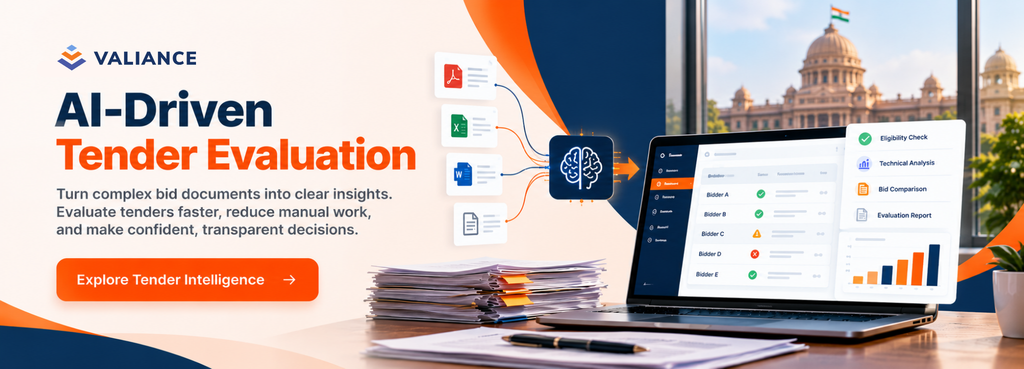
AI-driven tender evaluation uses artificial intelligence to review bid documents, extract important details, check requirements, and compare bidder submissions. It helps procurement teams reduce repetitive manual work and review tenders in a more consistent way.
In a traditional process, evaluators may need to read hundreds of pages, verify eligibility documents, check technical requirements, compare prices, and prepare comparative statements. This takes time and can lead to missed details.
AI-powered tender evaluation software can automate many of these tasks. It can organize bidder information, flag missing documents, identify differences between submissions, and prepare reports for review. Procurement officers still make the final decisions.
For government departments, public sector undertakings (PSUs), and large enterprises, AI-driven tender evaluation can make document-heavy procurement easier to manage. The results depend on the quality of the documents, the evaluation rules, and the level of human review.
What Is AI-Driven Tender Evaluation?
AI-driven tender evaluation is the use of artificial intelligence to help assess bids against the requirements stated in a tender document.
The system processes tender documents and bidder submissions, extracts relevant information, and organizes it around defined evaluation criteria. It can then help evaluators check eligibility, review technical details, compare commercial information, and identify possible gaps.
For example, a tender may require bidders to submit a turnover certificate, proof of relevant experience, technical specifications, and other supporting documents. An AI system can extract these details from submitted files and arrange them in a structured format.
The evaluation team can then check which requirements appear to be met, which documents are missing, and which details need further verification.
AI supports the evaluation process. It should not replace the tender’s published rules or the authority of the evaluation committee. Eligibility decisions, technical judgments, and award decisions must follow the applicable procurement rules and approval process.
How Does AI-Driven Tender Evaluation Work?
An AI tender evaluation system usually follows a structured workflow. The exact steps depend on the procurement process, document formats, and software being used.
1. Collect and Organize Tender Documents
The process starts with the tender document and the bids submitted by participating vendors.
These files may include:
- Request for Proposal (RFP) documents
- Eligibility and qualification forms
- Technical proposals
- Financial bids
- Turnover certificates and financial statements
- Experience certificates and past project details
- Licences, declarations, and compliance documents
The system brings the relevant files together so evaluators can review them in one place. Depending on the platform, documents may need to be uploaded manually or collected through supported integrations.
2. Read Documents and Extract Important Information
Bid documents often contain tables, scanned certificates, lengthy paragraphs, and information presented in different formats. Manually finding every relevant detail can take considerable time.
AI document processing uses technologies such as optical character recognition (OCR), natural language processing (NLP), and document extraction models to read and organize this information.
For example, the system may extract:
- Bidder name and company details
- Turnover figures and financial information
- Years of relevant experience
- Technical specifications
- Certificate numbers and validity dates
- Required declarations and supporting evidence
OCR helps convert text in scanned documents into machine-readable text. NLP and other AI methods help identify the meaning and context of the extracted information.
The extracted data should remain linked to its source document or page wherever possible. This allows evaluators to verify the original evidence instead of relying only on an AI-generated summary.
3. Check Eligibility and Compliance Requirements
A tender may set specific conditions for bidder eligibility. These can include minimum turnover, relevant experience, required licences, technical qualifications, or mandatory certificates.
An AI-based bid analysis system can compare the information found in bidder submissions with these predefined conditions.
For example, a tender may require a bidder to have completed three similar projects. The system can identify relevant project details in the submitted documents and present them for review.
It can also flag issues such as:
- A required certificate that appears to be missing
- Information that does not match across documents
- A certificate that may have expired
- A turnover figure that needs verification
- A qualification for which supporting evidence is unclear
These flags help the evaluation team focus on items that need attention. They should not automatically be treated as final findings. The original documents and applicable tender rules must be checked before a bidder is marked eligible or ineligible.
4. Evaluate Technical Bid Information
Technical evaluation checks whether a bid meets the technical requirements in the tender.
Depending on the tender, these requirements may cover product specifications, project experience, proposed methods, staffing, delivery schedules, service levels, or other technical conditions.
AI can extract the relevant details and map them against the published requirements. It can also highlight missing responses and differences between bidder submissions.
For example, if a tender specifies a minimum technical capacity, the system can locate the information supplied by each bidder and place it beside that requirement.
For criteria that use a defined scoring method, AI may help organize evidence or support preliminary scoring. However, evaluators should verify the evidence and apply the approved scoring rules. Complex technical judgments may require expert review.
5. Compare Commercial Bids
Commercial evaluation involves reviewing financial information and comparing bids according to the tender’s stated rules.
AI tender evaluation software can extract prices, taxes, quantities, rates, and other relevant commercial details. It can place the information into a comparative statement so evaluators can review the differences between bidders.
A structured comparison may include:
| Evaluation Item | Bidder A | Bidder B |
|---|---|---|
| Quoted Price | Extracted Value | Extracted Value |
| Required Document | Status for Review | Status for Review |
| Technical Requirement | Evidence Summary | Evidence Summary |
| Missing Information | Flagged Items | Flagged Items |
The actual fields depend on the tender. Financial calculations should use validated data and the applicable commercial rules.
The system should not assume that the lowest quoted price automatically makes a bidder the winner. The final outcome depends on the tender conditions, eligibility requirements, evaluation method, and approval process.
6. Identify Errors and Prepare Comparative Statements
After reviewing the submissions, the system can bring the extracted information together in a common format.
It may flag inconsistent figures, missing fields, unusual entries, or differences that need further review. These checks help evaluators identify potential problems before completing the evaluation.
The system can also generate a draft comparative statement or evaluation report. The report should show the relevant findings and provide enough supporting information for the team to verify them.
This step is particularly useful when a procurement team must compare many bidders or process large volumes of documents.
7. Review the Results and Record Decisions
The final step is human review.
Evaluators check flagged issues, confirm extracted information against original documents, apply the tender’s rules, and record their findings. Any corrections or overrides should be documented according to the organization’s process.
A reliable workflow should preserve the evidence behind important findings and maintain a clear record of how the evaluation was completed.
This makes the process easier to review and helps procurement teams explain their decisions when required.
Traditional Tender Evaluation vs AI-Driven Tender Evaluation
Traditional tender evaluation relies heavily on manual document review and data entry. AI-driven evaluation automates selected tasks and gives evaluators structured information to review.
| Area | Traditional Evaluation | AI-Driven Evaluation |
|---|---|---|
| Document Review | Staff read and search files manually | AI helps extract and organize relevant information |
| Data Entry | Details are entered into spreadsheets or templates | Extracted details can populate structured fields |
| Compliance Checks | Evaluators check each requirement manually | Rules and AI checks can flag possible gaps |
| Bid Comparison | Staff prepare comparative statements | Software can generate draft comparisons |
| Error Checking | Depends heavily on manual cross-checking | Automated checks can flag inconsistencies |
| Reporting | Reports are prepared manually or with templates | Draft reports can be generated from structured data |
| Final Decisions | Made by authorized evaluators | Still require authorized human review |
AI does not remove every manual task. Its main value is reducing repetitive work and helping evaluators focus on evidence, exceptions, and decisions.
Key Benefits of AI-Driven Tender Evaluation
1. Less Time Spent on Manual Work
Reading long bid documents, copying information into spreadsheets, and preparing comparisons can consume a large part of the evaluation cycle.
AI can automate parts of this work, allowing procurement teams to spend more time checking evidence and resolving important issues.
The time saved will vary with the number of bids, document quality, evaluation complexity, and level of automation.
2. More Consistent Evaluation
When several evaluators review many bids, differences in how information is recorded or interpreted can create extra work.
A well-configured system applies the same extraction process and predefined checks across submissions. This can make comparisons more consistent.
Consistency still depends on clear evaluation criteria, accurate data, and proper review.
3. Easier Compliance Checks
AI can help compare bidder submissions against the requirements listed in a tender. It can flag missing documents, incomplete information, and possible mismatches.
This gives evaluators a clearer list of items to verify. It does not guarantee compliance, and the system must follow the actual tender conditions.
4. Faster Bid Comparison
When information from different bids is organized in the same format, evaluators can compare key details without searching through every file repeatedly.
Automated comparative statements can make differences in prices, qualifications, experience, and technical details easier to review.
5. Better Handling of Large Document Volumes
Large procurement exercises may involve many bidders and thousands of pages of supporting information.
AI document processing can help manage this volume by extracting relevant data and organizing it for review. The platform must still be tested against the document types, languages, file sizes, and procurement rules used by the organization.
6. Clearer Records for Review and Audit
Procurement decisions may need to be explained or reviewed later. A system that retains source references, evaluation outputs, corrections, and approval records can make this work easier.
Audit-ready records depend on the platform’s logging features and the organization’s recordkeeping process. AI alone does not guarantee transparency or compliance.
Where Can AI Be Used in Tender Evaluation?
AI can support several parts of the evaluation process.
Eligibility and qualification checks: Extract information about turnover, experience, licences, and other stated conditions for review.
Technical bid analysis: Organize technical responses and highlight missing details or possible deviations from requirements.
Commercial bid comparison: Extract financial information and prepare structured comparisons using the applicable evaluation method.
Document verification support: Flag missing information, inconsistent figures, and details that require further checking.
Comparative statement preparation: Arrange information from multiple bids in a common format and create draft evaluation outputs.
Evaluation reporting: Summarize findings and prepare draft reports that evaluators can check and approve.
Pre-tender document drafting: Help prepare draft tender documents from defined objectives, requirements, and approved templates. This is a related use of AI in procurement, but it is separate from evaluating bids that have already been submitted.
The available features depend on the software. Buyers should confirm which tasks are automated, which require manual input, and which outputs need approval.
What Are the Risks and Limitations of AI Tender Evaluation?
AI can reduce repetitive work, but procurement teams should understand its limits before relying on it.
Incorrect Data Extraction
A scanned certificate may be unclear. A table may have a complex layout. A figure may be read incorrectly.
If extracted data is wrong, the comparison or compliance check may also be wrong. Important values and findings should be verified against the original documents.
Incorrect AI Interpretations
Generative AI may misunderstand a clause, overlook an exception, or produce a summary that does not reflect the full document.
For this reason, AI-generated findings should include supporting evidence and be checked by an evaluator, especially when they could affect a bidder’s eligibility or score.
Inconsistent or Unclear Tender Requirements
AI cannot reliably resolve every ambiguity in a tender. If the requirements are unclear, the system may produce inconsistent results or flag the wrong issues.
Evaluation criteria should be clearly defined before automation begins. Any ambiguity should be handled through the organization’s approved procurement process.
Data Privacy and Security
Tender submissions may contain confidential commercial information, personal data, and sensitive business records.
Procurement teams should assess where documents are stored and processed, who can access them, how long they are retained, and whether they may be used to train external AI models. The solution should meet the organization’s security, privacy, and data governance requirements.
Bias and Lack of Transparency
An AI system may produce unreliable or unfair results if its design, data, or evaluation rules are unsuitable for the task.
Teams should be able to understand why a result was flagged and which evidence supports it. They should also test the system across relevant document types and review its performance over time.
Public-sector guidance on AI procurement from the UK Government highlights the importance of data governance, risk assessment, oversight, and clear accountability when procuring AI systems.
Does AI Replace Human Tender Evaluators?
No. AI should support tender evaluators, not replace their responsibility for procurement decisions.
AI is useful for repetitive tasks such as extracting information, organizing documents, checking predefined conditions, and preparing comparisons. Human evaluators are needed to verify evidence, interpret complex requirements, resolve exceptions, and apply the approved evaluation method.
A responsible process should include:
- Clear evaluation criteria before processing begins
- Links to the original documents and supporting evidence
- Human checks for important findings
- Review of unusual or uncertain results
- Documented corrections and approvals
- Access controls and records of key actions
The evaluation committee or other authorized decision-makers remain responsible for the final outcome under the applicable procurement rules.
How to Choose the Right Tender Evaluation Software
Not every AI tool is designed for complex procurement work. Before choosing tender evaluation software, assess whether it can handle your actual documents, rules, and review process.
1. Document Processing Capability
Check whether the platform can process PDFs, scanned certificates, tables, spreadsheets, and other formats used in your tenders. Test it with real documents, including files with poor scans or complex layouts.
2. Configurable Evaluation Criteria
The system should support the eligibility and evaluation conditions used by your organization. Confirm whether rules can be configured for different tenders and whether changes can be reviewed and controlled.
3. Evidence-Based Results
Evaluators should be able to trace extracted details and flagged issues back to the original document. Ask how the platform handles uncertain results and how users verify them.
4. Comparative Statements and Reports
Check whether the software can generate the formats your team needs. Confirm that figures, calculations, and report outputs can be validated before they are approved.
5. Security and Data Governance
Review access controls, data storage, processing locations, retention, integrations, and the provider’s policies for handling confidential documents. Make sure these meet your organization’s requirements.
6. Audit Trails and Human Review
Look for clear records of system outputs, user corrections, approvals, and other important actions. The platform should support the review process rather than hide how a result was produced.
7. Integration and Scalability
Check whether the platform can work with your existing procurement portals and internal systems. Test how it performs with the expected number of tenders, bidders, and documents.
8. Measurable Results
Run a pilot using completed or otherwise approved test cases. Measure extraction accuracy, time spent per bid, the number of errors detected, the rate of incorrect flags, and the amount of human review still required.
These measures will help you judge whether the system improves your process in practice.
How Valiance Solutions Uses AI for Tender Evaluation
Valiance Analytics Pvt. Ltd. has developed an AI-powered tender evaluation platform for organizations that handle document-heavy procurement.
The platform supports automated document parsing, AI-driven data extraction, compliance checks, bidder comparison, anomaly flagging, and the preparation of comparative statements. It is designed to help procurement teams organize bid information and reduce repetitive manual work.
In a published case study, Valiance describes its work with a leading Indian oil and gas public sector undertaking. The client’s officers had to collect bidder documents from procurement portals, extract key information, and prepare comparative statements manually. Valiance developed a platform to automate document parsing, classify eligibility parameters and bid values, apply configured evaluation rules, and generate structured comparative statements.
The case study reports improvements in manual effort, evaluation speed, and consistency. These results relate to the reported project and should not be treated as guaranteed outcomes for every organization.
Organizations assessing similar solutions can also review the Valiance Tender Intelligence platform to see how its document intelligence, compliance validation, and bidder comparison capabilities may fit their procurement needs.
Conclusion
AI-driven tender evaluation helps procurement teams process bid documents, check requirements, compare submissions, and prepare evaluation reports with less repetitive manual work. It can improve speed and consistency, especially when teams handle large volumes of documents.
The best results come from clear evaluation rules, reliable document processing, evidence-based outputs, and human review. AI should make the evaluation process easier to manage without replacing the procurement authority’s responsibility for fair and compliant decisions.
For organizations planning to automate document-heavy procurement, the next step is to test a suitable tender evaluation platform against real workflows and measure the results before scaling its use.
Frequently Asked Questions
AI-driven tender evaluation uses artificial intelligence to extract information from bid documents, check submissions against defined requirements, compare bidders, and prepare evaluation outputs. It helps procurement teams work faster while keeping final decisions under human control.
AI can read and organize documents, extract bidder details, flag missing information, support eligibility and technical checks, compare commercial data, and prepare comparative statements. The exact tasks depend on the software and the rules configured for the tender.
AI can support parts of the evaluation, but it should not select a winner without the checks, approvals, and decision process required by the applicable procurement rules. Authorized evaluators must verify the evidence and apply the published evaluation method.
It can be useful for government departments and PSUs that process large volumes of documents and need structured comparisons. The solution must fit the organization’s procurement rules, security requirements, document formats, and approval process.
Tender management software may cover the wider tender lifecycle, including tender creation, publication, supplier communication, submission tracking, evaluation, and contract steps. AI tender evaluation focuses on using AI to process bids, check requirements, compare submissions, and support evaluation decisions. Some platforms provide both sets of features.
Automated tender evaluation may misread scanned files, extract incorrect values, misunderstand complex clauses, or flag information incorrectly. Clear criteria, source-level verification, security controls, and human review help reduce these risks.
Measure the time needed to evaluate a bid, the accuracy of extracted information, the number of issues correctly identified, the rate of false flags, and the amount of manual review required. Compare the results with a reliable baseline and test the system on representative documents before wider use.