

In the early days of enterprise automation was clear-cut: To replace human labor with quicker, rule-based systems that could simplify operations and reduce costs.
Enterprises used scripts, macros, and structured processes to reduce repetitive tasks. While these systems performed well for known procedures, they had little flexibility and needed constant human oversight.
Today, enterprises are entering a new phase, an age of intelligent autonomy. Organizations are creating systems that are capable of self-analysis, flexibility, decision-making, and continuous improvement rather than simply performing repetitive tasks. By learning from data, understanding human context, and acting on their own, these intelligent systems are changing the way modern enterprises operate.
Yet beneath this progress lies a growing limitation.
The environments in which modern enterprises function are no longer stable or predictable. Permanent, rule-based automation has reached its limits due to interconnected decisions, quickly growing data amounts, and constant change. Errors rise, human involvement increases, and innovations meant to simplify processes start to create challenges as conditions change more quickly than rules can be changed.
The shift appears in the data.
According to Gartner, rigid rule structures are unable to respond to changing operational conditions, which is why more than 60% of enterprise automation projects fail to produce long-term value. McKinsey reports that businesses that use intelligent, AI-driven decision systems beat those that mainly rely on traditional automation by up to 30% in terms of operational efficiency.
The question is no longer whether rule-based automation works.
The question is why it is no longer enough for modern enterprises.
Limitations of Rule-Based Automation
Rule-based systems operate on predefined logic created from previous ideas. They only function well when the assumptions are confirmed by reality.
Common limitations include:
- Lack of Learning and Adaptability: Without manual changes, static rules are unable to change or adapt to new circumstances.
- Rigid with Incomplete Data: The system is disrupted by textual content, a variety of formats, or unclear data.
- Maintenance and Flexibility: More regulations lead to more paperwork, costs, and error risk.
- Dependency on Humans: True automation is limited by the need for human supervision when exceptions or unexpected inputs arise.
Although these systems carry out commands, they are unable to understand intention. Rule-based automation turns weak as complexity rises.
Current Realities in Enterprise Operations
As enterprises grow, managing ongoing decisions rapidly takes importance over performing duties.
Key realities include:
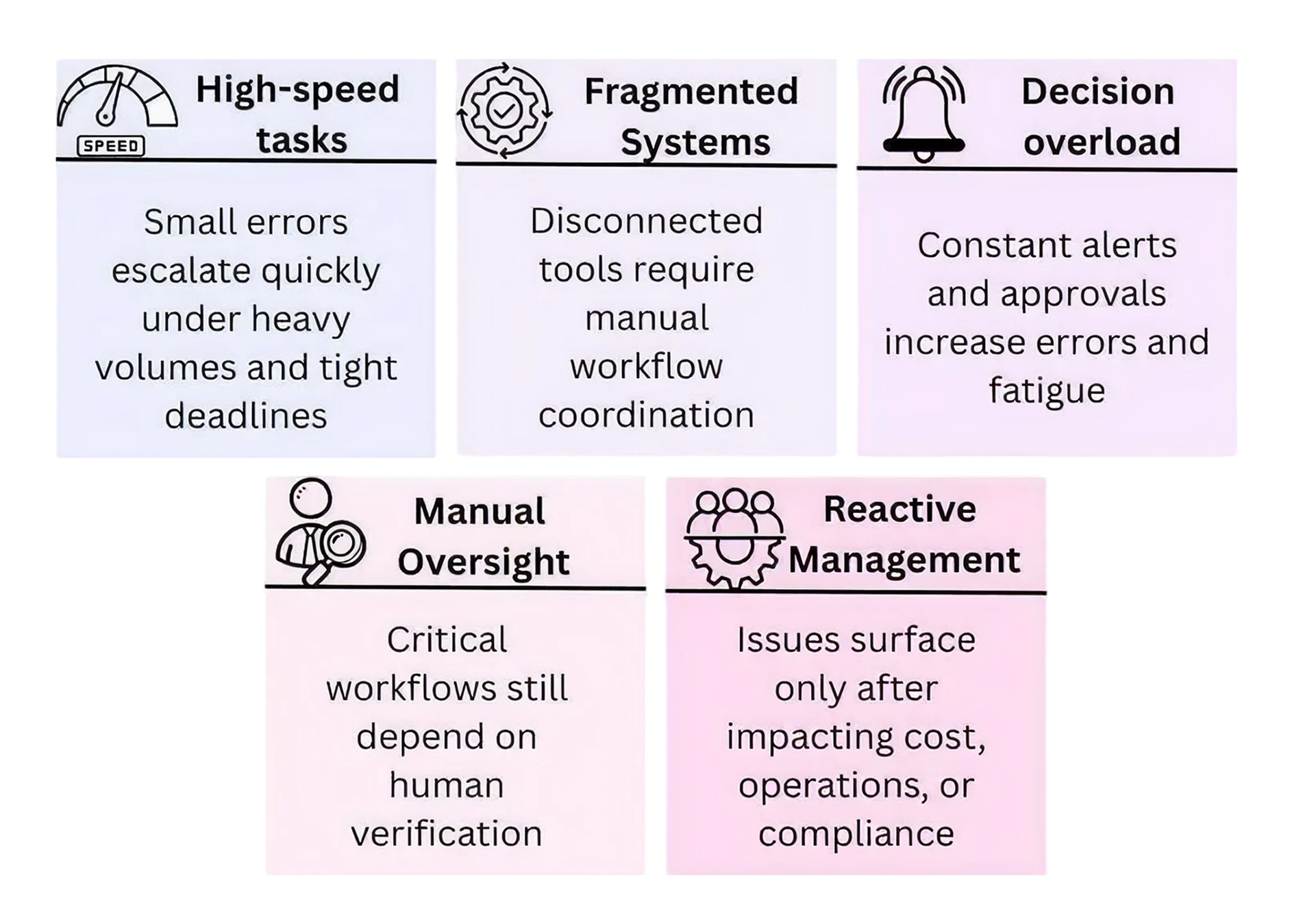
These facts highlight a basic problem in traditional automation: while it can carry out tasks, it is unable to handle complications or make large-scale judgments.
Key Challenges Enterprises Face Today
A number of key problems arise when enterprises switch from rule-based automation to advanced AI systems.
Among the main obstacles are:
- Gaps in quality and data readiness: AI’s ability to learn, think, and generate trustworthy results is limited by insufficient, unclear, or fragmented data.
- Lack of talent and capability: Adoption and effective use are slowed by the absence of skilled AI specialists and insufficient AI literacy within enterprises.
- Challenges of outdated systems: It is still difficult and costly to connect today’s artificial intelligence with outdated computer systems.
- Problems with trust and cultural resistance: Acceptance is restricted by resistance to workflow changes, uncertainty about AI decisions, and fear of losing one’s job.
- Uncertain ROI, governance, and strategy: Enterprises find it difficult to grow beyond tests in the absence of a clear AI strategy, governance structure, and measurable economic value.
These difficulties draw attention to an important fact: implementing intelligent AI requires organizational, cultural, and strategic change in addition to technological advancement.
How Intelligent AI Changes the Game
Enterprises move from execution to understanding with intelligent AI.
AI systems learn from data, detect patterns, and understand context, in place of rule-based automation that sticks to predetermined instructions. This enables them to function well in situations where circumstances change faster than rules can be updated.
Key benefits include:
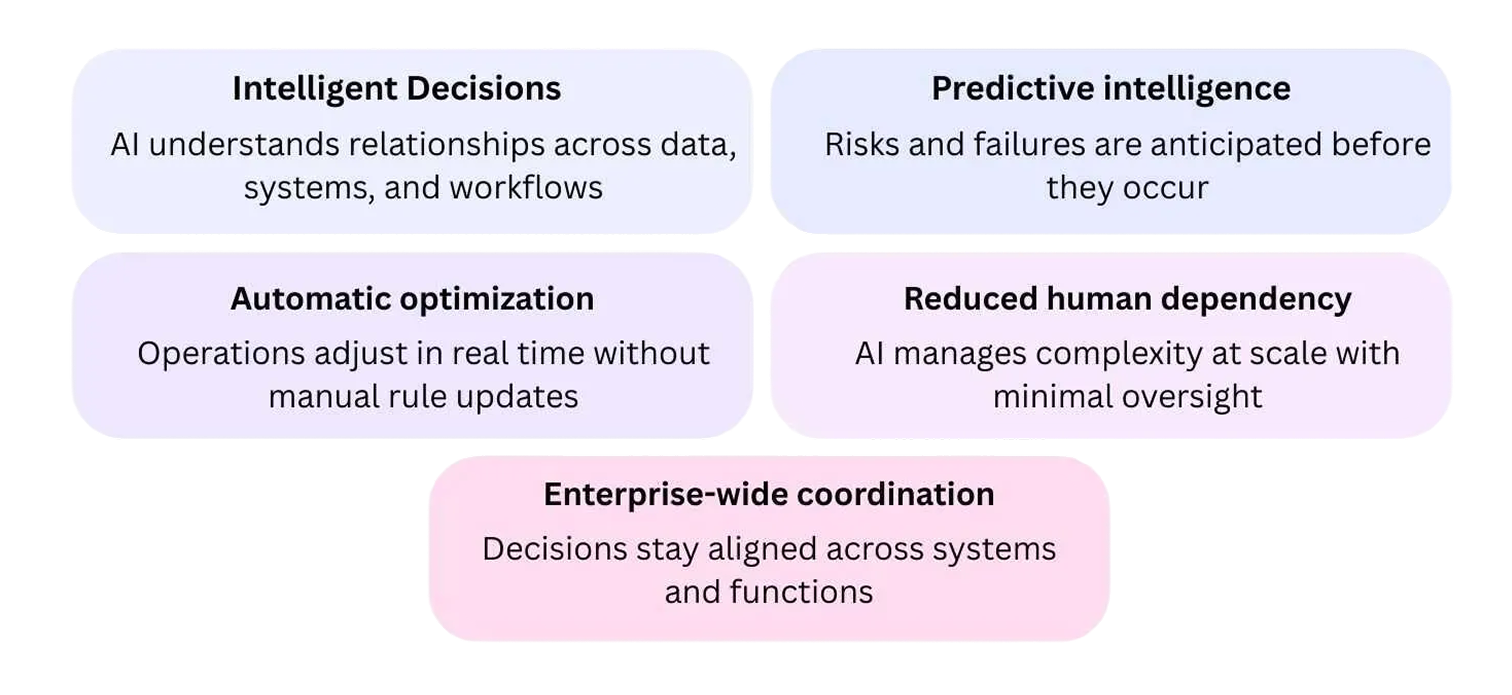
This marks a turning point.
AI helps enterprises understand, adapt, and grow where fixed rules fail, in addition to performing tasks faster.
Benefits of Intelligent AI Systems
Enterprises adopting intelligent AI systems experience:
- Greater accuracy and consistency: Decisions are data-driven, not assumption-driven.
- Proactive issue prevention: Problems are addressed before they escalate.
- Operational agility: Systems adapt without constant reconfiguration.
- Reduced manual workload: Teams focus on strategy, not exception handling.
- Lower operational costs: Fewer failures, delays, and compliance issues.
AI does not eliminate structure, it makes structure intelligent.
How AI Works in Enterprise Operations
AI-driven enterprise systems operate through a continuous intelligence loop:
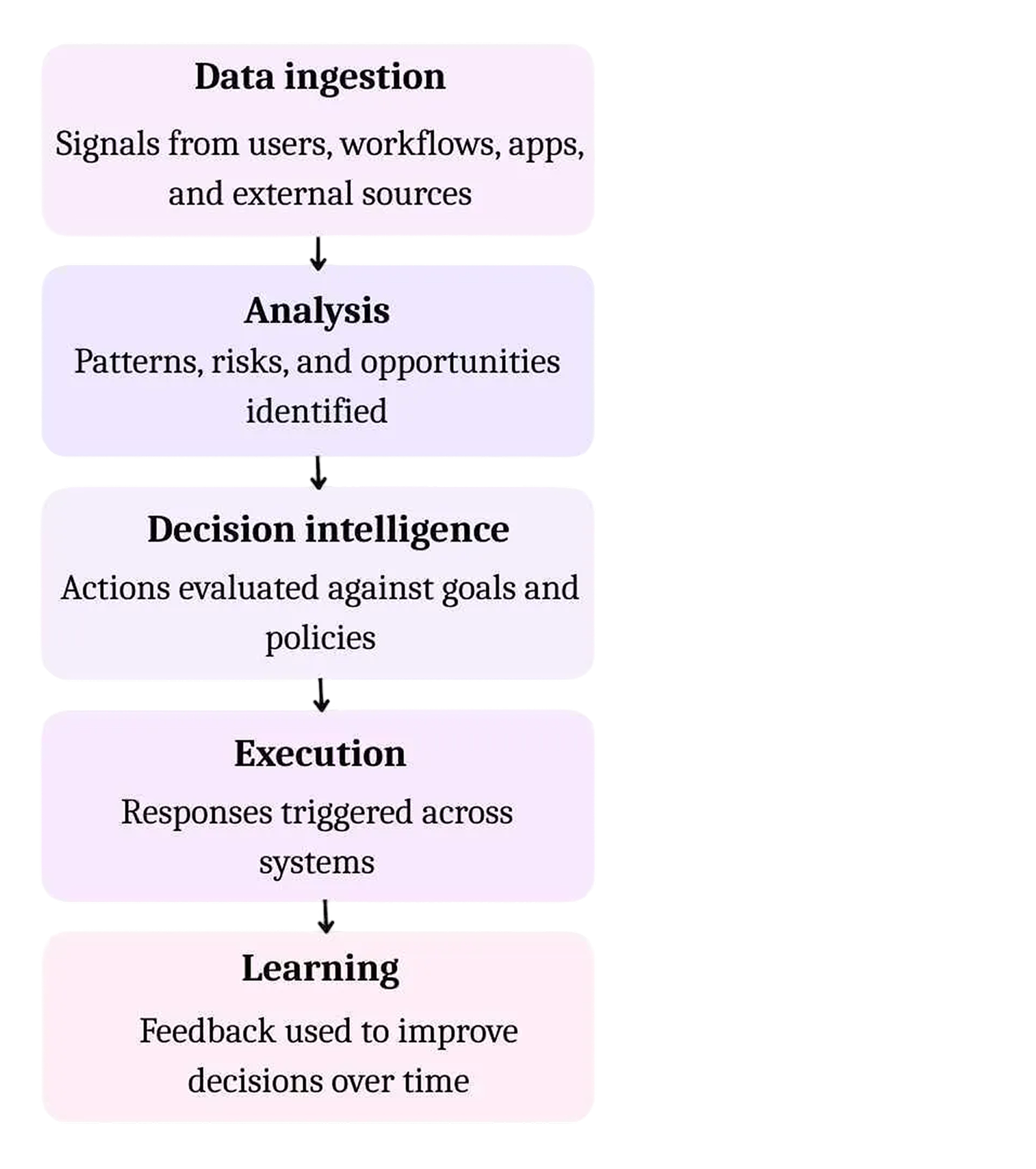
AI systems evolve over time.
They do more than just carry out procedures; they continuously optimize them.
Why It Matters
- Decisions now scale faster than human capacity.
- Small errors trigger large operational and financial consequences.
- Manual oversight breaks under enterprise-scale complexity.
- Reactive operations fall behind adaptive competitors.
- AI frees human judgment for strategy, not firefighting.
Intelligence is no longer optional.
It is the backbone of modern enterprise operations.
Looking Ahead: The Future of Enterprise Automation
The future of enterprise operations lies in systems that reason, adapt, and act independently.
- Automation will evolve from helping workflows to actively managing them as decision speed increases.
- Businesses will rely on AI-driven operational intelligence to forecast threats, coordinate actions across systems, and maintain stability at scale.
- For simple and consistent activities, rule-based automation will remain useful.
- Intelligence will replace rigidity in complex, high-impact operations.
At Valiance Solutions, we believe businesses that transition from static rules to intelligent adaptive systems will secure the best future.
Our solutions enable:
- Context-sensitive decision-making
- Proactive risk detection and anomaly management
- Coordination of actions across systems
- Continuous improvement and learning
- Simple and clear execution
Systems that only follow rules fail in constantly changing environments.
Enterprises need systems that can understand, decide, and adapt.
References
Sarker, I.H. AI-Based Modeling: Techniques, Applications and Research Issues Towards Automation, Intelligent and Smart Systems. SN COMPUT. SCI. 3, 158 (2022). https://doi.org/10.1007/s42979-022-01043-x
https://www.zetamicron.com/from-automation-to-autonomy-the-rise-of-intelligent-systems-in-mo dern-enterprises/
https://www.totalebizsolutions.com/blogs/automation-to-autonomy-intelligent-ai-agentic-ai-enterp rise-workflows/
https://flowster.app/how-ai-in-workflow-automation-are-redefining-business/
https://8allocate.com/blog/how-ai-is-reshaping-business-process-automation-for-modern-enterpr ises/
https://www.bitcot.com/ai-based-automation-adoption/