
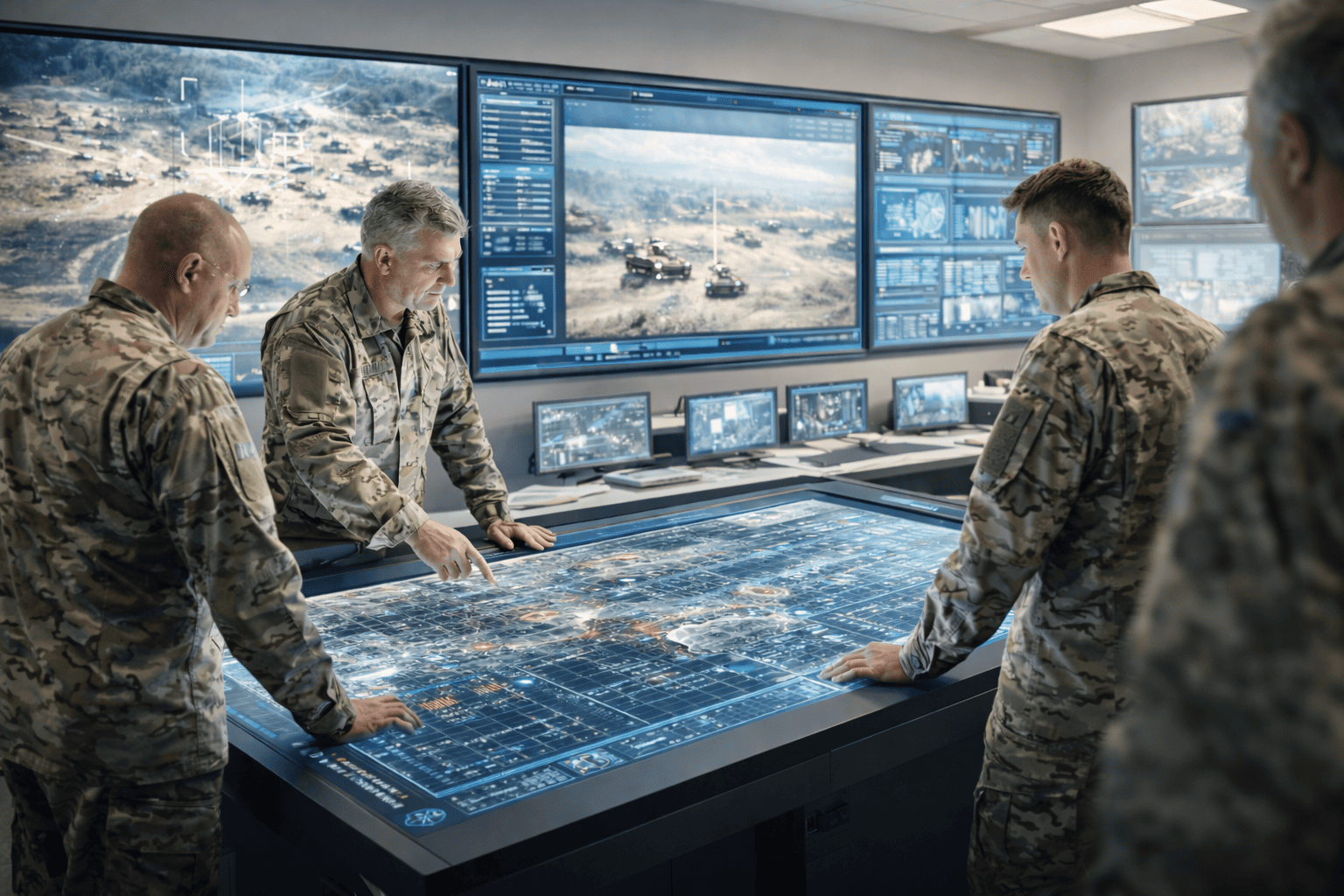
Reimagining Warfare with AI – How Conflict Evolved from Human Judgment to Machine-Speed Decisions
Warfare has always been shaped by technology—but not always in the ways we expect. Weapons change the scale of destruction.Platforms change the reach of power.But it is information—and the speed at which it becomes decision—that ultimately reshapes how conflicts are fought and won. Across centuries, the nature of war has remained constant: uncertainty, risk, and irreversible consequences. What has changed—quietly but profoundly—is the tempo at which those uncertainties must be navigated. From an era where intelligence traveled on horseback, to one where satellite imagery streams in real time, each technological leap has compressed the distance between observation and action. Yet every compression of time has introduced a new constraint—first scarcity of information, then overload, and now cognitive limits. Today, conflict unfolds at machine speed. The battlefield is no longer defined only by geography, but by data flows, interconnected systems, and multi-domain engagements that evolve within seconds. In this environment, advantage is no longer secured solely through superior firepower. It is secured through superior decision infrastructure. This article traces that evolution—from endurance-based warfare to decision-centric warfare—and examines how artificial intelligence is not changing the nature of war, but transforming the rhythm at which it is decided. When War Was Defined by Uncertainty Two hundred years ago, war began with incomplete maps and incomplete knowledge. A commander stood over terrain that was fixed on paper but fluid in reality. Somewhere beyond the horizon, opposing forces were moving—but how, where, and with what intent remained uncertain. Intelligence arrived through scouts, messengers, traders, and rumor. By the time information reached command, it was already dated. In that era, the defining constraint of warfare was not firepower. It was delay. Decisions were made in the absence of clarity because waiting carried its own risks. Once an order was issued, it was difficult to reverse. Communication lagged behind movement. Commanders relied on judgment shaped by experience, instinct, and limited intelligence. War rewarded endurance—the ability to act under uncertainty. That structural reality shaped military doctrine for centuries. But it would not remain unchanged. The First Compression of Time The transformation did not begin with a new weapon system. It began with connectivity. The telegraph fundamentally altered the relationship between time and command. For the first time, information could travel faster than troops. Headquarters could issue instructions across distances that once required days of physical travel. This shift did more than accelerate communication—it centralized authority. Strategy could now be shaped from afar. Campaigns became coordinated across fronts. War became more synchronized. Yet this acceleration introduced dependency. As command structures tightened around communication networks, the battlefield became reliant on uninterrupted connectivity. When the wire functioned, coordination improved dramatically. When it was cut, decision-making fractured. The telegraph compressed time—but it also revealed how tightly warfare would become coupled to information systems. That coupling would only intensify. From Communication to Observation If the telegraph allowed commanders to speak across distance, satellites allowed them to see across it. Space-based surveillance transformed strategic awareness. Large-scale troop movements could be monitored. Infrastructure and assets could be mapped and tracked. Surprise at scale became harder to achieve. This altered deterrence, escalation, and operational planning. For the first time in history, persistent observation became possible. But the expansion of visibility brought an unexpected challenge: scale. Intelligence was no longer scarce. It was continuous. Satellite imagery, radar data, signal intercepts, reconnaissance feeds—each layer added visibility but also volume. Analysts faced an expanding stream of inputs that outpaced manual interpretation. The fog of war did not disappear. It changed form. Uncertainty was no longer driven by absence of data—but by the difficulty of extracting meaning from abundance. This marked a subtle but profound shift. The bottleneck was no longer access to information. It was human processing capacity. The Rise of Network-Centric Warfare To manage growing complexity, militaries moved toward integration. Network-centric warfare emerged from a simple premise: if every sensor, platform, and command center shared information in real time, operational coordination would improve. Shared situational awareness would reduce friction. Decisions would be faster and more aligned. In many ways, this proved correct. Operations became synchronized across domains. Units operated with a unified operational picture. Visibility improved dramatically. However, another constraint surfaced. While information moved rapidly across networks, decision-making remained hierarchical. Data flowed instantly; approvals did not. Command structures—designed for slower eras—began to struggle under accelerating conditions. Awareness outpaced action. The traditional decision loop—observe, orient, decide, act—became increasingly strained in environments where threats emerged and evolved within seconds. This was not a technological failure. It was a cognitive one. The battlefield was accelerating faster than humans could comfortably manage. When the Battlefield Outpaced Human Cognition Modern conflict unfolds across land, air, sea, space, and cyber—often simultaneously. Drones can identify and engage within seconds. Electronic warfare systems react in microseconds. Cyber disruptions cascade across interconnected infrastructure almost instantly. In such environments, delays are no longer measured in hours or minutes. They are measured in moments. Human judgment remains central—but it operates within biological limits. The volume and velocity of modern battlefield data challenge those limits. By the time a situation is fully interpreted, its parameters may have already shifted. The structural constraint has evolved once again. Where early warfare struggled with too little information, modern warfare struggles with too much—and too fast. It is within this context that artificial intelligence becomes relevant. AI and the Era of Decision-Centric Warfare AI did not enter warfare primarily as a weapon. It entered as a response to tempo. Its most significant contribution lies in decision acceleration. Machine learning systems can process vast sensor inputs in real time, detect patterns across domains, filter noise, and surface actionable insights. Edge systems can analyze locally without waiting for centralized commands. Threat classification, anomaly detection, predictive modeling—these functions compress the time between signal and response. This does not eliminate human oversight. Rather, it redefines it. Commanders are no longer expected to manually interpret every input. Instead, they evaluate prioritized options generated at machine speed. Accountability remains human—but the cognitive burden is distributed. The evolution from endurance-based