Late one evening in a busy city, a serious crime takes place near a public area. A person is attacked and the suspect quickly runs away through nearby streets. Within minutes, the individual disappears into traffic and the crowd. By the time the police reach the location, the suspect is already gone. The first challenge for investigators is to understand what exactly happened and how the person managed to escape.
In such cases, officers need to collect information from different places and connect the events together. They try to understand where the suspect came from, which route was taken, and who might have been involved. However, in a large city where thousands of activities happen at the same time, finding the right information becomes difficult.
For police and investigation teams, time is very important. The faster they understand the situation, the faster they can identify the suspect and take action. But when there is a large amount of recorded data, locating the exact moment that matters can take a lot of time and effort, which often slows down the investigation.
This challenge is not limited to criminal investigations alone. Similar delays occur in many everyday incidents across cities, where identifying the right moment quickly can make the difference between prevention and escalation. Across busy streets and intersections, these delays can have even more serious consequences
The Increasing Risk on Our Streets
Road safety remains a major concern in densely populated areas. According to India’s Ministry of Road Transport and Highways, 1,77,177 people died in road accidents in 2024,
(https://www.thehindu.com/news/national/road-accident-deaths-rise-to-177-lakh-in-2024-gadkari/article70361512.ece) averaging about 485 deaths every day. Speeding, lack of protective gear, and conflicts at busy intersections are common causes, with young adults, pedestrians, children, and the elderly among the most affected.(https://www.globalroadsafetyfacility.org/sites/default/files/2024-05/Guide%20for%20Safe%20Speeds%20-%20Managing%20Traffic%20Speeds%20to%20Save%20Lives.pdf)
Many of these incidents occur suddenly in crowded public spaces where hundreds of people and vehicles move at the same time. Understanding what exactly happened, and responding quickly, becomes critical for authorities trying to prevent further harm or identify those who are responsible.
Although cities are widely covered by surveillance cameras, the huge volume of video footage makes consistent human monitoring difficult. Officers often spend hours reviewing recordings to locate specific incidents, which can slow investigations, delay police response, and increase the burden on manual manpower. As a result, critical moments may be missed, and situations like street disputes or unsafe pedestrian crossings may escalate before authorities can act.
AI-enabled video query systems help address this challenge by allowing rapid search and analysis across large video datasets. By retrieving relevant footage within seconds, these systems support faster investigations, improved transparency, and quicker response to incidents, enabling more effective urban safety management
Limitations of Traditional Urban Surveillance
Basic monitoring, manual oversight, and post-event inspection remain the primary methods of urban safety management. While helpful, they fall short in modern cities:
- Massive data overload: Hours of footage delay response.
- No early detection: Minor arguments or unsafe behavior go unnoticed until someone is harmed.
- Unmonitored risk zones: Children and the elderly are endangered by speeding vehicles and ignored crossings.
- Reactive only: Incidents are reviewed after they occur, too late to prevent harm.
- No easy queries: Teams cannot quickly search for “arguments near this intersection in the last 5 minutes.”
In short, traditional systems log chaos; they don’t prevent it.
Current Realities in Urban Safety Hotspots
Smart cities look flawless on paper. On the ground, however, small sparks can ignite quickly, and timely intervention often decides whether situations remain calm or escalate:
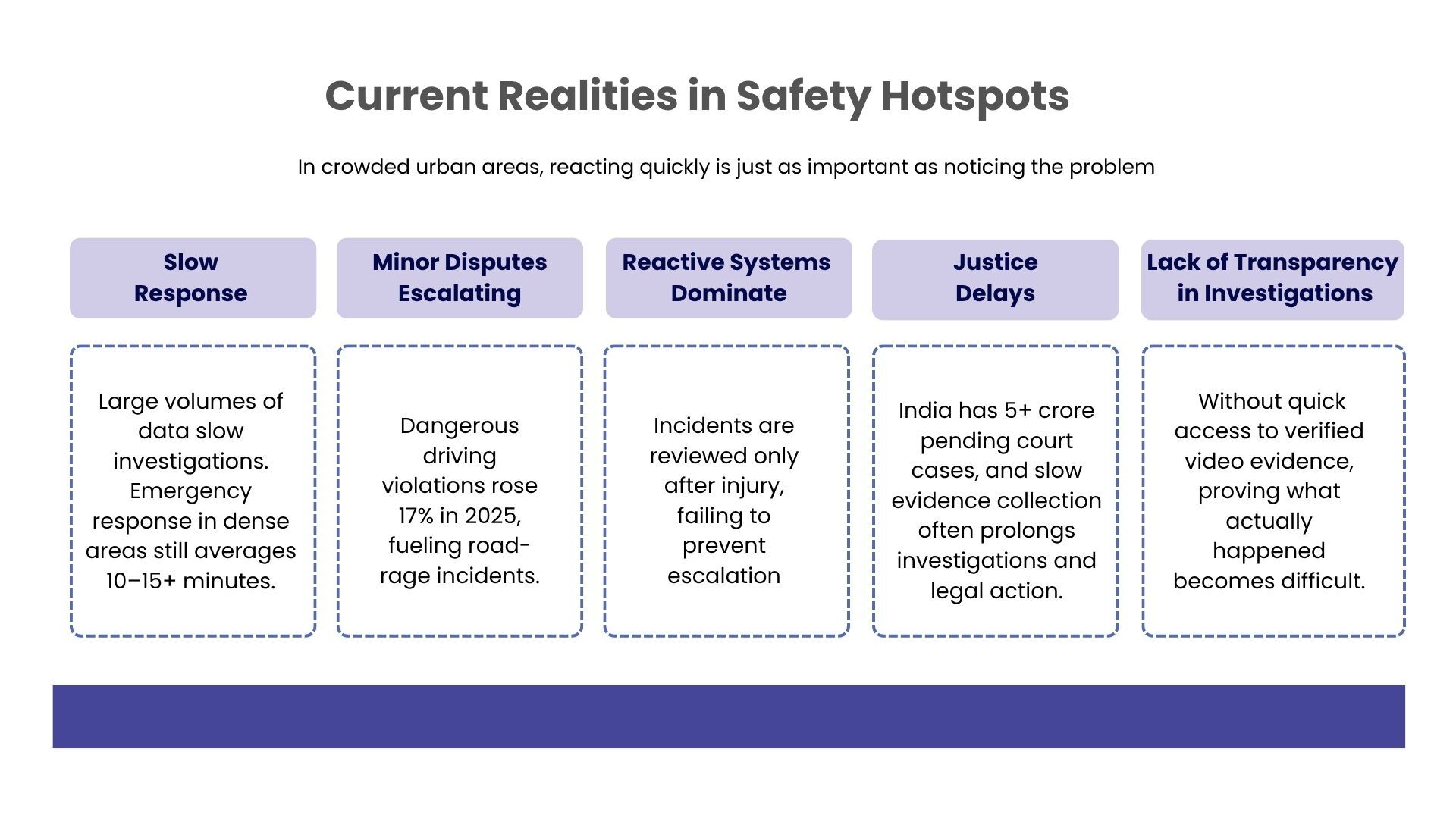
The core imbalance is clear: cities generate massive amounts of visual information but without intelligent interpretation, the most at-risk remain exposed.
Key Challenges Without Intelligence-Led Systems
Relying on non-intelligent monitoring keeps cycling dangers, regardless of scale. For urban safety teams, these are operational realities:
- Time-consuming investigations:
Reviewing recorded footage manually slows down incident response and prolongs case resolution. - Delayed justice and accountability:
When evidence takes longer to locate, decision-making and enforcement processes may also be delayed. - Limited transparency:
Manual analysis can create gaps in documentation and evidence tracking. - Operational inefficiency:
Large monitoring teams are required to review video feeds continuously, increasing manpower demands while still leaving blind spots.
Ultimately, traditional monitoring systems record events but struggle to provide rapid, actionable insights when they are most needed.
The hard truth: traditional monitoring records the past; it doesn’t secure the present.
Real safety requires query capability.
How AI Video Queries Transform Urban Safety
AI introduces a new way of interacting with surveillance systems. Instead of manually reviewing hours of footage, users can search for specific events using simple natural-language queries.
It asks :
- “Show instances of suspicious activity near this location.”
- “Find people wearing red clothing entering this zone.”
- “Retrieve clips from this camera between 7 and 8 PM.”
The system analyzes video streams, interprets the query, and retrieves relevant segments instantly.
This capability delivers several key advantages:
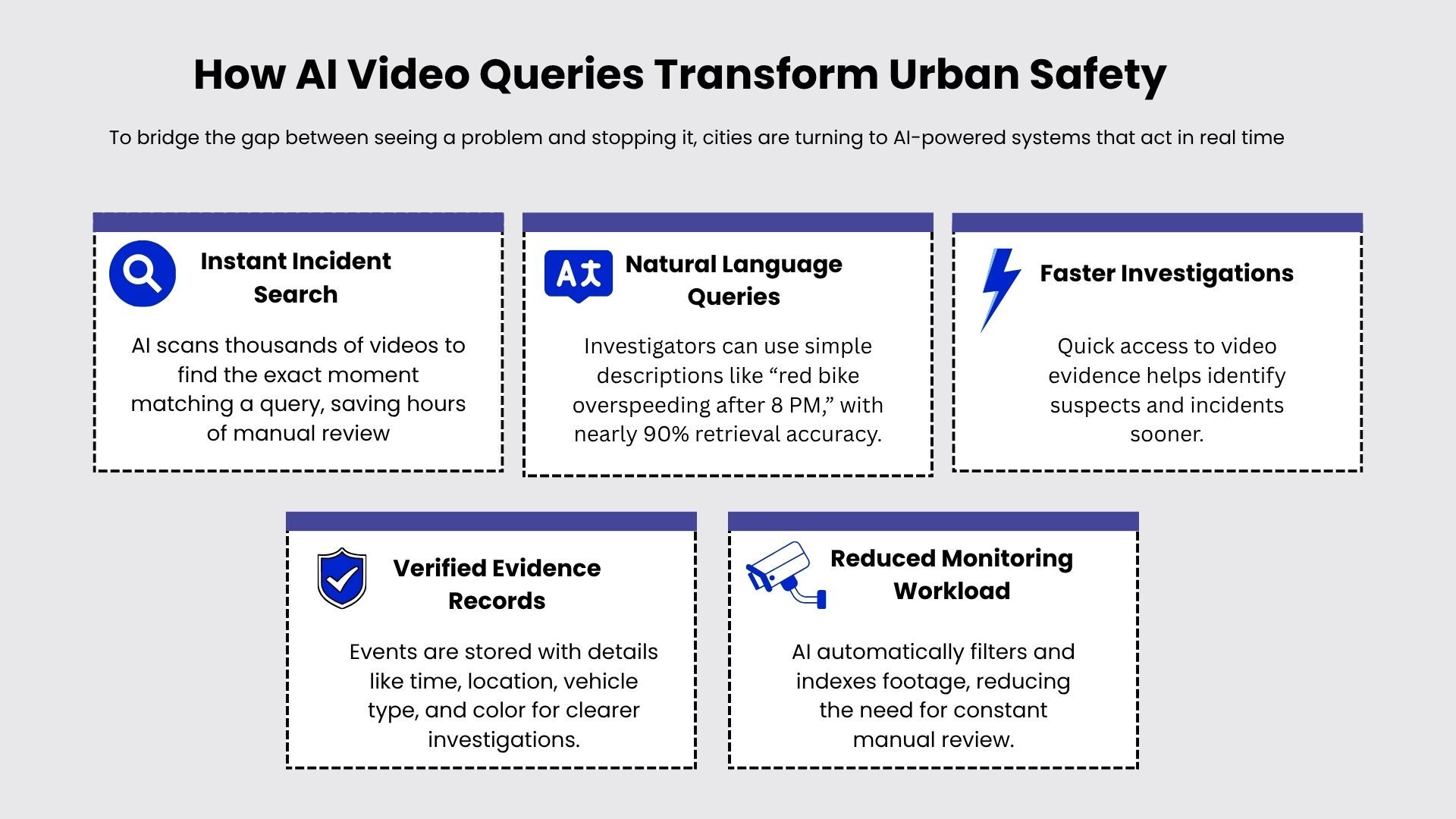
Why Video Query Systems Matter
- Faster investigations: Incidents can be found in seconds instead of reviewing hours of footage.
- Quicker response: Rapid access to video evidence helps authorities act sooner.
- Clear evidence: Timestamped clips help verify what actually happened.
- Reduced manual work: AI filters footage automatically, lowering the need for large monitoring teams.
- Better use of surveillance data: Massive footage becomes searchable and useful instead of unused recordings.
How Video Query Intelligence Works in Operational Environments
Behind the simple search experience, video query systems follow a structured workflow that turns raw footage into searchable intelligence.
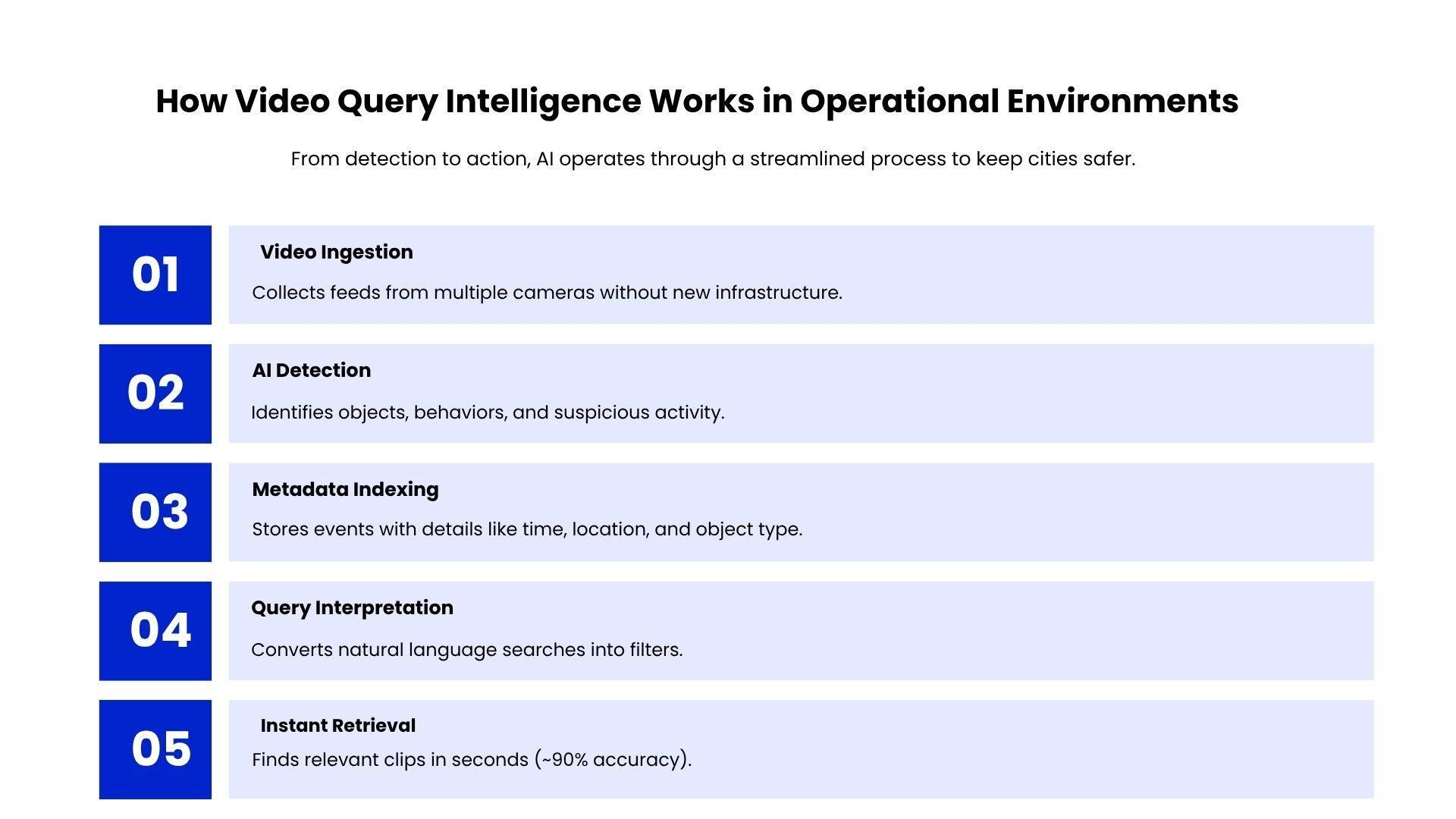
Through this workflow, video query systems transform raw surveillance footage into actionable insights, helping authorities move from slow manual searches to fast, data-driven investigations.
Urban Safety Intelligence
As cities continue to grow, the ability to understand and respond to visual information quickly will become increasingly important. Intelligent surveillance platforms can help authorities detect risks earlier, retrieve evidence faster, and improve overall safety management.
Future urban environments will not rely solely on cameras; they will rely on systems that can interpret what those cameras see.
At Valiance Solutions, AI technologies are used to enhance traditional surveillance systems by making video data searchable and easier to analyze.
The Video Query System developed by Valiance:
- Detects events and violations using AI-based models
- Stores detected information in a structured database
- Converts natural-language queries into searchable filters
- Retrieves relevant video frames or clips quickly
Instead of manually reviewing long hours of footage, users can enter a query and access relevant video results more efficiently.