
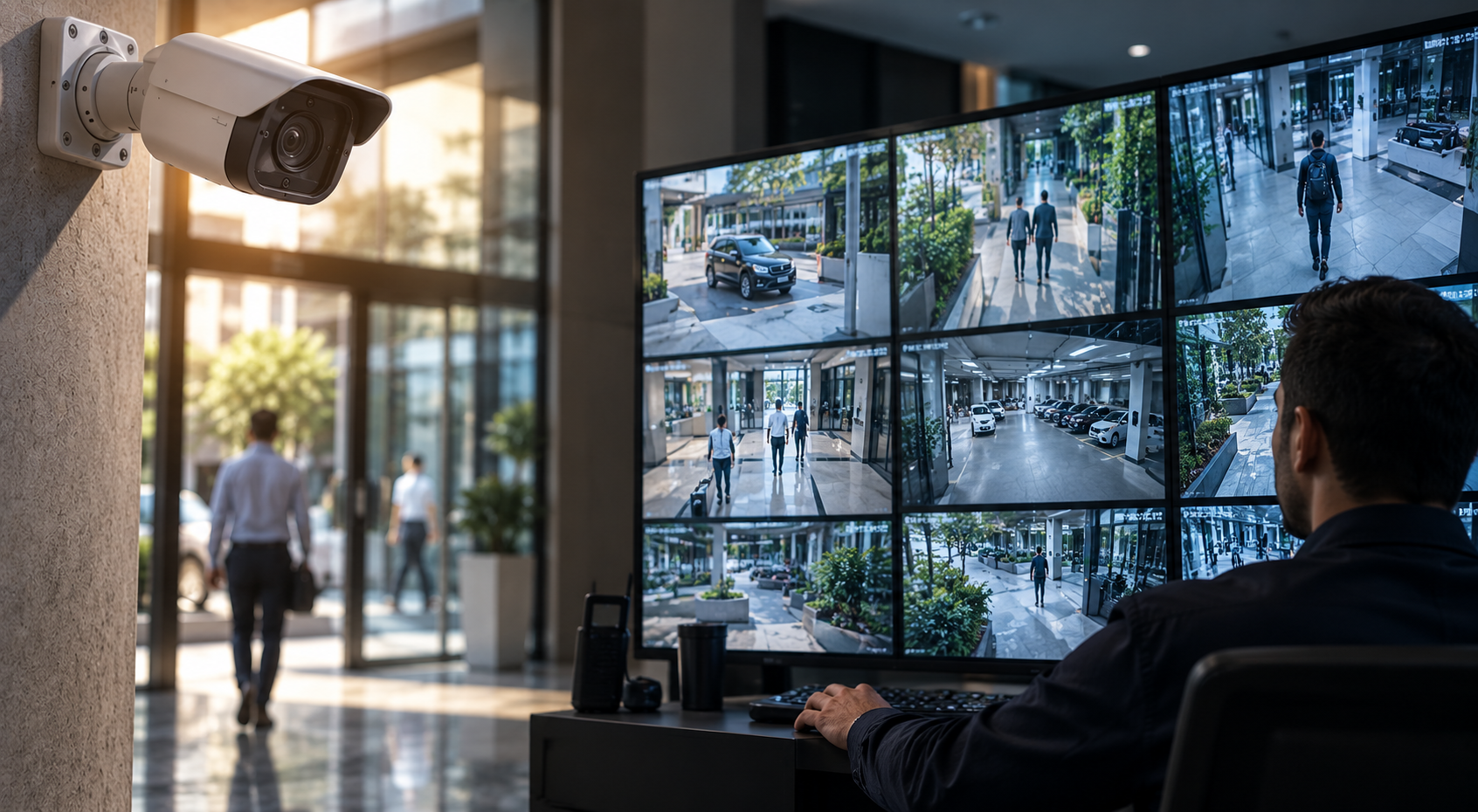
AI-Powered Video Surveillance: Intelligent CCTV for Security
CCTV is everywhere in the enterprise world factories, warehouses, offices, ports, mines, airports, retail stores, construction sites. But most of that infrastructure has one shared limitation: it records what happened. It doesn’t understand what’s happening. A security team watching hundreds or thousands of live feeds can’t give every screen continuous attention, and reviewing footage after an incident helps investigators piece together what occurred but it does nothing to prevent it. AI-powered video surveillance changes that equation. Instead of using cameras purely to record, computer vision can analyze streams in real time, detect specific events, flag unusual activity, generate alerts, and hand security teams the information they need to act turning CCTV from a passive archive into an active layer of enterprise security. What Is AI-Powered Video Surveillance? Traditional CCTV does three things: capture video, store it, and let someone review it later. AI-powered video surveillance adds a fourth layer on top: Depending on the trained models in use, that analysis layer can flag unauthorized entry, restricted-zone breaches, falls, PPE violations, smoke, crowd buildup, vehicle movement, safety violations, and other organization-specific conditions the moment they happen, not the next time someone reviews the tape. Why Traditional CCTV Isn’t Enough Anymore CCTV solved a real problem for decades; the issue it hasn’t solved is scale. A large manufacturing site might need to watch entry gates, production floors, storage areas, loading zones, parking, restricted rooms, perimeter fencing, and worker safety zones and a multi-site enterprise multiplies that by every additional facility. No human team can hold equal attention across every camera, every hour. Operators miss things when several incidents happen at once, when an event unfolds outside their field of view, when it develops slowly over a long shift, or when it simply happens at night. More screens don’t fix this. Better analysis does. How Computer Vision Makes CCTV Intelligent Computer vision lets software interpret what a camera sees identifying objects, movement, and patterns from trained models rather than relying on a person to notice them. Take a person entering a restricted area: with conventional CCTV, an operator has to spot them, recognize the zone as restricted, judge whether the movement is authorized, and decide whether to act. An AI system automates the detection step identifying the person, confirming the zone, applying the rule, and generating the alert so the security team’s time goes to judgment and response, not constant watching. AI Video Surveillance vs. Traditional CCTV Traditional CCTV AI-Powered Video Surveillance Records video Analyzes video Primarily reactive Supports proactive response Requires constant human monitoring Automated monitoring and detection Events reviewed after the fact Events detected in real time Large volumes of raw footage Event-based intelligence Limited automated analysis Computer-vision-based detection Isolated camera views Centralized intelligence Investigation-focused Detection and investigation Traditional CCTV still has a place the goal isn’t to rip out every camera, it’s to make the infrastructure you already have smarter. Can AI Work With Cameras You Already Have? This is usually the first question enterprise security teams ask, and it’s a fair one replacing an existing camera estate is expensive and disruptive. Guard Vision AI from Valiance Solutions is built to work with existing RTSP- and ONVIF-compatible CCTV cameras, so organizations can add AI video intelligence without ripping out what’s already installed. The practical question shifts from how do we replace our CCTV system to how do we make the one we have intelligent a far more realistic starting point for most enterprise budgets. How AI-Powered Video Surveillance Works A typical intelligent CCTV architecture runs across six layers: Real-Time Detection Changes the Response Timeline Speed is the whole point. If a person enters a restricted warehouse zone outside permitted hours, traditional CCTV only catches it if an operator happens to be watching that exact feed at that exact moment. An AI system detects the entry and fires an alert immediately, so the security team can assess and respond under its existing process. That’s not automation for its own sake it’s time saved, and time is the variable that matters most in restricted facilities, warehouses, ports, mines, oil and gas sites, construction zones, data centers, and large corporate campuses. AI Intrusion Detection Security teams can define zones perimeters, restricted rooms, storage and equipment areas, hazardous zones, employee-only sections where any unauthorized entry should trigger an alert. Computer vision detects people entering those zones and applies the rule automatically, cutting the need for someone to manually watch every restricted area around the clock. Built for Enterprise, Not Just One Site Large organizations rarely operate one building. Multiple offices, warehouses, plants, distribution centers, retail locations, ports, mines, and construction sites each generate their own camera feeds, and without a centralized layer, security leadership loses visibility across the whole operation. Guard Vision AI is built for exactly this centralized, multi-site monitoring across large camera deployments, so security leaders can think at the organization level instead of managing every site as an island. Where This Shows Up by Industry Edge AI vs. Cloud AI: Where Should Processing Happen? Cloud processing centralizes management and scales easily, but continuous video transmission raises bandwidth, latency, and privacy considerations. Edge AI processes video closer to where it’s captured, analyzing locally and sending only relevant events or metadata upstream cutting network dependence, bandwidth load, and detection latency. For remote or sensitive sites, edge processing is often the deciding factor in the architecture. Guard Vision AI supports both edge and cloud processing on top of existing compatible camera infrastructure, so the choice can match the site rather than the platform. Alerts Beat Raw Footage Weeks or months of recorded CCTV footage aren’t valuable on their own the value is in knowing which moments actually matter. Manually finding one event inside 10,000 hours of footage can take hours by itself; a system that surfaces the exact time and camera lets the security team focus on the event instead of the search. That shift from footage as a storage problem to footage as a structured information source is one of the biggest