

A technical bid can contain hundreds of pages of specifications, certificates, compliance statements, project details, and supporting documents. When an organisation receives bids from several vendors, checking every submission against the tender requirements becomes a demanding task.
Procurement teams must understand what each bidder has offered, whether the offer meets the required specifications, and where important differences exist. They also need to document their findings so that every evaluation can be reviewed and justified.
Doing all this manually takes time. It also creates opportunities for missed information, inconsistent comparisons, and avoidable delays.
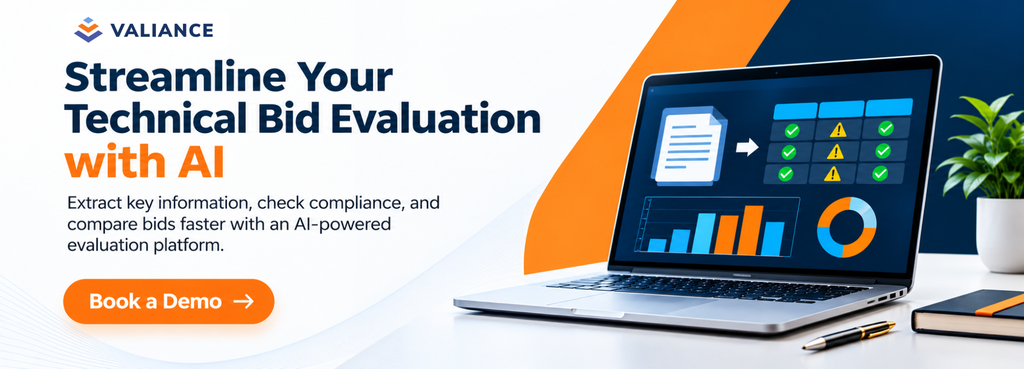
AI Technical Bid Evaluation Software helps organisations manage this work more efficiently. It uses artificial intelligence, document processing, and data analysis to extract information from bidder submissions, organise technical details, identify possible compliance gaps, and support side-by-side bid comparisons.
At Valiance Analytics, we see this as more than document automation. The real value of AI in procurement lies in helping evaluation teams find the right information, connect it to the actual tender requirements, and spend more time reviewing important findings instead of searching through files.
This article explains how AI-powered technical bid evaluation works, what features procurement teams should look for, and how organisations can use it to improve their tender evaluation processes.
What Is AI Technical Bid Evaluation Software?
AI Technical Bid Evaluation Software is a digital solution that helps procurement teams examine technical proposals submitted by vendors and compare them against the requirements specified in a tender.
It uses technologies such as artificial intelligence, machine learning, natural language processing (NLP), and intelligent document processing to read, extract, and organise information from different documents.
For example, imagine a government department inviting bids for the supply of industrial equipment.
The tender may specify:
- Minimum equipment capacity.
- Required technical certifications.
- Operating conditions.
- Product specifications.
- Warranty requirements.
- Relevant project experience.
- Installation and maintenance requirements.
Each bidder submits a technical proposal with its own specifications, certificates, product information, and supporting documents.
An AI-powered bid evaluation system can extract the relevant information from these submissions and organise it against the tender requirements.
Instead of opening multiple files and searching for every specification, evaluators can review the extracted information in a structured format.
The system can also flag missing details, possible deviations, inconsistent information, and items that need further verification.
The purpose is not to let AI make procurement decisions independently. It is to give evaluators better information and reduce the repetitive work involved in reviewing technical bids.
Why Is Manual Technical Bid Evaluation Difficult?
Technical bid evaluation requires careful attention to detail. A bidder may satisfy most requirements but fail to provide evidence for one important specification. Another bidder may offer an alternative technical solution that requires expert examination.
When several vendors participate, the evaluation becomes even more demanding.
Here are some common problems procurement teams face.
1. Reviewing Large Volumes of Documents
A technical proposal is rarely a single document.
It may include product catalogues, technical datasheets, certificates, experience records, compliance statements, drawings, and supporting annexures.
Evaluators must locate relevant information across all these files.
For tenders involving multiple bidders, this can create a large amount of repetitive work.
2. Comparing Different Technical Formats
Vendors do not always present information in the same format.
One bidder may provide specifications in a table. Another may include them in a product catalogue. A third may describe them in paragraphs.
Even when all bidders respond to the same tender, their submissions can look very different.
Manual comparison requires evaluators to locate the same information repeatedly and transfer it into a common format.
3. Identifying Technical Deviations
A bidder’s offer may differ from a tender requirement in several ways.
For example, the tender may specify a minimum operating capacity, while a bidder provides a different value.
The difference may be significant, acceptable under the tender conditions, or require clarification.
Finding these differences is important, but evaluating their meaning requires proper technical judgement.
4. Checking Supporting Documents
Technical claims often need supporting evidence.
A bidder may state that its product meets a particular standard but fail to include the relevant certificate. Another may provide a certificate with unclear details.
Procurement teams must verify whether the supporting information is present and relevant.
5. Maintaining Consistent Evaluation Records
Every technical evaluation needs clear documentation.
Teams may have to record requirements, bidder responses, observations, supporting evidence, and evaluation findings.
When this information is spread across spreadsheets, emails, and individual documents, reviewing the complete evaluation becomes harder.
These problems explain why organisations are exploring automated bid evaluation software.
How Does AI Technical Bid Evaluation Software Work?
An AI-powered system follows a structured process to turn unorganised bidder documents into information that evaluators can review.
The exact workflow depends on the software, tender structure, and evaluation rules.
A typical process involves the following stages.
Step 1: Collect Tender Documents and Bidder Submissions
The process begins with the tender document and the technical submissions received from participating vendors.
These may include:
- Request for Proposal (RFP) documents.
- Technical specifications.
- Bidder compliance statements.
- Product datasheets.
- Technical proposals.
- Experience certificates.
- Quality and safety certificates.
- Supporting declarations and annexures.
The documents are uploaded or collected through supported systems.
Bringing these files into an organised workflow gives the evaluation team a common place to work with the information.
Step 2: Extract Technical Requirements from the Tender
Before evaluating a bid, the system needs to understand what the tender is asking for.
AI can help identify important requirements from tender documents and organise them into structured information.
For example:
| Tender Requirement | Required Information |
|---|---|
| Equipment Capacity | Minimum 500 units per hour |
| Operating Temperature | Defined temperature range |
| Certification | Required product certification |
| Warranty | Minimum 24 months |
| Installation | Installation support required |
| Experience | Relevant project experience |
This creates a reference against which bidder submissions can be examined.
The quality of this step matters. If a requirement is misunderstood or missed, the later comparison may also be affected.
Step 3: Read and Extract Information from Bidder Documents
Once the tender requirements are organised, AI can process the documents submitted by each bidder.
Intelligent document processing helps extract relevant information from different document formats.
This may include:
- Technical specifications.
- Product model numbers
- Equipment capacity.
- Certification details.
- Warranty information.
- Project experience.
- Compliance declarations.
- Supporting evidence.
For scanned documents, optical character recognition (OCR) can help convert readable text in images into machine-processable text.
The extracted information can then be organised into structured fields.
This reduces the need for evaluators to copy details manually from every document.
Step 4: Match Bidder Responses Against Tender Requirements
This is one of the most important stages of technical bid evaluation.
AI compares the information provided by bidders with the corresponding requirements in the tender.
For example, consider a tender that requires equipment with a minimum capacity of 500 units per hour.
Three bidders provide the following information:
| Requirement | Bidder A | Bidder B | Bidder C |
|---|---|---|---|
| Required Capacity | 500 units/hr | 500 units/hr | 500 units/hr |
| Offered Capacity | 550 units/hr | 480 units/hr | Not Stated |
| Warranty | 24 Months | 36 Months | 24 Months |
| Supporting Evidence | Provided | Provided | Requires Review |
| Evaluation Observation | Meets Stated Capacity | Potential Deviation | Missing Technical Detail |
A system can help identify the differences and highlight information that needs attention.
However, the numerical comparison alone does not establish the final technical outcome.
The evaluation team must check the original documents, relevant conditions, and any permitted alternatives before reaching a conclusion.
Step 5: Identify Missing Information and Possible Compliance Gaps
After comparing the submissions, AI can flag issues that require further examination.
Examples include:
- Missing technical certificates.
- Incomplete product specifications.
- Conflicting information across documents.
- Unclear compliance statements.
- Differences between declared and supporting values.
- Missing warranty or experience details.
These findings help evaluators focus on specific issues rather than checking every document again.
A flagged item should be treated as an observation for review, not an automatic rejection.
Step 6: Prepare Comparative Statements
Once the relevant information has been extracted and organised, the system can help prepare bidder-wise comparative statements.
These statements bring key details into a common format.
Evaluators can review the requirements, bidder responses, differences, and supporting information together.
This is especially useful when several vendors participate in a tender.
It also reduces the time spent preparing spreadsheets and transferring information between documents.
Step 7: Human Verification and Final Evaluation
The final stage is human review.
Authorised evaluators examine the extracted information, check supporting evidence, resolve unclear observations, and apply the evaluation criteria stated in the tender.
They can verify whether a bidder meets the technical requirements and document their findings.
This step is essential because AI can misunderstand a document, miss an exception, or extract an incorrect value.
The final technical evaluation must follow the applicable procurement conditions and approval process.
Key Features to Look for in AI Bid Evaluation Software
Not every AI procurement tool offers the same capabilities.
Some focus mainly on document extraction. Others support bidder comparisons, compliance checks, reporting, or wider tender management.
Before selecting AI bid evaluation software, organisations should understand which features will solve their actual procurement problems.
1. Automated Document Parsing
Document parsing is one of the most useful capabilities in an AI-based evaluation system.
It helps extract important information from bidder documents and arrange it into structured data.
A good document processing workflow should support the document types commonly used by the organisation, including PDFs, spreadsheets, scanned documents, and other relevant formats.
This is particularly useful when technical proposals contain large amounts of information.
2. Intelligent Technical Bid Analysis
Technical bid analysis involves examining bidder responses against the requirements defined in the tender.
AI can help locate relevant information, compare technical values, and highlight possible differences.
For example, if a tender specifies a particular equipment capacity, the system can identify the corresponding value in each bidder’s submission.
This makes technical information easier to review.
3. Automated Compliance Validation
Compliance validation helps check whether the submitted information addresses the requirements specified in the tender.
AI-powered tender compliance checking software can assist with identifying:
- Missing documents.
- Incomplete responses.
- Unclear technical declarations.
- Mismatched information.
- Possible deviations from requirements.
The system should make the supporting information available so evaluators can verify each observation.
4. Side-by-Side Bidder Comparison
Comparing multiple submissions is a major part of procurement evaluation.
AI bid evaluation software can organise extracted information from different vendors into a common comparison format.
This helps teams examine technical specifications, eligibility details, and other relevant information without repeatedly searching through individual files.
It also makes differences between submissions easier to identify.
5. Anomaly Detection
Bid documents can contain inconsistent information.
For example, a bidder may mention one equipment model in its technical proposal and another in its supporting datasheet.
Anomaly detection can help flag such differences for further investigation.
This does not establish that a bidder has provided incorrect information. It simply helps evaluators identify details that deserve closer attention.
6. Comparative Statement Generation
Preparing comparative statements manually can take significant time, particularly when many bidders participate.
Automated bid evaluation software can organise extracted information and help generate draft comparative statements.
These outputs can make evaluation records easier to prepare, check, and share with authorised stakeholders.
7. Audit-Ready Evaluation Records
Procurement decisions need clear supporting records.
An effective system should help maintain information about extracted data, evaluation observations, user corrections, and review activities.
This makes it easier to understand how information was processed and how the evaluation team reached its conclusions.
8. AI-Assisted Document Drafting
Tender preparation also involves creating and updating technical requirements, eligibility conditions, and other procurement documents.
Generative AI can assist with preparing draft tender documents based on defined inputs and approved templates.
These drafts should always be checked by the responsible team before publication.
This capability is particularly useful in platforms that support both pre-tender preparation and post-submission evaluation.
AI Technical Bid Evaluation Software vs Manual Evaluation
The main difference between manual and AI-powered evaluation is how information is collected, organised, and compared.
| Evaluation Activity | Manual Process | AI-Powered Process |
|---|---|---|
| Document Reading | Evaluators search files individually | AI extracts relevant information |
| Data Entry | Details copied into spreadsheets | Extracted data organised into structured fields |
| Technical Comparison | Manual checking of specifications | AI-assisted requirement matching |
| Compliance Checks | Individual document verification | Automated checks flag potential gaps |
| Missing Information | Found during manual review | Possible omissions highlighted |
| Bidder Comparison | Manually prepared comparison sheets | Structured comparative outputs |
| Anomaly Identification | Depends on manual cross-checking | Automated inconsistency flags |
| Reporting | Manually prepared reports | Draft reports and evaluation records |
| Final Decisions | Authorised evaluation team | Authorised evaluation team |
AI can reduce repetitive tasks, but it does not remove the need for technical expertise.
The best approach combines automated information processing with careful human review.
Technical Bid Evaluation vs Commercial Bid Evaluation
One important point in procurement is the difference between technical and commercial bid evaluation.
They serve different purposes and should not be treated as the same process.
Technical bid evaluation examines whether a bidder’s proposal meets the technical requirements, eligibility conditions, and other applicable criteria.
Commercial bid evaluation examines the financial aspects of the bids according to the tender’s stated evaluation method.
Here is a simple comparison.
| Area | Technical Bid Evaluation | Commercial Bid Evaluation |
|---|---|---|
| Main Focus | Technical suitability | Financial offer |
| Information Reviewed | Specifications, experience, certificates and proposals | Prices, rates, taxes and financial terms |
| Main Purpose | Assess technical requirements | Assess commercial requirements |
| Common Documents | Technical proposal and supporting certificates | Price schedules and financial bid |
| AI Application | Technical information extraction and compliance support | Financial data extraction and comparison |
| Main Output | Technical evaluation findings | Commercial comparative statement |
The two stages may be handled within a broader tender evaluation platform.
However, the evaluation workflow must respect the tender’s prescribed bidding structure and confidentiality requirements. Where technical and financial bids are required to be evaluated separately, the software should preserve that separation.
Where Can Automated Bid Evaluation Software Be Used?
AI-based bid evaluation is useful across industries where organisations receive detailed proposals from multiple vendors.
Government Departments
Government procurement often involves detailed eligibility conditions, technical specifications, certificates, and supporting documents.
AI can help organise these submissions and support the review of technical requirements.
It can also assist with preparing comparative statements and maintaining evaluation records.
Public Sector Undertakings (PSUs)
PSUs manage procurement across sectors such as oil and gas, energy, infrastructure, manufacturing, and transportation.
Their tenders may involve large document volumes and multiple technical requirements.
AI-powered tender evaluation software can help reduce repetitive document processing and support more organised vendor comparisons.
Infrastructure and Construction
Construction and infrastructure projects involve technical proposals, equipment specifications, project experience, quality standards, and delivery requirements.
AI can help extract and compare relevant details from contractor submissions.
Manufacturing and Industrial Procurement
Manufacturing companies purchase machinery, components, industrial equipment, and technical services.
Evaluating these offers often requires comparing specifications, performance details, certifications, and warranty conditions.
AI can help bring this information into a common review format.
Defence and Engineering Procurement
Defence and engineering procurement may involve complex specifications, technical documents, and strict information-handling requirements.
AI-assisted document processing can help authorised teams organise and retrieve relevant technical information.
Any deployment must meet the organisation’s security, access, and data governance requirements.
IT and Technology Procurement
IT procurement often involves evaluating software proposals, system architecture, security requirements, implementation plans, and vendor experience.
AI can help locate relevant information and compare vendor responses against the stated requirements.
How to Choose the Right AI Technical Bid Evaluation Software
Choosing a platform requires more than comparing feature lists.
The software should fit the organisation’s procurement process, document types, evaluation rules, and security requirements.
Here are eight important things to examine.
1. Ability to Process Real Tender Documents
Ask whether the platform can process the types of files your organisation actually receives.
Test it with long PDFs, scanned certificates, spreadsheets, tables, and technical proposals.
Do not rely only on a standard product demonstration.
2. Accuracy of Information Extraction
Check whether the software extracts important values and technical details correctly.
Pay special attention to tables, units, technical parameters, and information spread across multiple pages.
Ask how extracted information can be verified against its source.
3. Requirement-Level Comparison
The platform should help compare individual tender requirements against bidder responses.
A general document summary is not enough for a detailed technical evaluation.
Look for structured comparisons that show the requirement, bidder response, supporting information, and any observation.
4. Custom Evaluation Criteria
Different tenders have different requirements.
The software should support the evaluation conditions and formats used by the organisation.
It should not introduce new requirements or change the published evaluation method.
5. Human Review and Approval
Procurement teams should be able to inspect AI-generated findings, correct errors, and record their decisions.
Important findings must remain open to verification.
6. Data Security and Confidentiality
Bid documents may contain confidential commercial and technical information.
Evaluate how the provider handles data storage, access permissions, encryption, retention, deployment, and integrations.
Security requirements should be assessed before uploading sensitive procurement documents.
7. Reporting and Audit Support
Check whether the platform can prepare comparative statements and organised evaluation records.
Look for traceability between findings and original documents.
8. Scalability and Integration
The software should support the organisation’s expected tender volume and work with its existing systems where required.
Also examine how the platform performs when several bidders submit large document sets.
Common Challenges When Implementing AI Bid Evaluation Software
AI can improve procurement workflows, but implementation requires proper planning.
Organisations should understand the following challenges before adopting a new platform.
Poor Document Quality
Scanned files with low resolution, handwritten information, or unusual layouts may affect extraction quality.
A proper testing process should include the actual documents used by the procurement team.
Complex Technical Language
Some tender documents use specialised engineering terms, abbreviations, and industry-specific specifications.
A general-purpose AI system may not interpret every technical detail correctly.
Domain-specific configuration and expert verification are important.
Different Document Structures
Bidders may use different formats to present similar information.
The system needs to identify relevant details without assuming that every document follows the same layout.
AI Hallucinations and Incorrect Interpretations
Generative AI may produce information that is not supported by the source document.
For procurement, this is a serious concern.
The software should make it possible to verify important findings against original evidence. AI-generated summaries should never replace the actual tender conditions or submitted documents.
Resistance to New Workflows
Evaluation teams may be accustomed to spreadsheets and manual review.
Introducing AI requires training, clear responsibilities, and a practical transition plan.
A pilot with completed tender documents can help teams understand where automation adds value and where manual checks remain necessary.
How Valiance Analytics Is Transforming Tender Evaluation with AI
At Valiance Analytics Pvt. Ltd., we work on AI solutions that help organisations manage complex information and improve operational processes.
One area where we apply these capabilities is tender evaluation.
Our Tender Intelligence platform is designed to help procurement teams move away from repetitive, paperwork-heavy evaluation workflows.
It brings AI-powered document processing, bidder comparison, compliance validation, and evaluation support into a more structured process.
Automated Document Parsing
Tender submissions often contain large collections of documents in different formats.
Our platform helps extract key information from bidder documents and organise it for further evaluation.
This reduces the effort involved in manually locating and copying information from multiple files.
Bidder Comparison
Comparing several vendor submissions can be difficult when information is spread across different documents.
Our platform helps organise bidder information into side-by-side comparisons.
This makes it easier for evaluation teams to review relevant details and identify differences between submissions.
Compliance Validation
Every tender has its own eligibility conditions and evaluation requirements.
Our platform supports compliance checks that help identify missing information, mismatches, and possible gaps in bidder submissions.
These observations give evaluators a clearer view of the areas that need further examination.
Anomaly Detection
Inconsistent information across documents can create problems during evaluation.
Our platform helps flag unusual or inconsistent details so teams can investigate them before finalising their findings.
Pre-Tender Document Drafting
The work does not begin only when bidders submit their proposals.
Preparing tender documents also requires careful attention to requirements and evaluation conditions.
Our platform supports AI-assisted drafting of tender documents based on defined inputs, helping procurement teams organise this part of the process.
Audit-Ready Records
Procurement teams need clear records of their evaluation activities.
Our platform supports structured evaluation outputs and digital records that help make information easier to review and track.
Real-World Experience: AI-Powered Tender Evaluation for an Oil and Gas PSU
Our experience with tender evaluation is not limited to a product concept.
Valiance has developed an AI-powered tender evaluation platform for a leading Indian oil and gas public sector undertaking.
The organisation faced a familiar procurement challenge.
Its officers had to collect bidder documents from procurement portals such as GeM and NIC, extract important eligibility parameters and bid values, and prepare comparative statements manually.
This required considerable effort and made the evaluation process harder to manage at scale.
To address this challenge, Valiance developed a platform with capabilities including:
- Automated collection and parsing of bidder documents.
- AI-driven data extraction and classification.
- Identification of eligibility parameters and bid values.
- Custom prompt-based evaluation.
- Rule-based filtering based on organisational requirements.
- Automated comparative statement generation.
- A structured, multi-step evaluation workflow.
The solution helped reduce manual work, speed up evaluation activities, and improve the consistency of comparative statements.
It also provided a more scalable approach to handling growing tender volumes.
This case demonstrates how AI can be applied to real procurement workflows rather than being limited to general document summarisation.
Read the AI-Powered Tender Evaluation Platform case study to learn more about the project.
The Future of Technical Bid Evaluation
Procurement is becoming more document-intensive. Organisations must review more information, compare more submissions, and maintain clear records of their decisions.
Manual evaluation still has an important role, but it does not need to handle every repetitive task.
AI Technical Bid Evaluation Software can help procurement teams extract technical information, compare bidder responses, identify possible gaps, and prepare structured evaluation outputs.
The next step is not simply to automate more documents. It is to make the connection between tender requirements, bidder evidence, and evaluation findings easier to understand and verify.
For organisations handling large and complex tenders, this can make a meaningful difference.
At Valiance Analytics, we believe AI should help procurement professionals make better use of their time and information. Our Tender Intelligence platform brings document parsing, bidder comparison, compliance validation, and evaluation support into a single intelligent workflow.
As procurement requirements continue to grow, organisations that combine AI capabilities with experienced human evaluators will be better equipped to manage complex tender processes.
Frequently Asked Questions
The right software depends on the organisation’s tender volume, document formats, evaluation requirements, security needs, and reporting process. Look for automated document parsing, technical bid analysis, compliance validation, bidder comparison, and human review capabilities. Valiance Tender Intelligence is one solution organisations can explore for AI-powered tender evaluation.
AI bid evaluation software processes tender documents and bidder submissions, extracts relevant information, organises data, and compares responses against defined requirements. It can also flag missing details, inconsistencies, and potential compliance gaps for human review.
AI can automate information extraction, requirement matching, preliminary checks, and comparison tasks. However, final technical decisions should be made by authorised evaluators who verify the evidence and apply the tender’s evaluation rules.
AI bid evaluation software focuses on reviewing bidder submissions, extracting information, checking requirements, and comparing bids. Tender management software may cover a wider process, including tender preparation, publication, bidder communication, evaluation, approvals, and contract award.
Yes. AI-powered systems can process multiple bidder submissions and organise extracted information into structured comparison tables. The quality of the comparison depends on the document formats, extraction accuracy, and evaluation criteria.
Organisations should test document extraction, technical requirement matching, compliance validation, bidder comparison, source traceability, security, reporting, integration, and human review controls. A pilot using representative tender documents is a practical way to assess the solution.