
Enterprises have been making huge investments in data pools, insights groups, and business intelligence platforms for years. The goal was simple and difficult: record every signal, transform data into insight, and enable leaders to make better decisions.
This promise often falls in real life.
In a lot of enterprises, so-called “actionable” ideas are rarely put into effect quickly enough to meet their demands. On shared drives, reports remain unchanged. Instead of being checked continuously, monitors are reviewed once a week. Important findings come after the time to take action has already expired.
In reality, enterprises have developed strong analysis tools but very few data-action tools.
One of the most costly errors in modern operations is the gap between the development of insights and execution in reality. Quality is now lost as a result of a delayed response rather than a lack of information. Reducing the time between knowing and performing is now the competitive edge.
AI starts radically changing the situation at this point.
Enterprise speed is being redefined by AI systems that go beyond analysis and directly start automated activities. Enterprises can go from problem identification to problem resolution in seconds, not weeks, through turning insights into prompt, planned action.
The change can be seen: understanding is no longer enough on its own.
Effective businesses stand out from intelligent ones by how they work.
Limitations of Insight-Driven Systems
The purpose of supportive AI and traditional analytics is to educate people, not to make choices.
When insights are quickly assessed and manually acted upon, they perform successfully. However, these assumptions break at scale.
Typical restrictions consist of:
- Human dependency at scale: Every insight requires validation, approval, and coordination
- Decision delays: Insights lose value as response time increases
- Disconnected systems: Analytics live separately from operational workflows
- Inconsistent execution: Outcomes vary based on human judgment, workload, and stress
- Reactive response: Problems are addressed after becoming visible, not before
Although these systems produce intelligence, they do not control the results. Insight without action becomes a liability as complexity increases.
Current Realities in Enterprise Operations
Today’s enterprise work is driven by ongoing decision processes rather than discrete tasks.
Important facts include:
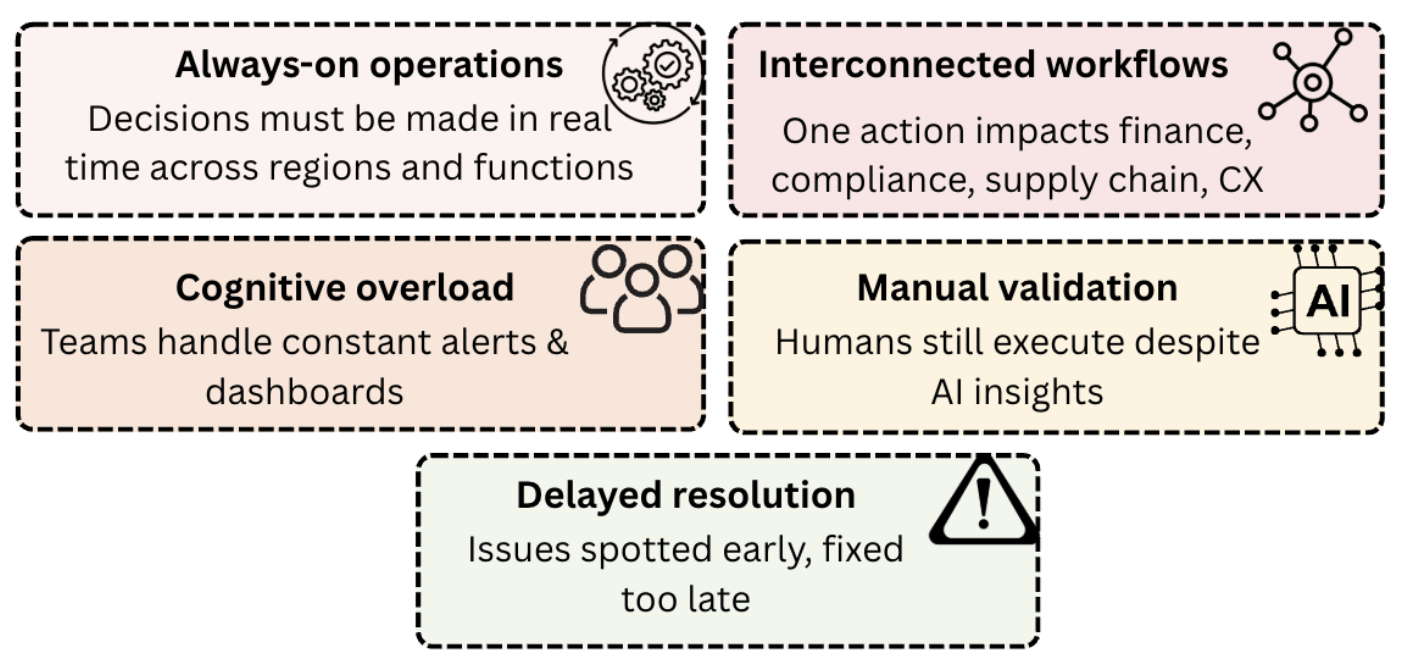
These facts highlight a basic limitation: enterprise-scale complexity cannot be handled by insight alone.
Key Challenges Enterprises Face Today
A number of obstacles arise when businesses try to go from insight to action.
Some of the more important ones are:
- Trust and accountability: Organizations hesitate to let AI act without human confirmation
- Data readiness: Fragmented or low-quality data limits reliable decision-making
- Legacy systems: Older infrastructure restricts automated cross-system execution
- Governance and control: Clear boundaries, policies, and escalation paths are required
- Cultural resistance: Teams are reluctant to relinquish control, even when outcomes improve
These difficulties highlight a crucial reality:
Reducing the gap between insight and action requires an operational shift rather than merely a technical upgrade
How Action-Oriented AI Changes the Game
Enterprises go from observation to execution with action-oriented AI.
These systems study context, gauge impact, and initiate actions within defined limits rather than stopping at ideas. They don’t wait for human approval at every stage. They work constantly, adjusting to new information as conditions change.
This change alters how enterprises operate:
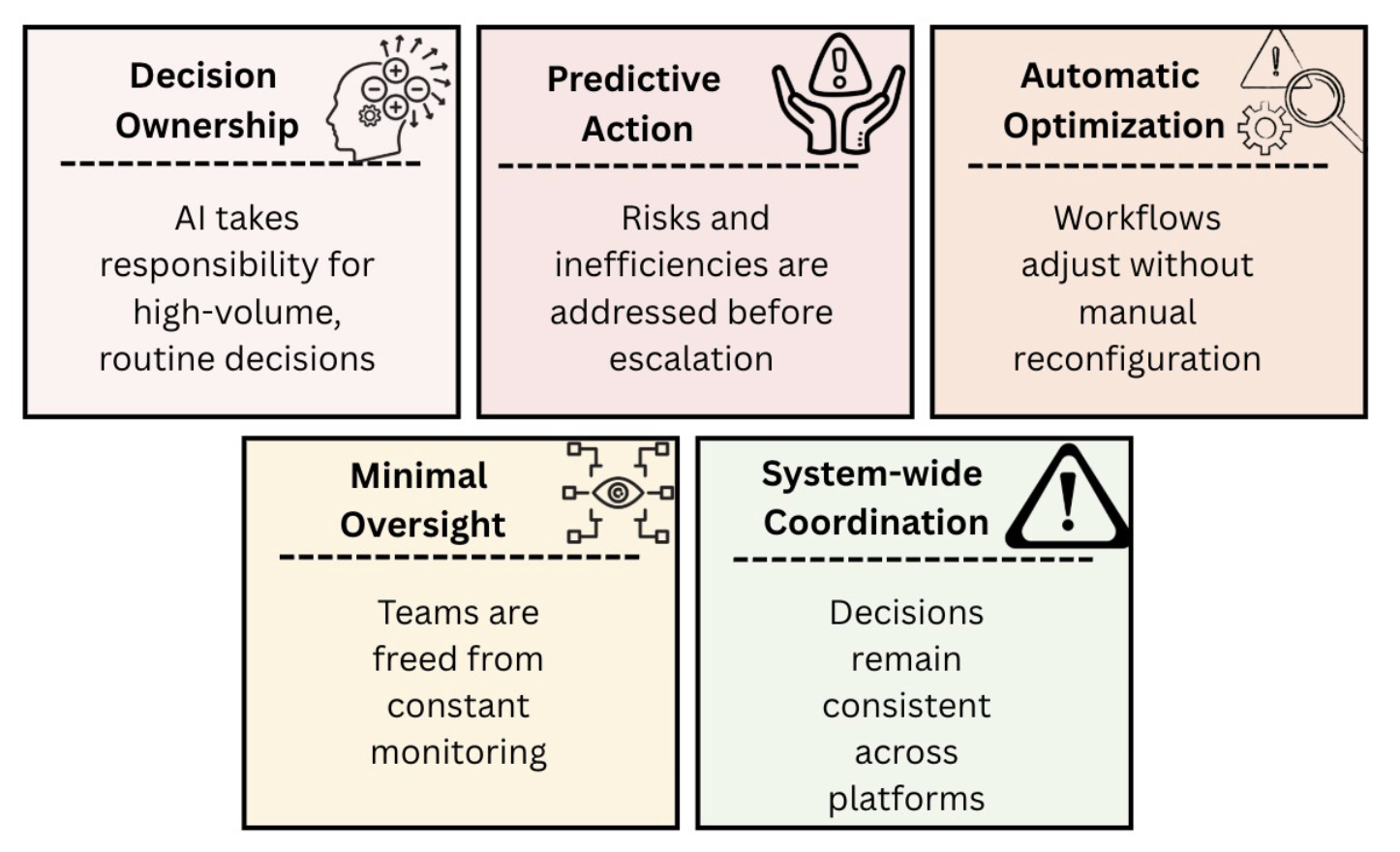
This is a crucial moment. AI is now more than simply an explanation.
It guarantees that anything takes place.
Why It Matters
- Decisions now move faster than human capacity
- Delayed responses turn small issues into failures
- Manual oversight breaks down at enterprise scale
- Adaptable enterprises outperform reactive ones
- Execution not insight defines performance
How AI Works in Enterprise Operations
A continuous intelligence loop is how action-oriented AI systems operate:
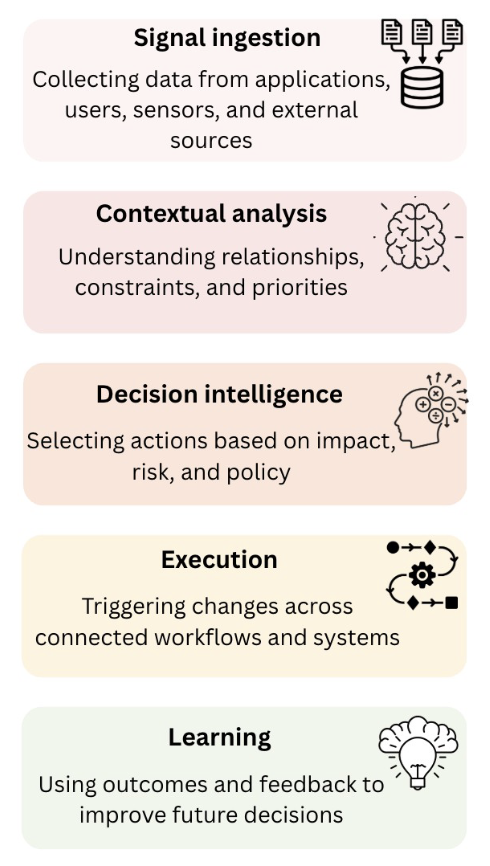
These systems change throughout time, in contrast to traditional analytics.
They provide more than surface-level insights.They put them into practice.
Looking Ahead: The Future of Enterprise Intelligence
Systems that are capable of understanding, making decisions, and acting on their own are the key to the future of business operations.
AI will progress from helping with decision-making to managing operational intelligence throughout the company as speed and difficulty rise. These systems will maintain stability at scale, predict errors, and coordinate responses.
Analytics are going to be important.
However, advantage will be defined by action.
Businesses that bridge the gap between insight and action, in our opinion at Valiance Solutions, will lead the next phase of operations.
Our AI systems make it possible for:
- Making decisions with information in mind
- Error management and predictive risk
- Coordination of actions among systems
- Continuous improvement and learning
- Performance that is trustworthy and visible at scale
Systems that simply watch will not be able to function well.
Businesses require actionable systems.