
In the rapidly evolving world of business, timing is everything. Decisions that once took weeks now need to be made in seconds. The ability to act swiftly, based on data-driven insights, is no longer a competitive advantage, it’s a necessity.
Enter Artificial Intelligence (AI), the transformative force empowering businesses to make real-time decisions with unprecedented accuracy and speed. From predicting market trends to optimizing supply chains and enhancing customer experiences, AI is fundamentally reshaping how decisions are made across industries.
Nowadays, enterprises move fast. Alerts go off in real time, workflows start immediately, and automated actions run across dozens of systems. The mandate is simple: move quickly, respond instantly, and keep operations running smoothly.
However, in reality, this promise often breaks down.
Many enterprises execute actions continuously, yet outcomes still disappoint. Alerts are raised but ignored. Workflows run, but generate downstream rework. Automated solutions fix one problem while quietly creating another.
Speed is not the real issue.
Most enterprises have strong execution engines but weak decision engines.
Poor judgment, rather than delayed action, is one of the most costly failures in modern business. According to IDC, nearly 70% of enterprise data is never used in decision-making, while McKinsey estimates that poor decisions cost organizations up to 3% of annual revenue.
Competitive advantage is no longer defined by how fast systems act. It is defined by how well they decide.
This is where decision-making AI begins to fundamentally reshape enterprise operations.
Limitations of Action-Oriented Systems
The purpose of action-oriented systems was to carry out orders, not to think. When things are simple and predictable, they do well. But these assumptions fall apart as enterprise situations grow.
Typical limitations consist of:
- Trigger-based operation: Rules, not situational awareness, decide when actions take place.
- Lack of prioritization: Systems are unable to decide which action is most important.
- Lack of effect awareness: Unnoticed are adverse effects across teams or platforms.
- Strong handling of errors: Human involvement is necessary in extreme situations.
- No learning loop: Future acts are not improved by past results.
These systems work well, but they are unaware of danger, motives, and choices.
Action without intelligence becomes an obstacle rather than a benefit as complexity rises.
Current Realities in Enterprise Operations
Continuous decision-making, rather than fixed activities, drives modern business operations.
Important facts include:
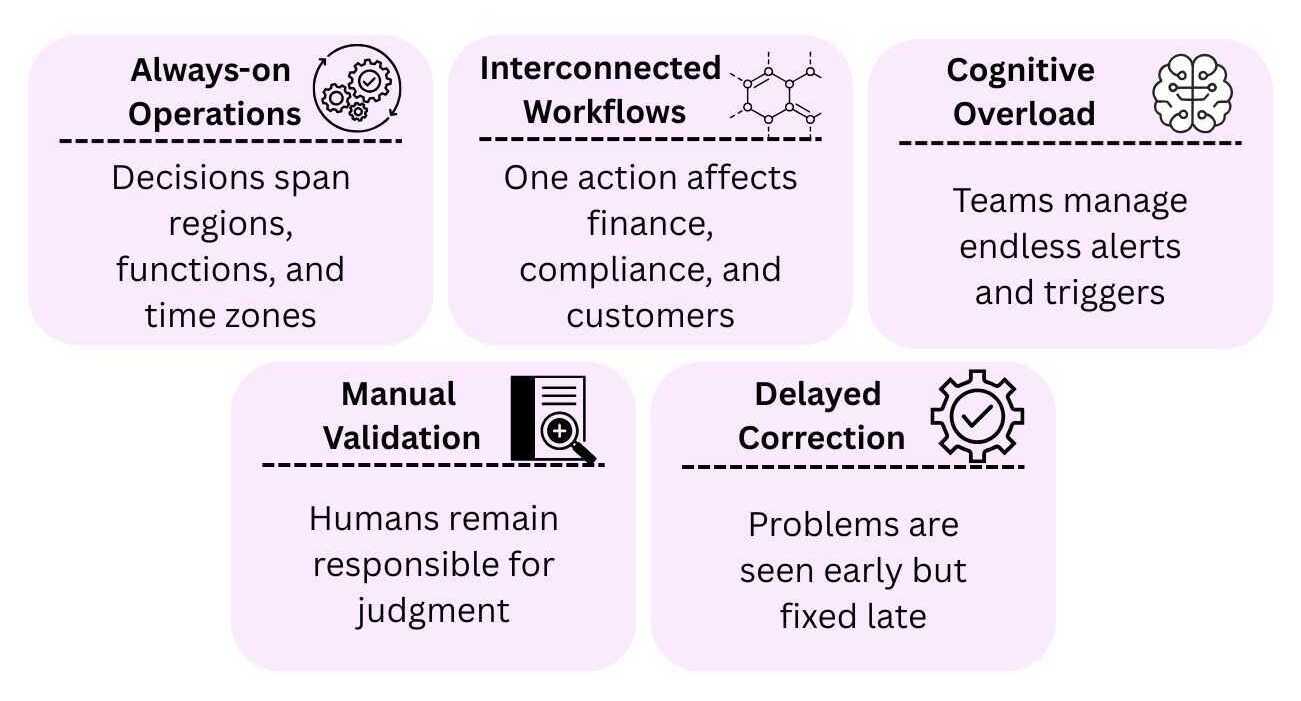
These realities expose a critical gap:
Enterprises are not struggling to act they are struggling to choose the right action at the right time.
Key Challenges Enterprises Face Today
As enterprises move past basic automation, other difficulties arise:
- Decision overload: Too many notifications that aren’t properly evaluated
- Inconsistent actions: Systems function alone with little coordination.
- Reactive procedures: Only after the effect is felt can responses start.
- Human-dependent evaluation: Manual review is advised for important decisions.
- Inconsistent outcomes: Similar circumstances result in different actions
These difficulties draw attention to an important fact:
Without decision intelligence, automation won’t develop.
The barrier is decision rather than action.
How Decision-Making AI Changes the Game
Making decisions AI changes enterprises from systems that value performance to those that value insight.
These systems question, “What decision produces the best outcome right now?” rather than, “What action should be taken?”
This change changes the basic operations:
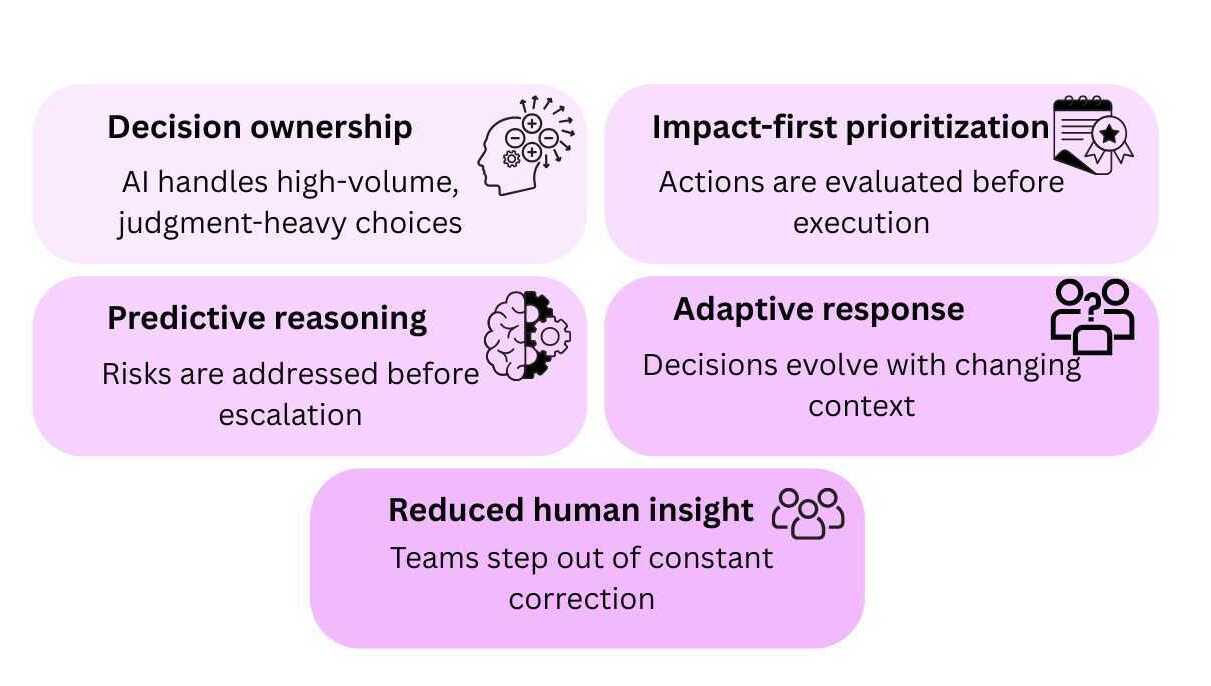
This is a key turning point. AI is doing more than just speeding up performance. It is making wiser decisions
How Decision-Making AI Works in Enterprise Operations
Decision-making AI operates as a continuous intelligence loop:
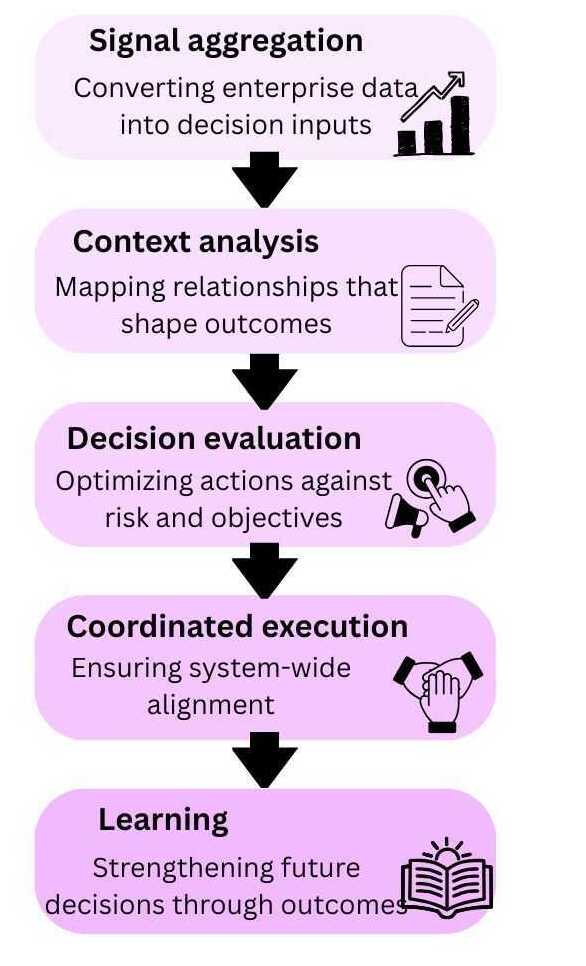
These platforms change over time, compared with traditional systems.
They do more than simply react.They evaluate, choose, and get stronger.
Why AI Matters for Enterprises Today
- Enterprises function at endless speed and complex while swimming in data. Older technologies and manual decision-making fail to keep up.
- AI turns data into real-time insight by recognizing patterns, forecasting results, and encouraging action before it has an impact.
- Enterprises that use AI at scale can reduce expenses by 10–20% and increase revenue by up to 10%, according to McKinsey. Effectiveness is not what that is. That’s a benefit.
- Automation is not AI. It’s increased in judgment.
Looking Ahead: The Future of Enterprise Operations
Enterprises that move beyond just using systems will own the future.
AI will move forward from helping with making choices to having operational intelligence across the enterprise as difficulty and speed continue to rise. These systems will maintain stability at scale, predict effects, and plan actions.
Execution will continue to be important.
Yet, decision-making skills will decide the benefit.
We at Valiance Solutions think enterprises have to move from action-oriented automation to intelligent decision systems.
Our AI systems make it possible to:
- Decision intelligence based on context
- Analysis of predictive risk and impact
- Coordination of choices among systems
- Continuous improvement and development
- Clear, understandable results at scale
Businesses do not require quicker systems in situations where every decision has effects.
They require more intelligent ones.