

Automation alone cannot guarantee successful citizen grievance resolution in today’s public sector settings, where thousands of complaints are collected, monitored, and processed daily. Authorities use workflow automation tools, feedback management systems, and online platforms to speed up response times. Faster complaint procedure does not, however, ensure quick, fair, or major results. Although there is data, responsibility and action clarity can often be lacking.
Public institutions now operate in extremely demanding and complex environments. Transparent, responsive, accurate, and equal grievance processes are expected by the public, regulatory bodies, oversight committees, and policy stakeholders.
However, this promise is often not fulfilled in practice.
Grievance cells find it difficult to accurately classify complaints, rate urgent cases, monitor recurring problems, coordinate across departments, and interact regularly. As a result, governments frequently continue to do well at collecting complaints but badly at effectively handling them.
Reducing the complaints collection process is the largest barrier. Turning public comments into useful intelligence is the true challenge. Public institutions can start to bridge the gap between the receipt of complaints and their effective resolution by utilizing artificial intelligence to convert unstructured citizen complaints into context-aware, priority-driven, and resolution-focused workflows.
Limitations of Traditional Citizen Grievance Systems
The majority of grievance redressal systems continue to use strict procedures and classification based on rules. Complaints are manually assigned, sorted according to predetermined keywords, and processed in order.
Although administrative records are created in this way, intelligent treatment is not guaranteed.
Typical limitations consist of:
- Request-based processing: Complaints often lack proper contextual interpretation
- Incorrect classification risk: Urgent or sensitive grievances may be overlooked
- Cycles of slow closure: Delays erode citizen trust
- Departmental barriers: Poor coordination between government units
- Manual overload: Staff burnout leads to inconsistent decisions
Governments often gather complaints well but have trouble resolving them effectively.
One example of a “water supply issue” would be a citizen stating, “Water has not been supplied for three days and elderly residents are suffering.”
However, the risk to public health, urgency, and susceptibility are frequently hidden. Intelligence becomes crucial at that point.
Current Realities in Public Sector Grievance Environments
Modern complaint systems are influenced by increasing service demands, political responsibility, and consumer expectations. The ability of governmental institutions to turn complaints into quick, fair, and important action affects their legality and effectiveness.
Among the necessary information are:
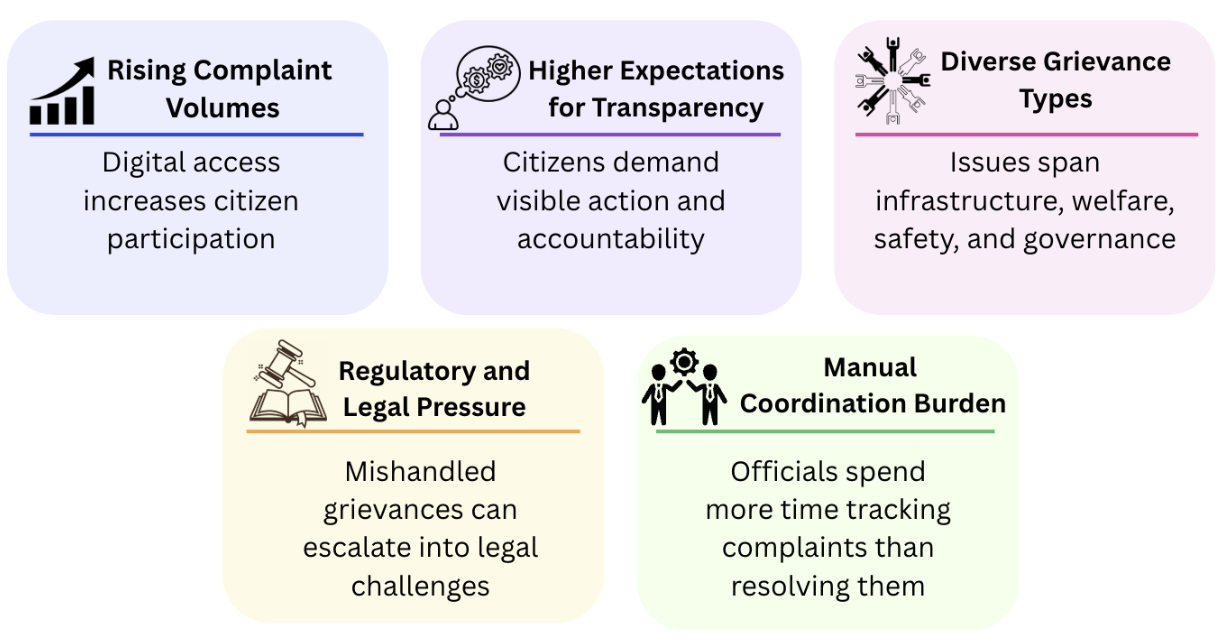
For example:
- In India, centralized public grievance portals receive lakhs of complaints annually, requiring multi-department coordination.
- In the UK, local councils report that complaint handling delays directly impact public trust ratings.
- In the US, unresolved civic complaints often escalate into public hearings or legal review.
The pattern is consistent globally governments have data.
What they lack is structured grievance intelligence.
Key Challenges Without AI in Grievance Redressal
Frequent issues arise when government agencies only use manual or rule-based grievance procedures:
- Generic responses that make citizens feel unheard
- Inconsistent outcomes across departments
- Delayed escalation of sensitive cases
- Limited insight into recurring systemic issues
- Higher risk of political, media, or legal backlash
In 2020, several municipal bodies globally faced criticism not because complaints were unregistered, but because patterns of repeated infrastructure failures were not detected early.
The issue was not speed. It was the absence of pattern intelligence.
How AI Transforms Citizen Grievance Redressal
AI-driven complaint management replaces intelligent decision-making for immediate processing. AI does more than just record complaints; it identifies patterns, sorts cases, recognizes context, detects urgency, and suggests actions that enhance resolution results.
AI-enabled systems question, “What does this citizen need, how urgent is the issue, what department should act, and how do we guarantee a fair resolution?” compared to, “How do we record this complaint?”
This change makes it possible for:
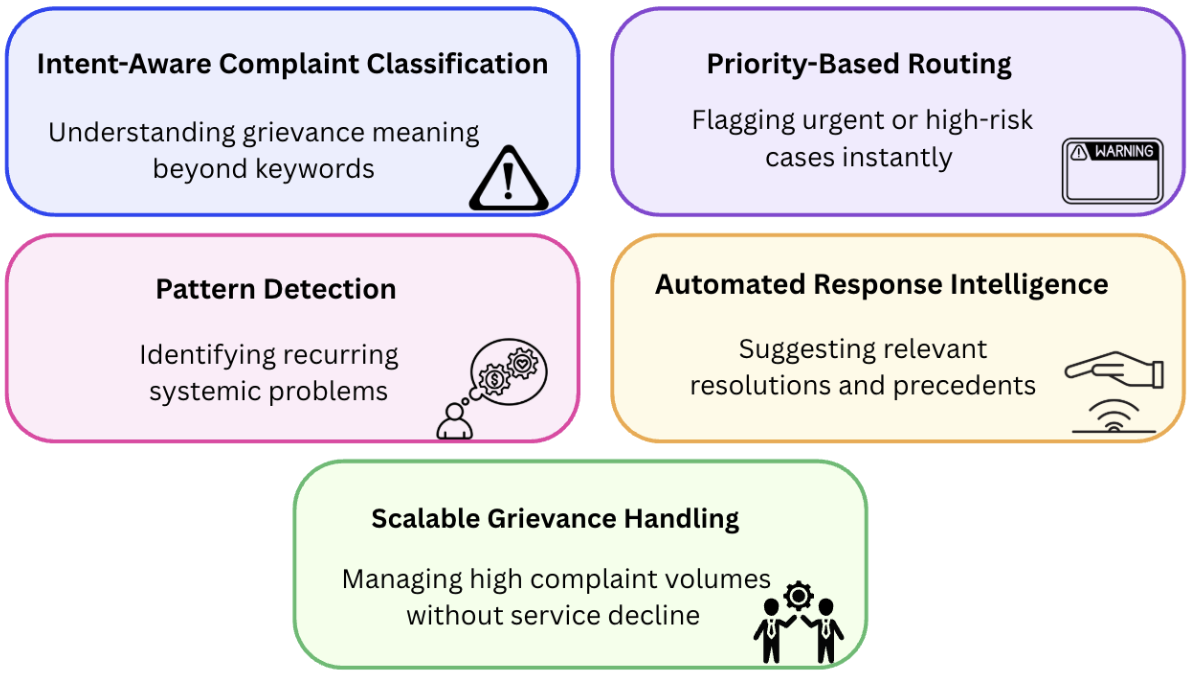
This shift matters. Governments move from responding faster to responding smarter.
Why AI Matters More Than Ever
Public institutions face growing complexity:
- More citizens
- More data
- More scrutiny
- Higher expectations
Manual systems cannot scale accordingly. AI does more than improve speed. It strengthens:
- Accountability through audit trails
- Transparency through traceable decisions
- Consistency through standardized interpretation
- Fairness through priority-based resolution
When responsibly implemented, AI reduces administrative burden and improves governance quality.
Grievances are not just service tickets, they signal systemic gaps.
How AI Works in Citizen Grievance Workflows
A modern AI-powered grievance system operates as a continuous intelligence-driven process:
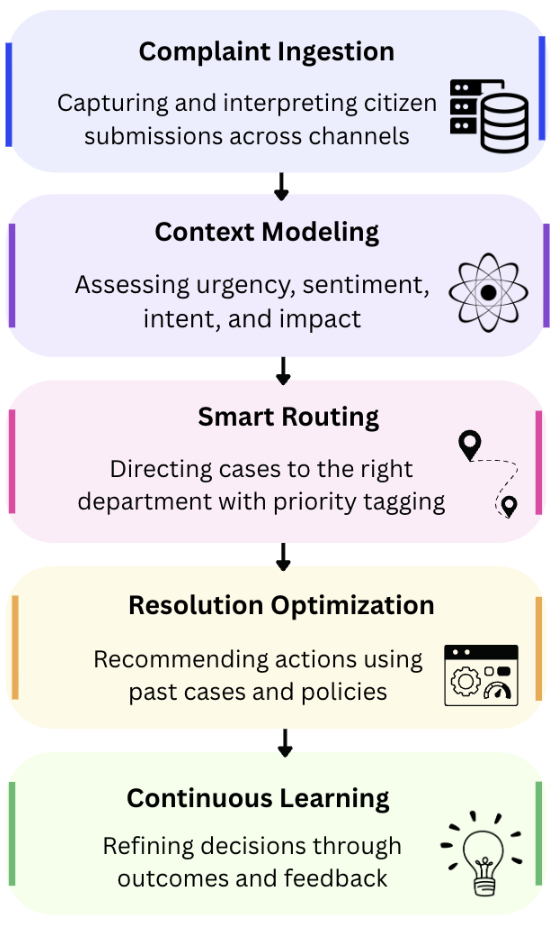
AI is not just a tracking tool. It understands. It prioritizes. It learns.
Looking Ahead: Building Governance Intelligence, Not Pilot Projects
In several countries, grievances are now handled using centralized grievance portals that use standard digital interfaces across departments and ministries. Despite improvements in intake, departmental escalation and manual coordination are frequently required for resolution, revealing structural gaps between digitization and decision intelligence.
Alignment of quality is not guaranteed by technology alone, though. Institutions must switch from pilot-led automation to intelligence-driven governance systems designed for operational scale as the number of complaints rises and public accountability increases.
Grievance ecosystems that are stable rely on:
- Institutional supervision of decisions influenced by AI
- Transparent audit trails to allow automated routing
- Alignment between policy frameworks and AI recommendations
- Coordination among departments as compared to segmented workflows
- Continuous monitoring of fairness, bias, and settling outcomes
Organizational responsiveness and system durability, rather than filing speed, will decide the long-term course of complaint management.
A general rule holds true for larger public sector AI projects. AI systems that work well need to be:
- Integrated into core decision-making procedures
- From the beginning, according to with the principles of governance
- Reasonable and prepared for an audit
- Created with compatibility in mind
- Designed to grow in secure settings
An individual service deal is not what a grievance is. They serve as indicators of the effectiveness of governance. Grievance handling moves from administrative processing to an educated institutional response when intelligence is physically integrated with coordination, transparency, and continuity.
Operational visibility is improved by speed. The ability to govern is strengthened by intelligence.
In the public sector, sustainable progress is measured not by digital adoption alone, but by the long-term resilience of decision systems.
Real-World Parallels: AI in Action Across Public Systems
While grievance redressal is one domain, the intelligence layer required is similar across governance. For example:
- AI in RFP Evaluation: When analyzing complicated documents, evaluation committees use AI to analyze terms, verify accuracy, and identify mistakes, thus minimizing supervision and guaranteeing choices that can be justified.
- AI in Audit Automation:AI collects data, performs checks for compliance, and highlights high-risk errors in place of a human auditor of vouchers stuck in PDFs.
- AI for Public Information Access:People can ask simple questions and get correct reports based on policy texts and distributed notices.
- AI in Urban Governance (Civic Eye):Video streams are now searchable and queryable intelligence for quicker, more informed action rather than passive recordings.
The change is not identical in every case. It is large-scale contextual awareness.
The same change is necessary for grievance relief.