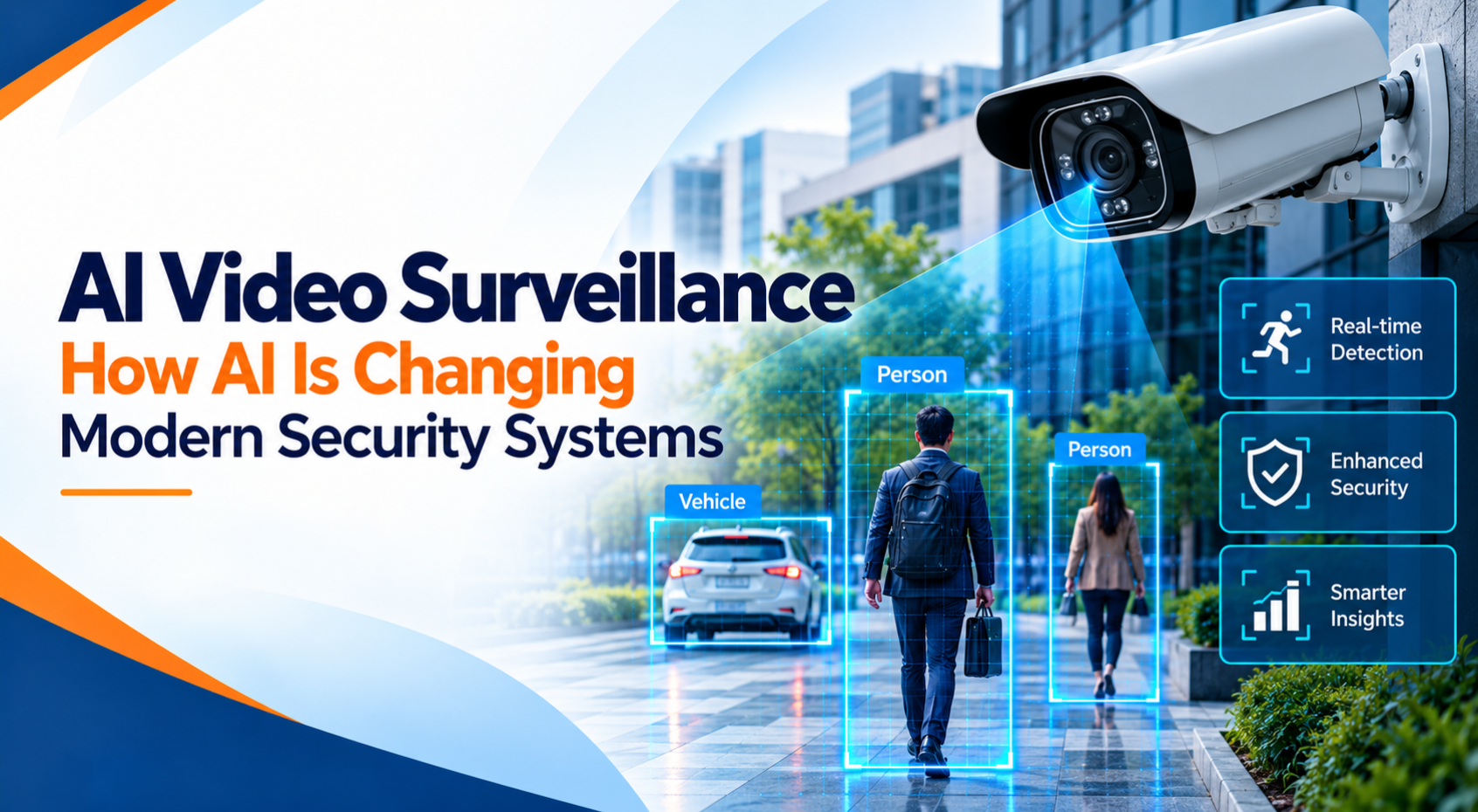
AI video analytics for smart cities uses artificial intelligence and computer vision to analyse live camera feeds, detect specific urban events, and provide alerts to the people responsible for public safety and city operations.
Unlike traditional CCTV, which mainly records video for later review, AI video analytics can identify events as they happen. This can include traffic violations, road conditions, crowd activity, violence, stray animals, and unauthorized street activity.
For city authorities, the main value is simple: cameras can do more than record. They can help identify what is happening and bring important incidents to the attention of the right teams faster.
What Is AI Video Analytics for Smart Cities?
AI video analytics is a technology that uses computer vision models to analyse video from surveillance cameras.
The system can be configured to look for particular objects, activities, or conditions. When the system detects an event that matches a configured use case, it can generate an alert or report for the relevant authority.
For example, cameras installed on city roads can be used to monitor traffic safety. Cameras in public areas can help monitor crowds or suspicious activity. Cameras covering roads and other urban spaces can also help identify road conditions or stray animals.
The important difference is that the system is not simply storing footage.
It is analysing the footage and turning video into useful information.
This makes AI video analytics an important technology for smart city surveillance, public safety, traffic management, and urban operations.
Why Do Smart Cities Need AI Video Analytics?
Cities already have large networks of surveillance cameras.
The problem is that having more cameras does not automatically mean having better visibility.
A control room may receive video from hundreds or thousands of cameras. Human operators cannot continuously watch every feed with the same level of attention.
An incident can happen in seconds.
A traffic violation may occur between two manual observations. A crowd may grow quickly. An animal may enter a road. A road hazard may remain unnoticed until someone reports it.
AI video analytics addresses this gap by continuously analysing configured camera feeds.
It can help authorities:
- Detect specific incidents in real time
- Reduce dependence on constant manual monitoring
- Send alerts when defined events occur
- Improve incident response
- Monitor large areas more consistently
- Identify recurring urban problems
- Give officials better information for decision making
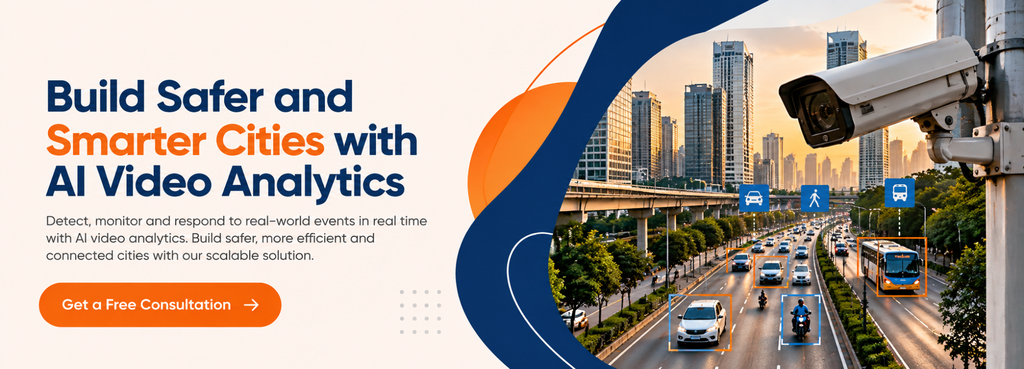
CivicEye is designed around this approach, using AI powered cameras and real time video intelligence to detect urban incidents, identify potential risks, and alert the appropriate authorities.
How Does AI Video Analytics Work?
The process is easier to understand when broken into a few practical steps.
1. Video Is Captured
Existing or deployed surveillance cameras capture video from roads, intersections, public spaces, and other monitored areas.
2. AI Analyses the Video
Computer vision models process the camera feed and look for the objects, activities, or conditions relevant to the deployment.
The system does not need to treat every frame as a separate manual review. AI models continuously analyse the incoming video based on their configured detection capabilities.
3. An Event Is Detected
When the system identifies an event that matches a configured rule, it can classify the event.
For example, a deployment may be configured to identify a traffic violation, crowd activity, road issue, stray animal, or unauthorized activity.
4. An Alert Is Generated
The detected event can be reported to a control centre or authorised official.
CivicEye supports real time reporting for incidents such as road hazards, unauthorized street vendors, and suspicious activities.
5. Authorities Take Action
The final decision and response remain with the responsible authority.
AI provides information and alerts. City teams can then assess the situation and follow the appropriate response process.
This distinction is important.
AI video analytics supports public safety teams. It does not replace the people responsible for making operational decisions.
Key Features of AI Video Analytics for Smart Cities
A smart city video analytics platform can provide several capabilities depending on the city’s requirements.
Real Time Monitoring
AI can continuously analyse video from roads, public spaces, and other urban locations.
This gives city authorities a more consistent view of monitored areas without requiring an operator to manually watch every camera feed.
CivicEye provides real time monitoring across urban environments as one of its core capabilities.
Automated Incident Detection
Instead of waiting for an operator to notice an event, AI can identify configured incidents automatically.
This is useful for repetitive monitoring tasks where specific conditions need to be detected across a large camera network.
Real Time Alerts
An AI system becomes much more useful when detection is connected to an alert mechanism.
When an event is detected, the relevant information can be sent to a control centre or authorised personnel.
This helps reduce the gap between an incident happening and the authority becoming aware of it.
Mobile Access
Urban incidents do not always happen when officials are sitting inside a control room.
CivicEye supports mobile notifications so that relevant updates can reach officials on their mobile devices.
This can help field teams stay informed while moving between locations.
Predictive Insights
Video analytics can also help authorities identify recurring issues and patterns.
For example, repeated incidents in a particular area may indicate a need for additional monitoring, enforcement, infrastructure work, or other intervention.
CivicEye includes predictive insights as part of its platform capabilities.
Scalable Design
Every city has different requirements.
A platform may need to support a small number of critical locations initially and expand as the city’s monitoring needs increase.
CivicEye is designed to support different urban monitoring requirements across roads, public spaces, and other critical areas.
Comprehensive Urban Monitoring
Smart city surveillance is not limited to traffic.
A broader AI video analytics system can support road safety, public safety, road condition monitoring, crowd monitoring, stray animal detection, and unauthorized street activity.
This makes the same technology relevant across multiple city operations.
AI Video Analytics Use Cases for Smart Cities
The real value of AI video analytics becomes clearer when we look at practical applications.
1. Traffic Violation Detection
Traffic safety is one of the most important applications of AI video analytics.
City authorities can use computer vision to monitor specific traffic violations without relying entirely on manual observation.
Depending on the configured system, this can include:
- Helmet violations
- Seat belt violations
- Triple riding
- Other defined road safety violations
CivicEye specifically supports road safety monitoring and uses AI and computer vision to help authorities identify traffic related issues.
The objective is not simply to generate more violations.
The objective is to give traffic and public safety teams better visibility into what is happening on city roads.
2. Crime and Violence Detection
Public spaces can experience incidents that require immediate attention.
Manually monitoring every camera for signs of violence is difficult at city scale.
AI video analytics can be configured to identify defined indicators of crime or violent activity and bring relevant events to the attention of authorities.
CivicEye includes crime and violence detection among its public safety use cases.
The detected event can then be reviewed by the responsible team before further action is taken.
3. Road Condition Monitoring
Road problems can affect traffic movement and public safety.
Potholes, damaged road sections, or other visible road conditions may need attention from municipal teams.
AI video analytics can help identify relevant road conditions from camera feeds and provide information to the teams responsible for road management.
CivicEye includes road condition monitoring as part of its urban management capabilities.
This can help cities move from relying only on public complaints toward a more continuous monitoring approach.
4. Crowd Monitoring
Crowds can form around markets, public events, transport areas, intersections, or other busy locations.
Large or unexpected crowds can create operational and safety challenges.
AI video analytics can help authorities monitor crowd activity across selected locations and identify situations that may require attention.
The benefit is particularly relevant when a city has many public areas that cannot be watched manually at all times.
5. Stray Animal Detection
Stray animals on busy roads can create safety risks for drivers, pedestrians, and the animals themselves.
AI based video monitoring can detect animals appearing in monitored areas and generate alerts for the relevant teams.
CivicEye includes stray animal detection as one of its urban monitoring use cases.
This can be useful for cities where stray animals frequently enter roads or other high traffic areas.
6. Unauthorized Street Activity
Urban authorities also need to manage activities that affect public spaces and road usage.
AI video analytics can help identify configured forms of unauthorized street activity and report them to the appropriate teams.
CivicEye can provide real time reporting for issues such as unauthorized street vendors and suspicious activities.
This gives authorities another way to monitor public spaces without depending entirely on manual patrols.
AI Video Analytics vs Traditional CCTV
Traditional CCTV and AI video analytics are not the same thing.
Traditional CCTV is primarily focused on capturing and storing video.
AI video analytics adds an intelligence layer to that video.
| Traditional CCTV | AI Video Analytics |
|---|---|
| Records camera footage | Analyses camera footage |
| Mainly used for monitoring and investigation | Used for detection, monitoring and alerts |
| Requires operators to watch feeds | AI can continuously analyse configured feeds |
| Incidents may be found during manual review | Defined incidents can trigger alerts |
| Useful for reviewing what happened | Useful for identifying what is happening |
| Limited by human monitoring capacity | Can analyse multiple configured feeds continuously |
This does not mean traditional CCTV has become unnecessary.
Recorded footage remains useful for investigations, verification, and evidence.
AI video analytics adds another capability by helping authorities identify relevant events sooner.
What Can AI Video Analytics Detect?
There is no single list that applies to every AI video analytics platform.
Detection depends on the AI models available, camera placement, video quality, deployment environment, and the specific requirements of the city.
For CivicEye, the documented use cases include:
- Traffic violations
- Road safety issues
- Crime and violence
- Road conditions
- Crowd activity
- Stray animals
- Unauthorized street activity
- Suspicious activities
This is important when evaluating an AI video analytics platform.
Cities should start with their actual operational problems and then select the detection capabilities needed to address them.
How AI Video Analytics Improves Urban Public Safety
Public safety depends heavily on how quickly authorities can become aware of an incident.
Consider a simple example.
A problem occurs on a city road.
With traditional monitoring, an operator may need to notice it manually, understand what happened, communicate the information, and then wait for the responsible team to respond.
With AI video analytics, a configured detection model can identify the event and generate an alert.
The responsible authority still decides what action to take, but the information reaches the team faster.
This creates a more structured public safety workflow:
Detection, reporting, notification, assessment, response.
CivicEye is built around this connection between detection, reporting, and mobile notification.
Benefits of AI Video Analytics for Smart Cities
Faster Incident Response
Real time detection and alerts can help authorities become aware of incidents sooner.
CivicEye is designed to send alerts to control centres and provide mobile updates to authorised officials.
Reduced Manual Monitoring
AI can continuously analyse configured camera feeds.
This reduces the need for operators to manually watch every feed at all times.
Human teams can instead focus more of their attention on incidents that require review or action.
Better Public Safety Visibility
A city can have cameras across roads, public spaces, and other important locations.
AI video analytics can turn those camera feeds into a more structured source of incident information.
Better Decision Making
Authorities can make decisions with access to current incident information rather than relying only on delayed reports or manual observation.
Proactive Urban Management
Repeated incidents can reveal patterns.
If certain issues happen repeatedly in a particular area, city authorities can use that information to consider longer term measures.
Centralized Monitoring
A centralized platform can bring information from multiple monitored areas into one operational environment.
This is particularly useful for city control rooms that need visibility across different locations.
CivicEye is designed to provide centralized visibility into urban incidents while supporting mobile access for officials.
AI Video Analytics for Government and Municipal Authorities
AI video analytics has applications beyond conventional surveillance.
Government and municipal organizations can use it as part of broader urban management systems.
Potential users include:
- Municipal corporations
- Smart city authorities
- Government agencies
- Traffic management teams
- Public safety departments
- Police and law enforcement teams
- City control rooms
- Urban operations teams
The specific implementation depends on the city’s infrastructure, operating procedures, camera network, and monitoring priorities.
Why Existing CCTV Infrastructure Matters
Many cities have already invested heavily in CCTV infrastructure.
Replacing every camera to introduce AI can make an AI video analytics project more expensive and difficult to deploy.
A practical approach is to assess the existing camera network first.
The key questions include:
- What cameras are already installed?
- Where are they located?
- What video feeds are available?
- Which locations require AI monitoring?
- What events need to be detected?
- Where should alerts be sent?
- Which teams are responsible for responding?
This approach helps connect AI capabilities with actual city operations instead of treating AI as a standalone technology purchase.
CivicEye: AI Video Analytics for Smart Cities
CivicEye by Valiance Solutions is an AI powered public safety and urban management platform designed to help city authorities detect incidents, receive alerts, and respond to urban challenges.
The platform uses AI powered cameras and real time video intelligence to identify potential risks across urban environments. Its documented capabilities include incident detection, instant reporting, and mobile notifications.
CivicEye supports several urban use cases:
Road Safety Monitoring
AI based monitoring can help identify defined traffic violations such as helmet, seat belt, and triple riding violations.
Crime and Violence Detection
The platform supports monitoring for crime and violence related events.
Road Condition Monitoring
CivicEye can help monitor road conditions and identify relevant issues visible through camera feeds.
Crowd Monitoring
The platform can support monitoring of crowd activity in public areas.
Stray Animal Detection
AI can help identify stray animals appearing in monitored urban areas.
Unauthorized Street Activity
The platform can report configured activities such as unauthorized street vendors and suspicious activities.
How CivicEye Works
The CivicEye operating model can be understood through three core functions.
Incident Detection
AI powered cameras monitor urban environments and identify defined incidents such as road conditions, stray animals, and crowd activity.
Instant Reporting
Detected incidents can be reported to control centres in real time.
Mobile Notifications
Relevant updates can be sent to authorised officials through mobile devices, helping field teams stay informed when they are away from the control room.
This creates a practical link between city surveillance infrastructure and the teams responsible for urban response.
How to Choose an AI Video Analytics Platform for a Smart City
Selecting an AI video analytics platform should start with the city’s operational requirements.
1. Define the Problems First
Identify the issues the city wants to monitor.
For one city, traffic safety may be the priority.
For another, it may be crowd monitoring, road conditions, public safety, or unauthorized street activity.
2. Check Detection Capabilities
Make sure the platform supports the specific detection models required for the project.
3. Evaluate Camera Integration
Review whether the platform can work with the city’s existing surveillance infrastructure.
4. Check Alert Mechanisms
An AI system should provide a clear way to communicate detected incidents to the responsible teams.
5. Consider Mobile Access
Field officials may need incident information while away from the control centre.
6. Evaluate Scalability
The platform should be able to support additional locations and use cases as the city’s requirements grow.
7. Review Reporting and Insights
Detection is only one part of the system.
Reporting and analytics can help authorities understand recurring problems and support better urban planning.
8. Consider Human Oversight
AI detection should fit into existing government workflows.
Authorities should have appropriate processes for reviewing alerts, validating incidents where required, and deciding the response.
What Is the Future of AI Video Analytics in Smart Cities?
The role of city surveillance is moving beyond passive recording.
As AI and computer vision become more capable, camera networks can support a wider range of urban operations.
The long term value is not simply having more cameras.
It is being able to turn existing visual data into useful operational information.
A city can use that information to understand where incidents happen, how frequently they occur, which locations require more attention, and where preventive measures may be useful.
This makes AI video analytics relevant not only to surveillance teams, but also to traffic management, municipal operations, public safety, and city planning.
Conclusion
AI video analytics is changing how cities can use their surveillance infrastructure.
Traditional CCTV gives authorities a record of what happened. AI video analytics can add another layer by helping identify specific events as they happen and bringing those events to the attention of the right teams.
Traffic violations, road conditions, crowd activity, violence, stray animals, and unauthorized street activity are examples of urban problems that can be monitored through AI powered video intelligence.
The technology is most useful when it is connected to a real operational process. Detection needs to lead to reporting. Reporting needs to reach the right people. Those people then assess the situation and take the appropriate action.
CivicEye by Valiance Solutions brings AI, computer vision, real time monitoring, incident detection, reporting, and mobile notifications together for public safety and urban management.
Valiance Solutions is a leading AI solutions company working on practical applications of artificial intelligence and computer vision for government, public safety, and enterprise environments.
Frequently Asked Questions
AI video analytics for smart cities uses artificial intelligence and computer vision to analyse surveillance camera feeds and detect defined urban events such as traffic violations, road issues, crowd activity, violence, stray animals, and unauthorized street activity.
Traditional CCTV primarily captures and stores video. AI video analytics analyses that video and can detect configured events and generate alerts, helping authorities identify important incidents faster.
Depending on the platform and deployed models, AI video analytics can detect traffic violations, road conditions, crowd activity, violence, stray animals, unauthorized street activity, and other defined events.
This depends on the camera infrastructure, available video feeds, and the AI platform being deployed. CivicEye is designed to integrate with existing urban surveillance infrastructure across roads, public spaces, and other critical areas.
No. AI can automate monitoring and alert generation, but authorised personnel remain responsible for reviewing information and deciding what action should be taken.
Municipal corporations, smart city authorities, government agencies, traffic teams, public safety departments, police, city control rooms, and urban management teams can use AI video analytics for suitable monitoring requirements.
Yes. AI video analytics platforms can be configured to generate alerts when defined events are detected. CivicEye supports real time reporting to control centres and mobile notifications for authorised officials.