
We live in an era where AI feels everywhere
Artificial intelligence has progressed swiftly in recent times.
If we pause to observe our surroundings, it becomes evident that AI is intricately integrated into our everyday existence. It can be quite remarkable how chatbots are prepared with responses even before we complete our questions, and how models can read and summarize documents in the blink of an eye. Automation is promising a future where work gets done at light speed. The numbers reflect this reality
The global AI market soared past USD 196 billion in 2023, and it seems like every organization is scrambling to inject a bit of intelligence into everything they do.
But once AI moves beyond controlled environments and into real operation a critical question begins with most teams that
What happens when an AI system needs to make multiple decisions at the same time across teams, tools, and constantly changing conditions?
This is where the limits of single-model intelligence begin to show
Introducing Agentic AI and Multi-Agent Systems: Where Intelligence Learns to Act Together
Artificial intelligence has long aided in our understanding of the world by producing insights, forecasting results, and evaluating data giving us a world where it goes beyond simply responding to your command and we have witnessed the transformative power of traditional AI and the creative power of generative AI.
Now a new wave of intelligence is growing, giving AI systems greater decision-making capabilities. That is Agentic AI, the next major leap in artificial intelligence, to redefine the way we interact with technology and do business across multiple industries. In fact, Gartner predicts that a remarkable 33% of enterprise software applications will include agent-based AI by 2028, a staggering increase from less than 1% in 2024
Also , Agentic AI will autonomously make at least 15% of day-to-day work decisions, signifying a fundamental shift in how work gets done. Furthermore, the economic implications are substantial, with Gartner predicting a 25% reduction in customer service costs
So, what is Agentic AI exactly? An artificial intelligence system that is capable of planning, making decisions, and taking action toward a goal as opposed to only producing outputs are referred to as agentic AI
It represents a paradigm shift from reactive and generative models to intelligent systems that can perceive their environment, reason about complex tasks, make independent decisions, and execute those decisions with minimal human oversight
But once intelligence begins to act on its own, one truth becomes unavoidable: no decision exists in isolation and that’s exactly where traditional AI start to break
Key Features of Agentic AI:
- Autonomy: Operates without constant human oversight.
- Goal-Orientation: Works towards achieving defined objectives.
- Context-Awareness: Adapts to changes in the environment or task requirements.
- Interactivity: Communicates with humans and other systems seamlessly.
Why Traditional AI Systems Fall Short
Despite advances in machine learning and analytics, most AI systems today remain structurally
limited:
- Static by design: Conventional AI is dependent on set rules and historical data, which causes it to malfunction when circumstances suddenly change.
- Ownership-less insight: It can forecast results but is unable to make decisions or take action on its own.
- Human-dependent execution: AI becomes a coordination burden rather than a force multiplier due to ongoing manual oversight.
- Context-blind intelligence: This type of intelligence suffers with complexity, nuance, and uncertainty because it lacks situational awareness.
- Siloed at scale: Conventional AI cannot coordinate choices across linked enterprise systems when it operates independently.
These architectural flaws don’t remain theoretical as complexity rises; they are evident in the day-to-day operations of contemporary organizations.
Current challenges and limitations of agentic AI
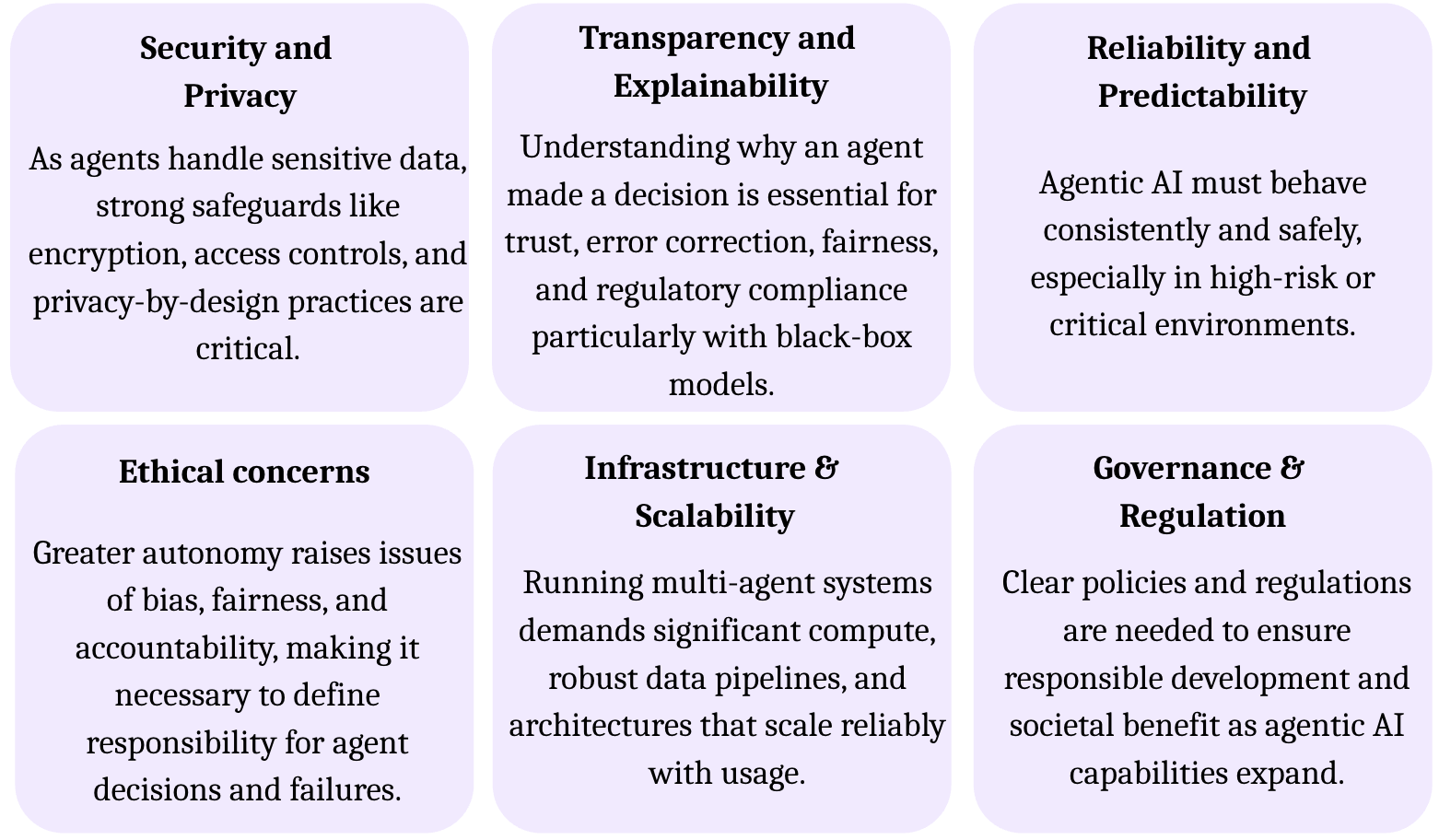
Instead of creating more ways to see problems or be notified about them, we need smarter systems that can automatically solve the problems on their own shifting from human monitoring to automated intelligent problem-solving
How Agentic AI Changes the Game
Agentic AI introduces intelligence that can decide, act, and adapt continuously.
- Autonomous – Agentic AI makes decisions with minimal human guidance. It assesses events and acts without constant oversight, allowing humans to concentrate on higher-level tasks.
- Action-oriented –Agentic AI acts like a smart, proactive employee that figures things out and takes action on its own to reach a goal, instead of just waiting for instructions
- Aspirational – Agentic AI is AI that acts like a smart assistant: you give it a big goal, and it figures out the steps, plans them, and executes them on its own to get it done, learning as it goes, instead of just following simple commands
- Adaptable –Agentic AI is smart software that learns from its own actions and new information, letting it figure things out and get better at tasks on its own, without needing constant human help, much like how you learn from mistakes to improve at a game.
- Agency –It has permission to view and use all relevant information and datasets. It can control and allocate the tools and resources it needs to perform tasks and take action to make impactful decisions on its own (like scheduling, managing data, etc) rather than needing human approval for every step
To understand why this shift is so powerful, it helps to see how an Agentic AI system actually operates in practice.
How an Agentic AI System Works
Agentic AI tools can take many forms and different frameworks are better suited to different problems, but here are the general steps that agentic systems take to perform their operations.
- Perception: Agentic AI begins by gathering information from its surroundings via sensors, APIs, databases, or user interactions. This stage guarantees that the system has up-to-date data to analyze and act on
- Reasoning: Once the data is collected, the AI processes it to extract useful information. It reads user queries, finds patterns, and understands the larger context by utilizing natural language processing (NLP), computer vision, and other AI capabilities. This skill assists the AI in determining which actions to take based on the situation.
- Goal setting: The AI creates objectives based on established goals or user input. It then devises a strategy to attain these objectives, frequently employing decision trees, reinforcement learning, and other planning methods.
- Decision-making: AI makes decisions by evaluating several options and selecting the best one based on efficiency, accuracy, and expected results. The optimum path of action may be determined using probabilistic models, utility functions, or machine learning-based reasoning.
- Execution: After choosing an action, the AI carries it out, either by engaging with external systems (APIs, data, robots) or by responding to humans.
- Learning and adaptation: After performing an action, the AI examines the results and collects input to enhance future decisions. The AI refines its techniques over time using reinforcement learning or self-supervised learning, making it more effective in future challenges.
- Orchestration: AI orchestration involves the coordination and administration of systems and agents. Orchestration solutions automate AI workflows by tracking job progress, managing resource utilization, monitoring data flow and memory, and handling failure situations. With the correct architecture, dozens, hundreds, or even thousands of agents might hypothetically collaborate to achieve high productivity.
When decisions flow so smoothly from idea to action, the impact is measurable rather than theoretical.
Why Smarter, Agentic Intelligence Matters

The underlying challenge is how enterprises can adopt Agentic AI securely, at scale, and with trust.
Benefits of Agentic AI
- Efficiency & productivity: Automates multi-step, repetitive workflows. McKinsey estimates GenAI could automate 60–70% of tasks in some roles, operating 24/7 without fatigue.
- Personalization at scale: Context-aware agents adapt interactions in real time, enabling dynamic recommendations beyond rule-based systems.
- Scalability & adaptability: Agents scale horizontally, handling thousands of parallel tasks without proportional increases in headcount.
- Data-driven insights: Decision logs reveal how and why actions were taken, enabling deeper analysis and transparency.
- Cost reduction: Automation lowers errors and operational costs, allowing humans to focus on higher-value work.
Looking Ahead: Future of Agentic AI at Valiance Solutions
Agentic AI is set to play a transformative role across industries. Its ability to automate, adapt, and collaboration will drive innovation in areas like autonomous robotics, intelligent IoT, and next-generation virtual assistants. By leveraging Agentic Patterns, developers can create systems that not only perform tasks but also learn, grow, and interact intelligently within their ecosystems.
At Valiance Solutions, we believe the future of enterprise intelligence lies in autonomous, collaborative decision systems.
Our Agentic AI frameworks enables:
- Goal-driven AI agents
- Cross-domain decision orchestration
- Real-time adaptive intelligence
- Seamless integration with existing platforms
- Continuous learning and explainability
Because in a complicated environment, intelligence that acts alone will fall behind while intelligence that collaborates will lead.
Key References
Bandi, A., Kongari, B., Naguru, R., Pasnoor, S., & Vilipala, S. V. (2025). The Rise of Agentic AI: A Review of Definitions, Frameworks, Architectures, Applications, Evaluation Metrics, and Challenges. Future Internet, 17(9), 404. https://doi.org/10.3390/fi17090404
Hosseini, S., & Seilani, H. (2025). The role of agentic AI in shaping a smart future: A systematic review. Array, 26, Article 100399. https://doi.org/10.1016/j.array.2025.100399
D. B. Acharya, K. Kuppan and B. Divya, “Agentic AI: Autonomous Intelligence for Complex Goals—A Comprehensive Survey,” in IEEE Access, vol. 13, pp. 18912-18936, 2025, doi: 10.1109/ACCESS.2025.3532853.
https://www.superannotate.com/blog/agentic-ai
https://doi.org/10.1016/j.array.2025.100399
https://insights.daffodilsw.com/blog/rise-of-multi-agent-ai-systems-what-you-need-to-know
https://hatchworks.com/blog/ai-agents/multi-agent-systems/
https://www.tredence.com/blog/enterprise-ai-agents-and-multiagentic-systems-with-google-cloud-from-concept-to-production
https://www.analyticsvidhya.com/blog/2024/11/agentic-ai-multi-agent-pattern/
https://lekha-bhan88.medium.com/introduction-to-agentic-ai-and-its-design-patterns-af8b7b3ef7
38