We live in an era where businesses are running quicker than ever before.
Emails are delivered in seconds, approvals occur in minutes, and decisions that used to take days are now finalized before the next meeting concludes.On the surface, everything appears to be functioning properly.
However, underneath this speed hides a fragile reality: modern businesses continue to rely heavily on human decision-making at every important intersection. When humans works under pressure, they experience tiredness, complexity, time restrictions, an imperfect management system, and a terrible social environment. Mistakes are an unavoidable condition.
The numbers tells a sobering story.
According to studies, human error causes 60–90% of operational failures across industries.
According to IBM reports the data says human error-related data breaches cost enterprises an average of USD 4.45 million per incident.
A single procedural error in manufacturing can cause production lines to shut down for hours. In finance, a missed approval or improper data entry can lead to compliance issues.
The question is no longer whether human mistake exists.
The question is: what is the true cost of human mistake in modern organizations and why does it persist?
Introduction: The Hidden Cost of Human Error
In recent years, incidents caused by human mistakes in the enterprise’s safe production have received increasing attention.
According to data from the state department of work safety, the national overall death rate by accident is depicted through a graph.
The results show that, while the number of accidents is decreasing year after year, the total number remains high. Accidents are often caused by people’s risky behavior and the unsafe state of items, which is ultimately driven by human causes.
Relevant data reveals that more than 80% of accidents are caused by human mistake.
Human Error
The causes of human mistake are complex, including the following main aspects: one’s own risky psychological actions, physiological and environmental conditions, inadequate safety training and management.
Human error is no longer about getting something wrong.
It is about being asked to manage complexity that exceeds human cognitive limits.
Types of Human Error in Enterprises
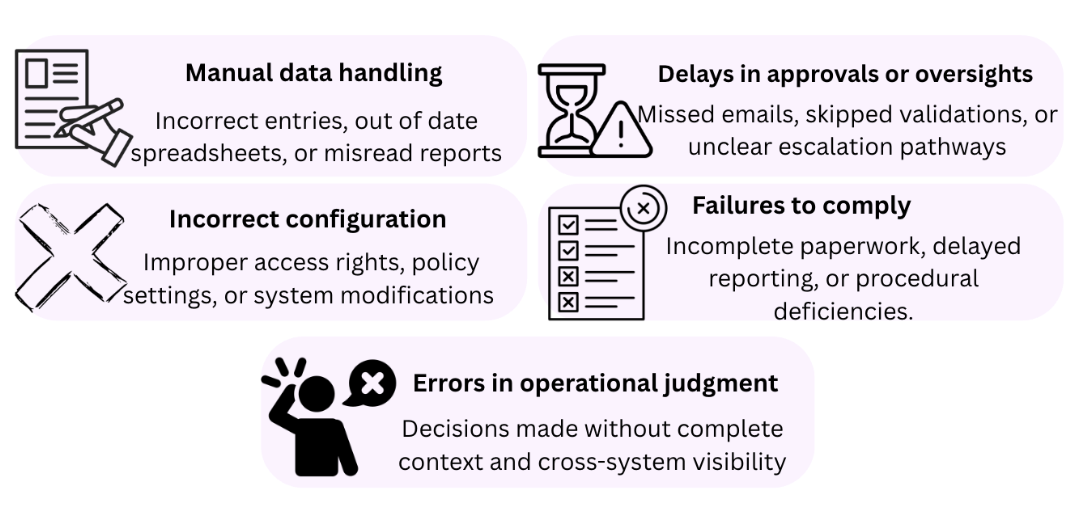
These errors do not occur as separate incidents. They spread through enterprise systems, increasing risk.
Why Traditional Enterprise Systems Fall Short
After years of spending in digitization, most enterprise systems remain limited in their ability to handle human error:
- Design-based rules: Traditional systems rely on static rules that fail when situations change.
- Insight without action: Dashboards indicate problems but require human intervention to fix them.
- Heavy manual oversight: Humans must constantly monitor warnings, validate outcomes, and coordinate replies.
- Context Blindness: Systems lack awareness of the downstream impact across functions.
- Silent Execution: Decisions are taken locally without enterprise wide alignment.
As complexity grows, these restrictions become less theoretical. They appear as rework, delays, compliance flaws, and operational friction.
Current situations in Enterprise Operations
Today’s enterprises operate in an environment defined by speed and scale:
- Large-scale decision overload:Employees manage too many tools, notifications, and approvals, increasing the chance of errors or quick decisions.
- Manual steps are still used to drive important workflows: Despite automation, approvals, validations, and handling of errors are still handled manually.
- Separated systems need humans to connect the dots: People operate as a link between different platforms, leaving the possibility for inconsistency and mistakes.
- Small errors grow quickly: A single mistake can have severe consequences for costs, timeliness, and safety.
- Speed demands weaken judgment: Faster processes offer little space for context, making errors an expected outcome rather than a strange one.
This is the current reality enterprises face high-speed operations, high decision volume, and high consequences managed through processes that still depend on manual oversight. And as complexity continues to grow, so does the cost of getting it wrong.
Challenges Enterprises Face Today
As organizations scale, the challenge is no longer eliminating mistakes, it is preventing them from multiplying.
Key challenges include:
- Scaling operation without causing error: As workflows expand, manual decision points multiply, making precision more difficult to maintain.
- Balancing speed with accuracy: Teams are expected to move fast while managing difficult, high-impact decisions.
- Fragmented visibility across systems: Multiple tools avoid a clear end-to-end view of operations.
- High dependence on individual judgment: Outcomes depend heavily on experience and attention rather than system intelligence.
- Reactive error management: Most issues are identified after damage is already done.
These challenges expose a fundamental limitation: humans are being asked to manage complexity that systems were meant to handle.
How AI Changes the Game
AI offers a new functional model, one that goes beyond monitoring to intelligent action. Rather of just alerting problems, AI-powered systems can:
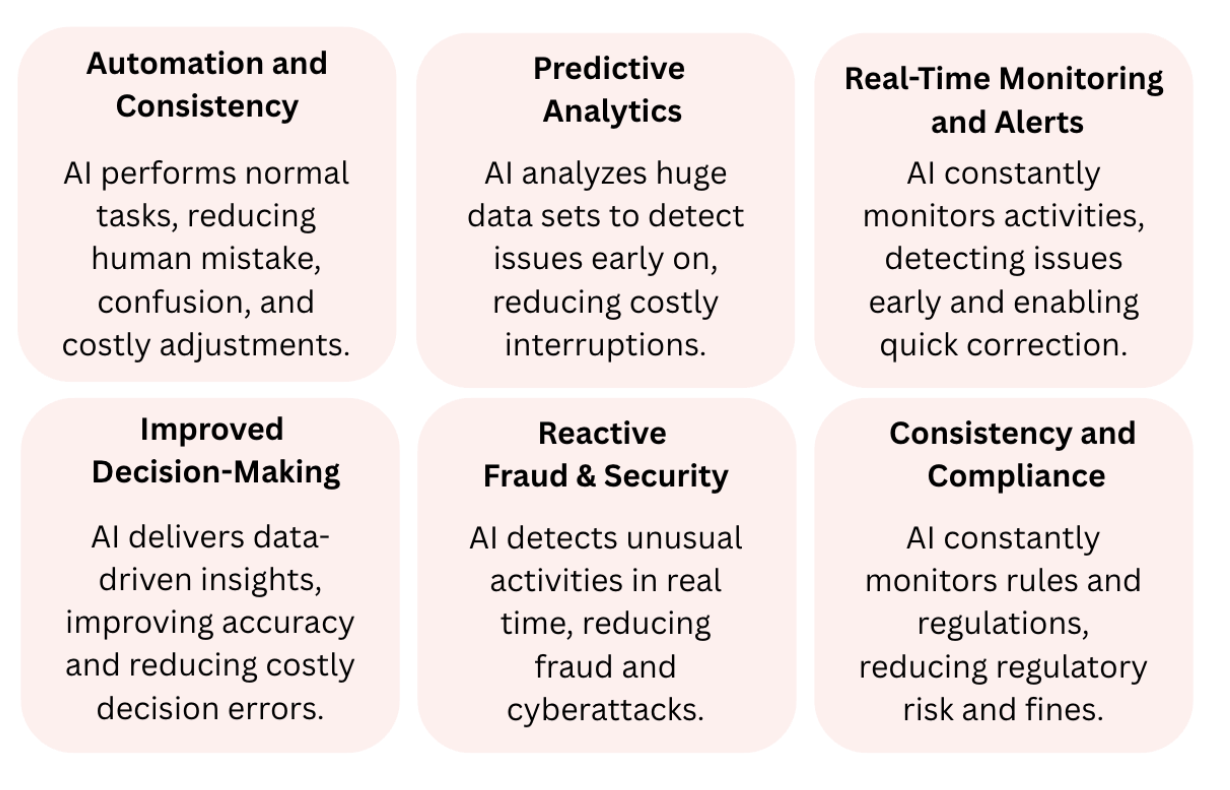
This shift reduces cognitive load on teams and transforms operations from reactive to resilient.
How AI Works in Enterprise Operations
AI-enabled operational systems typically follow a continuous cycle:
- Perception: Collecting information from machines, records, detectors, and user inputs.
- Reasoning: involves analyzing trends, dangers, and environmental relationships.
- Decision-making: Analyzing decisions in terms of impact, policy, and productivity
- Execution: Taking action using connected systems or activities.
- Learning: Making better decisions over time requires outcomes and feedback.
Rather than relying on humans to coordinate every step, AI systems orchestrate decisions at scale.
Why It Matters
Reducing human error is not about removing people from processes it is about placing human judgment where it adds the most value.
- Mistakes grow faster than teams as operations become larger and faster.
- People can’t keep up with the number of decisions that need to be made.
- Operational failures cost money, create compliance issues, and damage reputation.
- Tired employees make more mistakes over time.
- Smooth, reliable operations help businesses stay ahead in competitive markets.
In high-speed enterprise environments, reliability becomes a competitive advantage.
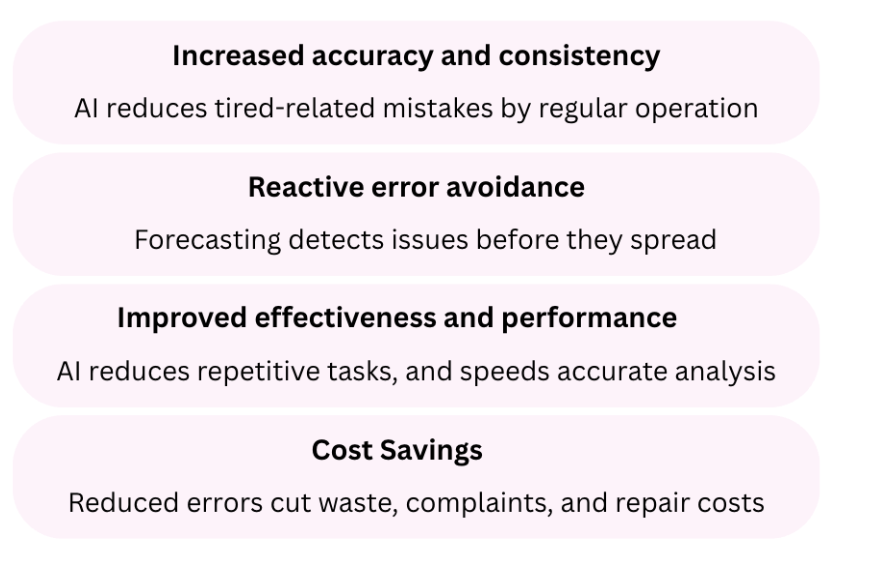
Benefits of Reducing Human Error with AI
Looking Ahead: Building Error-Resilient Enterprises
AI is about to change how companies control risk and expand effectively. Its ability to simplify, adapt, and learn will change how errors are prevented in difficult, high-speed systems. As decision rates increase, automated systems will move on from supporting processes to actively directing them.
Enterprises may use AI-driven operational intelligence to develop systems that not only perform tasks, but also forecast problems, modify themselves, and act reliably throughout workflow.
At Valiance Solutions we believe that intelligent, coordinated decision systems that prevent human mistakes on a large scale are the future of company operations.
Our AI frameworks enable:
- Relevant decision intelligence.
- Active risk and detection of anomalies.
- Multi-system functional management.
- Continuous, flexible executing
- Constant learning and transparency
Because in complex enterprise environments, systems that only report problems will fall behind while systems that anticipate, decide, and act together will lead.
References
Shi, W., Jiang, F., Zheng, Q., & Cui, J. (2011). Analysis and control of human error. Procedia Engineering, 26, 2126–2132. https://doi.org/10.1016/j.proeng.2011.11.2415
Liu, H., Hwang, S.-L., & Liu, T.-H. (2009). Economic assessment of human errors in manufacturing environment. Safety Science, 47(2), 170–182. https://doi.org/10.1016/j.ssci.2008.04.006
https://blog.charlesit.com/the-hidden-risk-in-your-organization-human-error
https://rewo.io/the-true-cost-of-downtime-from-human-error-in-manufacturing/
https://www.ocrolus.com/blog/empower-business-solving-for-the-cost-of-human-error/
https://books.google.co.in/books?