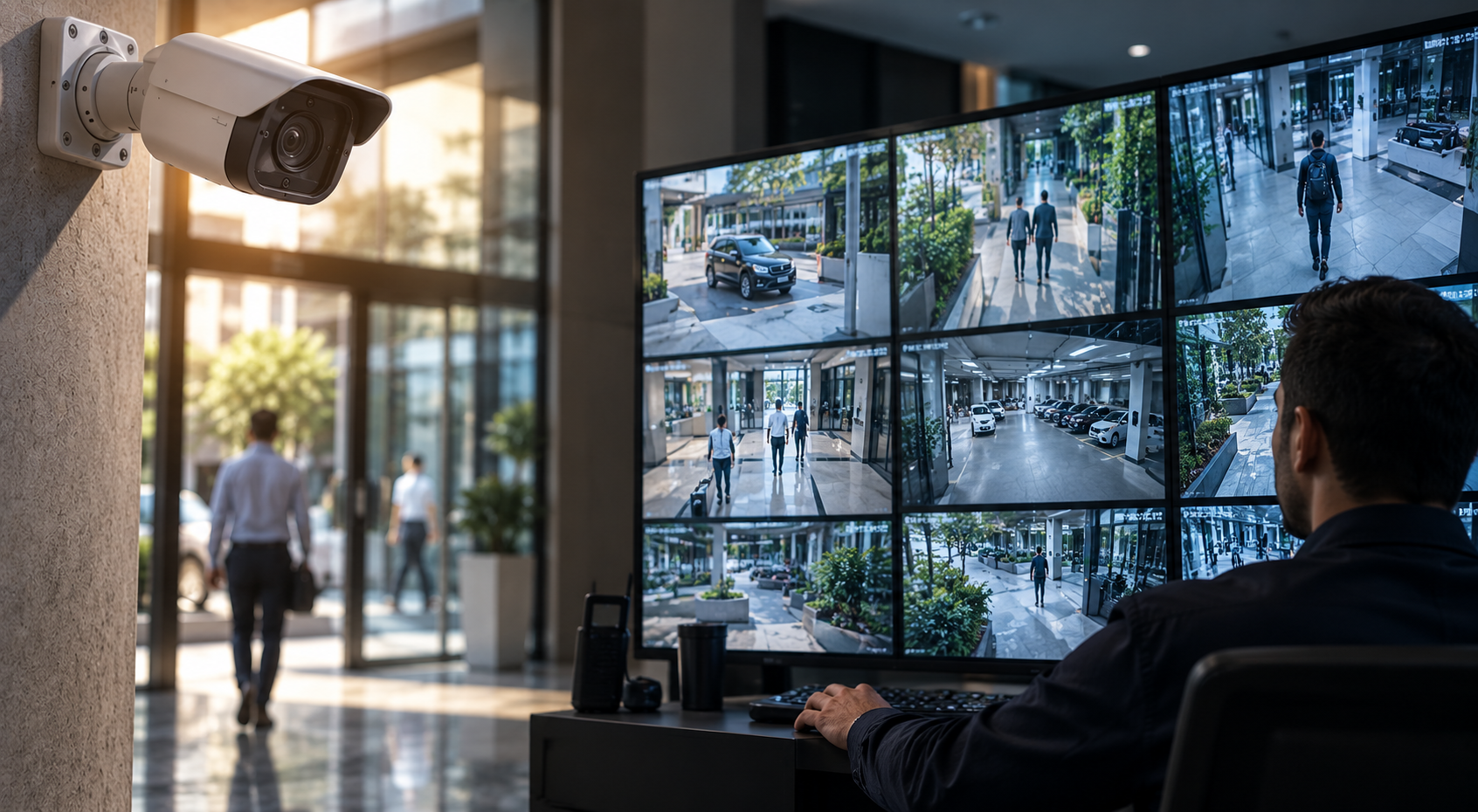
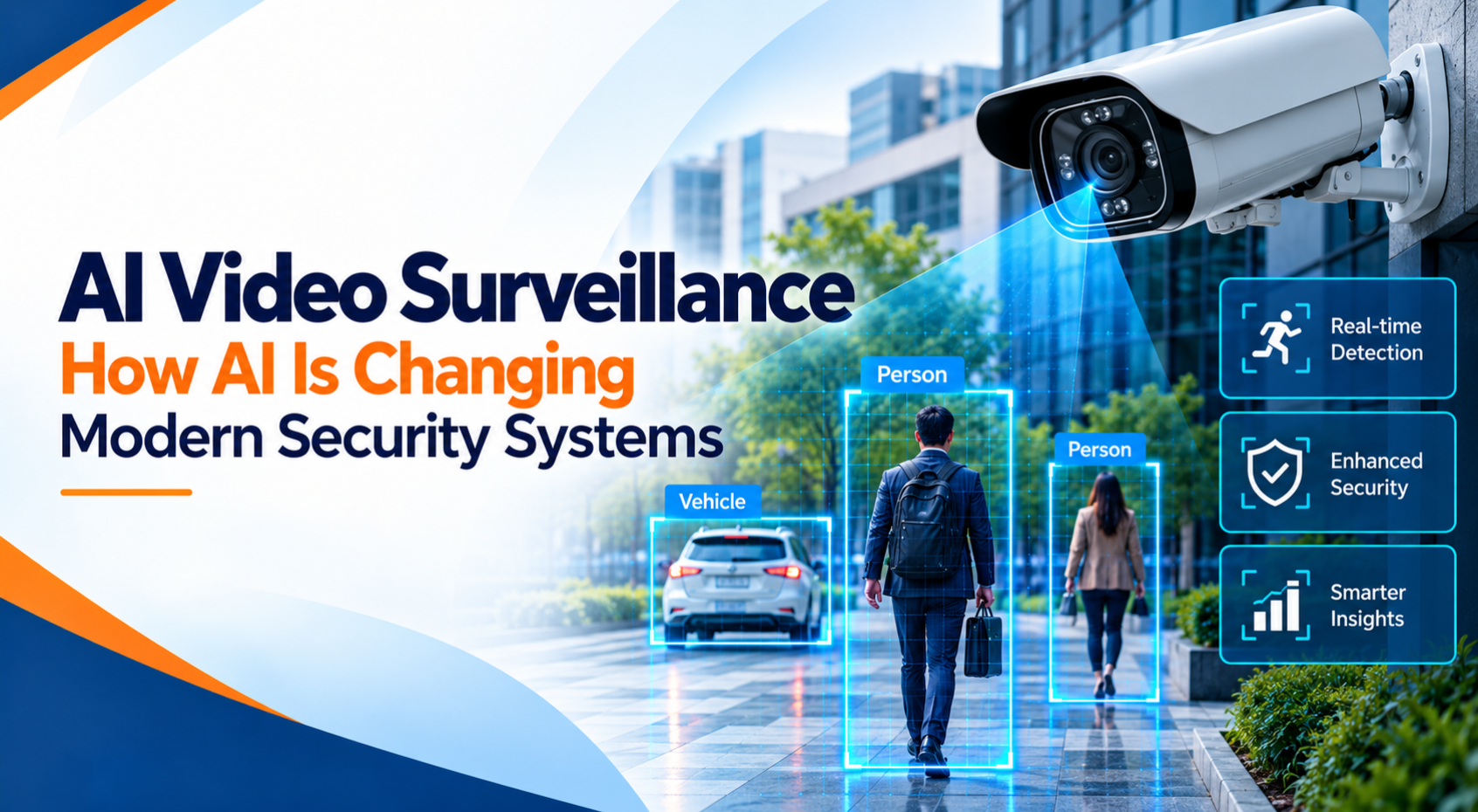
Traditional CCTV cameras record what happens. AI video surveillance goes one step further by analysing video feeds and identifying events as they happen.
An AI video surveillance system can detect people, vehicles, objects, movements and specific activities in a camera feed. When the system identifies an event that needs attention, it can send an alert to the relevant team. This helps security and operations teams act faster instead of spending hours watching screens or searching through recorded footage.
This is changing the role of CCTV in factories, warehouses, ports, construction sites, oil and gas facilities, public spaces and other large environments.
Modern AI video surveillance can also work with existing camera infrastructure. This means organizations do not always need to replace their current CCTV network to add AI based monitoring. GuardVision AI, for example, is designed to work with existing cameras and can turn an existing CCTV setup into a real time video intelligence system.
What Is AI Video Surveillance?
AI video surveillance is a security and monitoring system that uses artificial intelligence and computer vision to analyse video from cameras.
A normal CCTV system mainly records video. Someone then watches the live feed or checks the recording when an incident happens.
An AI video surveillance system can analyse the feed automatically.
- It can be trained or configured to detect events such as:
A person entering a restricted area - A worker without required PPE
- A person falling
- Smoke or fire
- An unauthorized entry
- A vehicle entering a specific area
- A person crossing a defined boundary
- A crowd forming in an area
- A forklift operating near people
- A person staying in an area longer than expected
The exact capabilities depend on the AI models used by the system.
GuardVision AI uses more than 60 pre-trained AI models across safety, security, operations and compliance. It is designed for enterprise environments where organizations may have large numbers of cameras and many different monitoring requirements.
How Does AI Video Surveillance Work?
The basic process is simple.
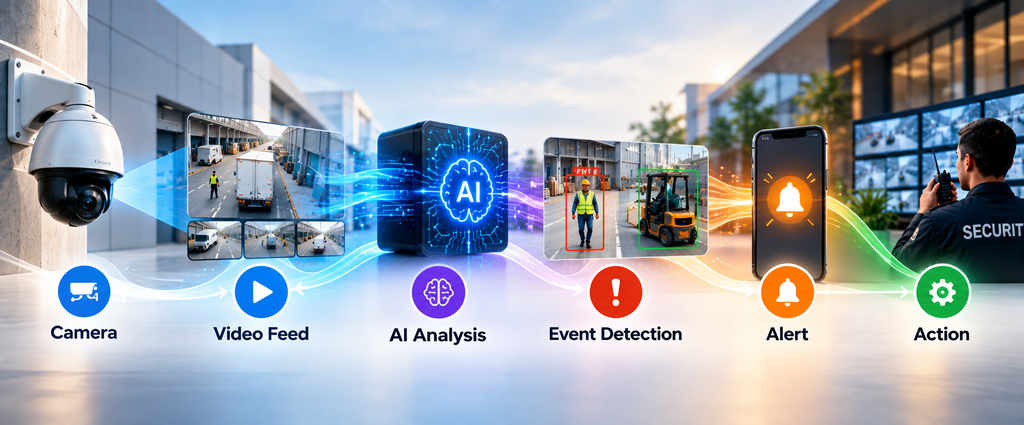
1. Cameras capture the video
Existing CCTV cameras capture activity across the facility or location.
The cameras can monitor entrances, production areas, warehouses, roads, restricted zones, loading areas and other important locations.
2. The system analyses the video
The video feed is processed by AI models that are designed for specific detection tasks.
For example, one model may detect PPE violations while another detects intrusion.
3. The system identifies an event
When the system finds an event that matches a defined condition, it identifies it as an incident or alert.
4. An alert is sent
The relevant team can receive an alert through the channels supported by the platform.
GuardVision AI supports alerts through SMS, WhatsApp, Email and Microsoft Teams.
5. The team takes action
The security or operations team can then review the event and take the required action.
This is one of the biggest differences between traditional CCTV and AI video surveillance.
Traditional CCTV helps you find what happened.
AI video surveillance can help you know when something is happening.
AI Video Surveillance vs Traditional CCTV
The difference is not that one uses cameras and the other does not.
Both can use cameras.
The main difference is what happens after the camera captures the video.
| Traditional CCTV | AI Video Surveillance |
|---|---|
| Records video | Analyses video |
| Depends heavily on manual monitoring | Uses AI to monitor defined events |
| Investigation often happens after an incident | Alerts can be generated during an event |
| Security teams search recorded footage | AI can identify relevant events |
| Limited video analysis | Computer vision-based analytics |
| Higher manual monitoring effort | Less repetitive monitoring |
| Mainly used for recording and review | Used for security, safety, operations and compliance |
Traditional CCTV still has an important role. It provides video evidence and helps teams understand incidents.
The problem starts when an organization has hundreds or thousands of cameras.
It is not practical for people to watch every camera continuously.
That is where AI video surveillance becomes useful.
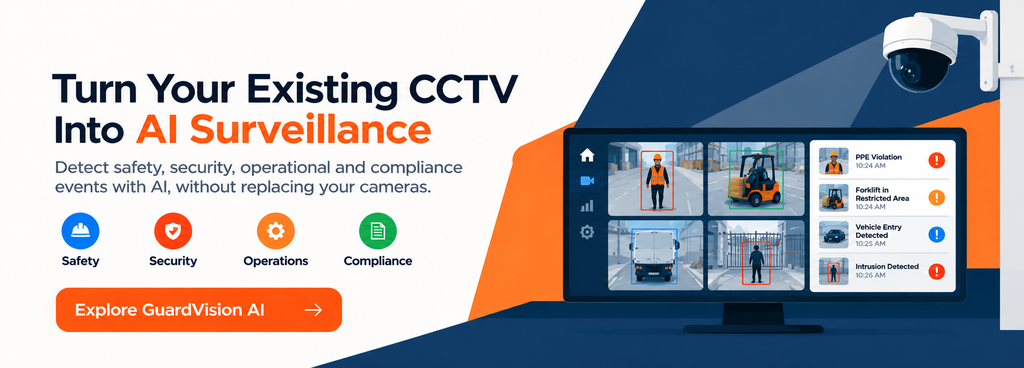
Why Are Organizations Moving Towards AI Video Surveillance?
Large facilities generate a huge amount of video every day.
A warehouse may have cameras covering loading docks, storage areas, entrances and vehicle movement.
A manufacturing plant may have cameras around production lines, worker areas and restricted zones.
An oil and gas facility may need to monitor safety, access and perimeter activity.
A port may have cameras across vehicles, cargo areas and operational zones.
The cameras may already be installed.
The challenge is turning all that video into useful information.
AI video surveillance helps solve this problem by analysing the video automatically and focusing attention on events that matter.
Instead of asking a security team to watch hundreds of camera feeds, organizations can use AI to identify specific events and send alerts when they occur.
GuardVision AI is built around this approach. Its product positioning focuses on turning traditional CCTV from a passive recording system into real time video intelligence.
What Can AI Video Surveillance Detect?
AI video surveillance is not limited to detecting intruders.
Modern systems can support several types of monitoring.
Safety Monitoring
Workplace safety is one of the major use cases.
AI can help detect:
- Missing PPE
- Falls
- Smoke
- Fire related events
- Unsafe behaviour
- Worker fatigue
- Other defined safety conditions
This can help safety teams identify issues without relying only on manual observation. GuardVision AI includes safety models for PPE, falls, smoke and fire, fatigue and unsafe behaviour.
Security Monitoring
Security teams can use AI video surveillance to monitor:
- Unauthorized entry
- Intrusion
- Tailgating
- Loitering
- Fence climbing
- Abandoned objects
- Crowd activity
- Restricted areas
The system can be configured to focus on the security events that matter to a particular facility.
Operations Monitoring
AI video analytics can also help with day to day operations.
Examples include:
- People counting
- Vehicle counting
- Forklift monitoring
- Dock monitoring
- Queue monitoring
- Dwell time
- Material tracking
- Asset monitoring
This changes the role of video surveillance.
The camera is no longer useful only when there is a security incident.
It can also provide operational information.
Compliance Monitoring
Organizations often have rules that need to be followed across large sites.
AI video surveillance can help monitor conditions such as:
- PPE compliance
- Smoking
- Phone usage
- Restricted area access
- Wrong direction movement
- Parking violations
- Other defined compliance conditions
GuardVision AI includes AI models across safety, security, operations and compliance use cases.
Key Features of an AI Video Surveillance System
A good AI video surveillance system should do more than detect objects.
It should fit into the way an organization already works.
Real Time Monitoring
The system should continuously analyse camera feeds and identify events as they occur.
This is important for situations where a delayed alert can reduce the value of the system.
Automated Alerts
Detection is useful only when the right people know about it.
An AI surveillance system should provide alerts through channels that security and operations teams already use.
GuardVision AI supports SMS, WhatsApp, Email and Teams alerts.
Multiple AI Models
Different environments have different requirements.
A warehouse may need forklift and loading dock monitoring.
A factory may need PPE and unsafe behaviour detection.
An oil and gas facility may need restricted area and perimeter monitoring.
A platform with multiple AI models can support these different requirements without using a separate system for every use case.
GuardVision AI provides more than 60 pre-trained AI models across four broad areas: safety, security, operations and compliance.
Centralized Monitoring
Large organizations may have cameras across multiple buildings, facilities or cities.
A centralized system can give authorized teams a single view of events across locations.
GuardVision AI is designed for centralized multi-site monitoring and supports large enterprise deployments.
Existing Camera Support
This is one of the most important points when evaluating AI surveillance software.
An organization may already have hundreds of cameras installed.
Replacing all of them just to introduce AI can be expensive and disruptive.
GuardVision AI supports existing RTSP and ONVIF camera infrastructure. It also lists compatibility with camera brands including Axis, Hikvision, Dahua, Bosch, Honeywell, CP Plus, Pelco and Hanwha.
Different Deployment Options
Not every organization can use the same deployment model.
Some may prefer clouds.
Others may need private cloud, hybrid infrastructure or on premise deployment.
Organizations working in highly restricted environments may also require air gapped systems.
GuardVision AI supports Cloud, Private Cloud, Hybrid, Edge AI and On Premise or Air Gapped deployment options.
Can AI Video Surveillance Work With Existing CCTV Cameras?
Yes, if the cameras and video infrastructure support the required interfaces and formats.
This is important because many organizations already have a large CCTV investment.
They may not need to start again from zero.
AI video surveillance software can use compatible video streams from existing cameras and add an intelligence layer on top.
GuardVision AI is built around this approach.
It supports RTSP and ONVIF and works with several established CCTV camera brands. The platform also supports camera types such as PTZ, dome, bullet, thermal and fisheye cameras.
For an enterprise, this can make AI adoption much more practical.
The organization can keep the existing camera infrastructure where it is suitable and add AI based monitoring on top.
Benefits of AI Video Surveillance
The value of AI video surveillance is not only better security.
It can affect several parts of an organization.
Faster Response
When an AI system detects an event and sends an alert, the responsible team can respond without waiting for someone to notice the incident manually.
Less Manual Monitoring
Security teams do not have to depend only on continuous screen watching.
AI can handle repetitive monitoring tasks and bring important events to human attention.
Better Use of Existing CCTV
Existing cameras can become more useful when their video feeds are analysed rather than simply stored.
Improved Workplace Safety
AI can help identify PPE violations, falls and other defined safety events.
Better Security
Intrusion, unauthorized access, perimeter activity and other security events can be monitored automatically.
Better Operational Visibility
People, vehicles, forklifts, queues and other operational activities can be monitored through video analytics.
Multi Site Visibility
Organizations with multiple facilities can bring monitoring into a centralized environment.
GuardVision AI describes its business impact around reducing safety incidents, reducing theft and pilferage, improving productivity, lowering operational costs and improving incident response.
AI Video Surveillance Use Cases
The best use of AI surveillance depends on the environment.
AI Video Surveillance for Manufacturing
Manufacturing facilities often have strict safety requirements and large areas to monitor.
AI video surveillance can help monitor PPE, unsafe behaviour, restricted areas, vehicle movement and other defined events.
AI Video Surveillance for Warehouses
Warehouses have constant movement of people, forklifts, vehicles and materials.
AI can help monitor forklift activity, loading areas, vehicle queues, people movement and restricted zones.
AI Video Surveillance for Oil and Gas
Oil and gas facilities require strong security and safety monitoring.
AI video analytics can support perimeter monitoring, restricted area monitoring, PPE compliance and other facility specific use cases.
AI Video Surveillance for Ports and Logistics
Ports and logistics facilities may have large camera networks covering vehicles, docks, loading areas and people.
AI can help identify relevant events without requiring teams to manually watch every feed.
AI Video Surveillance for Construction
Construction sites change throughout the day and often have multiple safety risks.
AI can support PPE monitoring, unsafe behaviour detection, restricted area monitoring and other safety use cases.
AI Video Surveillance for Smart Cities
AI video analytics can also support public spaces and urban environments.
Possible use cases include crowd monitoring, intrusion detection, vehicle monitoring and other public safety requirements.
GuardVision AI lists manufacturing and mining, ports and logistics, construction and infrastructure, smart cities and townships, oil and gas and power, and retail and public facilities among its target industries.
What Is Video Surveillance Analytics?
Video surveillance analytics means using software to extract useful information from video instead of treating the camera feed only as a recording.
Traditional surveillance answers questions such as:
“Can we see what happened?”
Video analytics can help answer:
“What is happening?”
and
“Does this event require attention?”
For example, a camera may be watching a warehouse entrance.
Traditional CCTV records the entrance.
Video analytics can identify when a person enters a restricted area.
That difference is important at scale.
When an organization has hundreds of cameras, finding useful information manually becomes difficult.
AI surveillance software can reduce that workload by analysing the video continuously.
Edge AI and Cloud AI in Video Surveillance
AI video surveillance does not have to follow one deployment model.
The processing can happen close to the camera through edge AI, or video and data can be processed through cloud infrastructure, depending on the system design and requirements.
Edge AI
With edge AI, processing happens closer to where the video is captured.
This can be useful where fast response and reduced dependence on network connectivity are important.
It can also be useful for remote or sensitive environments.
Cloud AI
Cloud based processing can provide centralized infrastructure and management.
It can be useful for organizations that want to manage video intelligence across multiple locations.
Hybrid Deployment
Some enterprises need a combination of both approaches.
That is why deployment flexibility matters when choosing AI surveillance software.
GuardVision AI supports Edge AI along with Cloud, Private Cloud, Hybrid and On Premise or Air Gapped deployment options.
Security and Access Control for AI Video Surveillance
Adding AI to CCTV does not remove the need for strong system security.
In an enterprise environment, the organization also needs to control:
- Who can access cameras
- Which locations users can see
- Which zones they can access
- Who can view alerts
- Who can change system settings
- What actions have been taken
GuardVision AI supports role based access control, camera, zone and location level access, MFA, SSO, Active Directory, LDAP, encryption, APIs and audit logs.
These controls become especially important when video surveillance covers sensitive facilities.
How Should a Company Choose AI Video Surveillance Software?
The right system depends on the organization’s cameras, sites, security requirements and use cases.
Before choosing a platform, ask these questions.
Does it work with existing cameras?
Check RTSP, ONVIF and camera compatibility before planning a replacement.
What can it detect?
Look beyond the number of AI models.
Check whether the system has models that match your actual requirements.
Can it send real time alerts?
An alert that reaches the team too late has limited value.
Does it support multiple locations?
This matters for enterprises with several plants, warehouses, offices or facilities.
Can it run in the required environment?
Check whether the platform supports cloud, private cloud, hybrid, edge or on premise deployment.
How is access controlled?
Look for role based access, authentication, encryption and audit capabilities.
Can it scale?
The system should be able to support the organization’s future camera and site requirements.
GuardVision AI is designed for enterprise scale deployments and states support for more than 10,000 cameras in a single enterprise rollout, along with a 99.9% uptime SLA.
GuardVision AI: Turning Existing CCTV Into AI Video Surveillance
At Valiance Solutions, we see AI video surveillance as more than adding another software layer to CCTV.
The real value comes from making existing cameras useful for real time decision making.
GuardVision AI is our enterprise AI video intelligence platform designed to turn existing CCTV cameras into an intelligent monitoring system without requiring hardware replacement.
The platform brings safety, security, operations and compliance monitoring into one system.
It supports more than 60 AI models and can work with existing camera infrastructure.
For example, an organization can use the platform to monitor PPE compliance in one area, forklift activity in another, restricted area access at an entry point and perimeter intrusion at another location.
The same camera infrastructure can therefore support several business requirements.
GuardVision AI also supports real time alerts, centralized multi site monitoring and different deployment models based on enterprise requirements.
This is particularly useful for organizations that have already invested heavily in CCTV but still depend on manual monitoring.
Instead of replacing the camera network, the organization can add an intelligence layer to the infrastructure it already has.
The Future of Video Surveillance Is Not Just More Cameras
Organizations do not necessarily need more cameras.
In many cases, they need to make better use of the cameras they already have.
AI video surveillance adds an intelligence layer to CCTV. It can analyse video, identify defined events, send alerts and help teams respond faster.
The biggest change is simple.
CCTV records what happened. AI video surveillance helps organizations understand what is happening.
For enterprises with large camera networks, this can turn video from a passive record into a useful source of safety, security and operational information.
At Valiance Solutions, we build AI solutions for real business and public sector challenges. GuardVision AI reflects that approach by combining existing camera infrastructure with AI based video intelligence, real time alerts, enterprise monitoring and flexible deployment options.
Valiance Solutions is a leading AI solutions company helping organizations apply AI, computer vision and intelligent automation to complex operational problems.
If your organization already has CCTV infrastructure and wants to add AI based monitoring without replacing the entire camera network, GuardVision AI is built for that use case.
Frequently Asked Questions
AI video surveillance uses artificial intelligence and computer vision to analyse camera feeds and detect defined events in real time. It can support security, safety, operations and compliance monitoring.
Traditional CCTV mainly records and displays video. AI video surveillance analyses the video and can identify defined events, generate alerts and provide useful information to security and operations teams.
Yes. Compatible existing cameras can often be connected to an AI video surveillance system. GuardVision AI supports RTSP and ONVIF and works with several common CCTV camera brands.
Depending on the AI models available, they can detect events such as intrusion, PPE violations, falls, smoke, fire, crowd activity, unauthorized access, vehicle movement and other defined safety, security, operational or compliance events.
The main benefits include faster incident detection, reduced manual monitoring, better use of existing CCTV infrastructure, improved safety monitoring, better security visibility and support for multi site operations.
Intelligent video surveillance is a broader term for surveillance systems that use technologies such as AI and computer vision to analyse video and identify events rather than only recording footage.
It can be used in manufacturing plants, warehouses, ports, logistics facilities, construction sites, oil and gas facilities, smart cities, public facilities and other environments where large numbers of cameras need to be monitored.
No. AI video surveillance is designed to support security and operations teams. It can handle repetitive monitoring and bring important events to human attention, while people remain responsible for reviewing incidents and taking appropriate action.