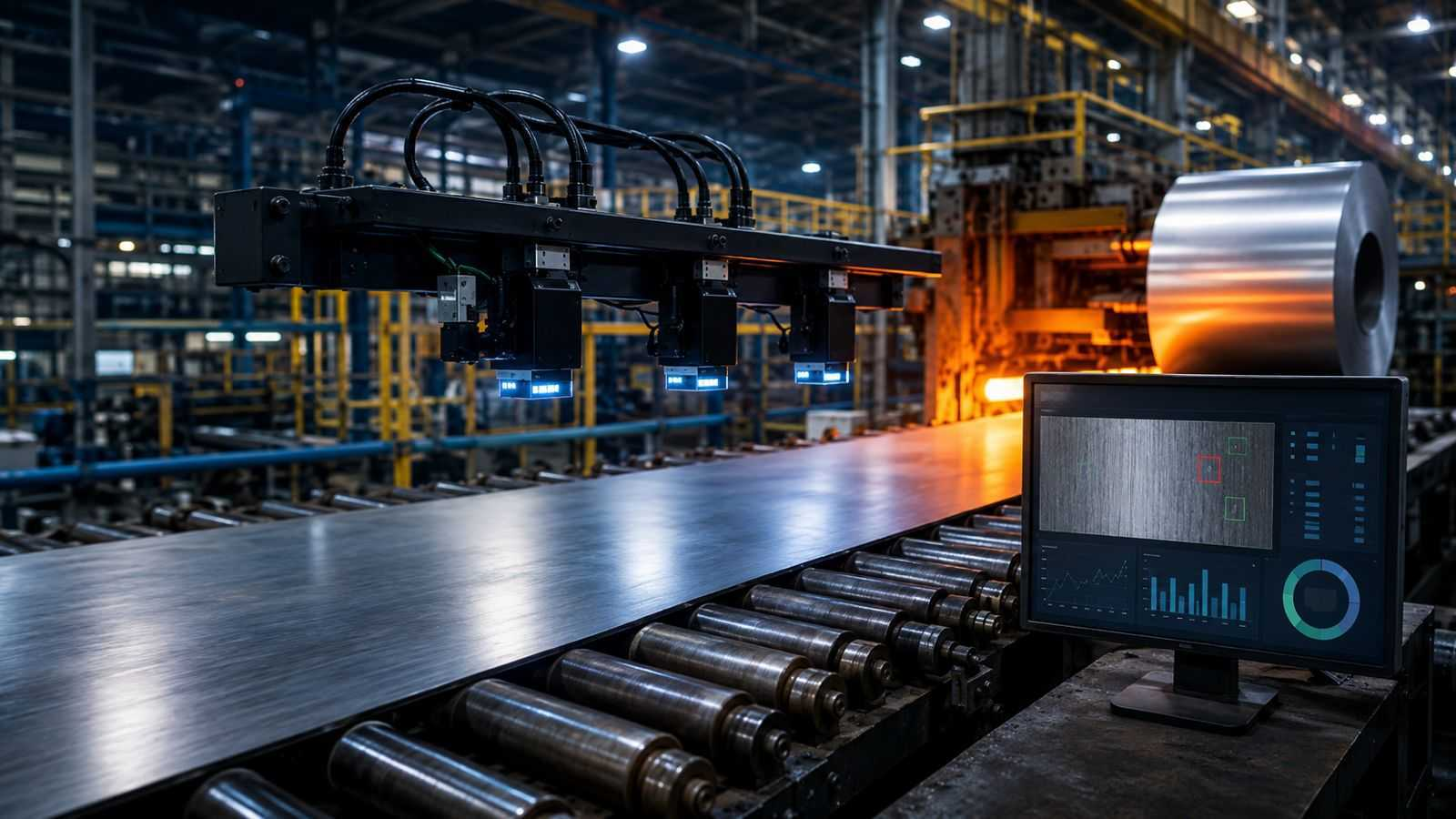

Multimodal AI for Root Cause–Driven Predictive Maintenance
In modern industrial systems logistics automation centers, steel processing units, manufacturing plants, and continuous material handling environments rotating assets operate under sustained thermo-mechanical stress, cyclic loading, torsional variation, and dynamic imbalance. A single rolling-element bearing operating at 1,800 RPM completes over 2.5 million revolutions per day. Even microscopic surface fatigue (on the order of microns) can evolve into macro-spalling under repeated Hertzian contact stress. When undiagnosed, such defects propagate into shaft eccentricity, housing vibration, lubricant contamination, and eventual seizure. According to reliability studies across heavy industry, unplanned downtime contributes to 5–20% productivity loss annually, with rotating machinery accounting for a dominant share of mechanical failure events. The U.S. Department of Energy estimates that predictive maintenance strategies can reduce breakdowns by 70–75% when correctly implemented yet many deployments plateau at anomaly detection rather than mechanistic understanding. Traditional vibration monitoring systems trigger alerts based on threshold exceedance. However, under dynamic industrial loading, anomaly detection without spectral interpretation and contextual reasoning results in high diagnostic ambiguity. Under these high-variability conditions, AI-driven multimodal root cause intelligence emerges not as a dashboard layer, but as a physics-aware reasoning system integrated into maintenance workflows. The Growing Challenges in Industrial Predictive Maintenance Industrial rotating machinery operates in nonlinear dynamic regimes characterized by: The challenge is not simply detecting vibration amplitude it is interpreting spectral energy distribution and harmonic structure within dynamic operating conditions. Limitations of Traditional Predictive Maintenance Systems Conventional systems rely on: These approaches face structural limitations. Loss of Spectral Granularity VRMS compresses vibration energy into a scalar value, eliminating frequency-domain information necessary for defect classification. Signal-to-Noise Interference Industrial environments introduce: Rule-based alerts cannot adapt to dynamic noise profiles. Static Documentation Dependency OEM manuals contain detailed fault trees, but remain: Technicians manually correlate symptoms with documentation introducing delay and cognitive overload. Diagnostic Uncertainty in Early Failure Phases Incipient bearing defects often present as subtle high-frequency modulation rather than large amplitude spikes. Early detection requires contextual modeling beyond fixed thresholds. As a result, facilities experience: Current Realities in Industrial Maintenance Operations Despite IoT sensor proliferation, many facilities operate in hybrid states: This fragmentation limits transition from predictive monitoring to prescriptive intervention. Key Challenges for Modern Diagnostic Systems High-Dimensional Time-Series Complexity Vibration signals are high-frequency signals (kHz range) requiring: Manual interpretation of these parameters does not scale across hundreds of assets. Multimodal Diagnostic Signals Root cause signals span: Traditional systems cannot synthesize these modalities into unified inference. Rare Failure Class Imbalance Certain catastrophic failures occur in <1% of assets annually, limiting labeled datasets for supervised modeling. Infrastructure Integration Constraints SCADA, CMMS, and IoT platforms often lack AI-native interoperability for contextual reasoning. How Multimodal AI Changes the Game Multimodal AI introduces physics-aware contextual reasoning across structured and unstructured industrial data. Spectral Feature Extraction and Pattern Recognition AI models analyze: Instead of single-value VRMS, models interpret full spectral fingerprints. Failure Mode Classification Deep learning models trained on labeled vibration spectra classify: Probabilistic outputs rank likely mechanisms rather than issuing binary alarms. Generative Diagnostic Reasoning Using large language models (LLMs), the system: Multimodal RAG Integration Text and image content from manuals are embedded into vector databases. Reciprocal Rank Fusion improves retrieval robustness across semantically similar queries. Image embeddings allow cross-reference of uploaded bearing photos with documented defect imagery. Audio and Acoustic Modeling Abnormal acoustic emissions (e.g., high-frequency squeal from dry bearings) are transcribed and contextualized into diagnostic hypotheses. The system moves from “vibration is high” to:x “Dominant spectral energy at BPFO with increasing kurtosis suggests early-stage outer race spalling; elevated temperature indicates lubrication degradation. Recommend inspection within the defined operating window.” Where Intelligent Root Cause Intelligence Matters In automated logistics hubs processing 10,000+ parcels per hour, a single failed motor may halt entire conveyor loops. In continuous manufacturing: Reducing MTTR by 25% in high-volume facilities can prevent cascading downtime losses worth millions annually. Early root cause clarity prevents: How AI-Based Root Cause Intelligence Systems Work: The Process Flow Measurable Impacts of Multimodal AI-Driven Predictive Maintenance Industrial deployments demonstrate: ROI models show payback periods within 6–12 months in high-throughput environments. Platform Capabilities of Valiance Solutions for Multimodal AI in Predictive Maintenance Valiance Solutions delivers an industrial-grade multimodal AI architecture engineered for high-frequency mechanical diagnostics. By embedding spectral analytics, multimodal reasoning, and knowledge-grounded generative AI into maintenance operations, Valiance transitions predictive maintenance from: Threshold-based alerting Spectral-aware diagnosis Physics-informed root cause intelligence Predictive reliability optimization