
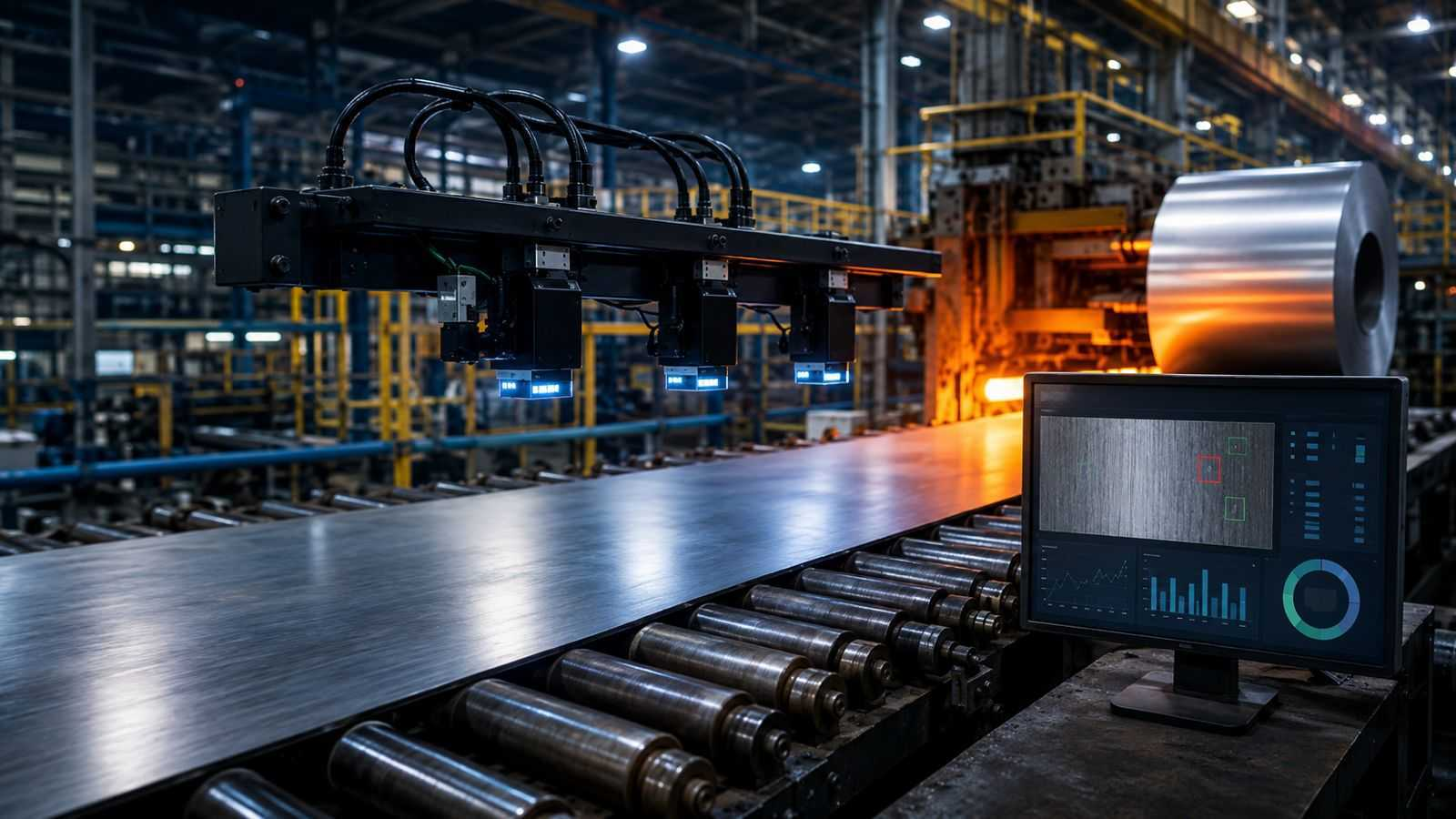
In modern steel manufacturing, quality deviations cannot be understood as isolated surface imperfections. Steel production is a thermally coupled, deformation-intensive, high-throughput system in which material behavior evolves continuously from casting through rolling and finishing.
At production speeds exceeding 20 m/s and temperatures surpassing 1,500°C, transient instabilities, thermal gradients, roll force imbalance, lubrication inconsistency, or cooling asymmetry can initiate microstructural disturbances that later manifest as surface or sub-surface defects.
With global steel output reaching 1.89 billion metric tons annually (World Steel Association, 2023), even marginal undetected defect rates translate into large-scale material, energy, and yield losses. In such an environment, defect detection must transition from isolated visual inspection toward integrated, real-time quality intelligence.
The Growing Challenges in Steel Manufacturing
Steel production operates under tightly coupled thermo-mechanical conditions:
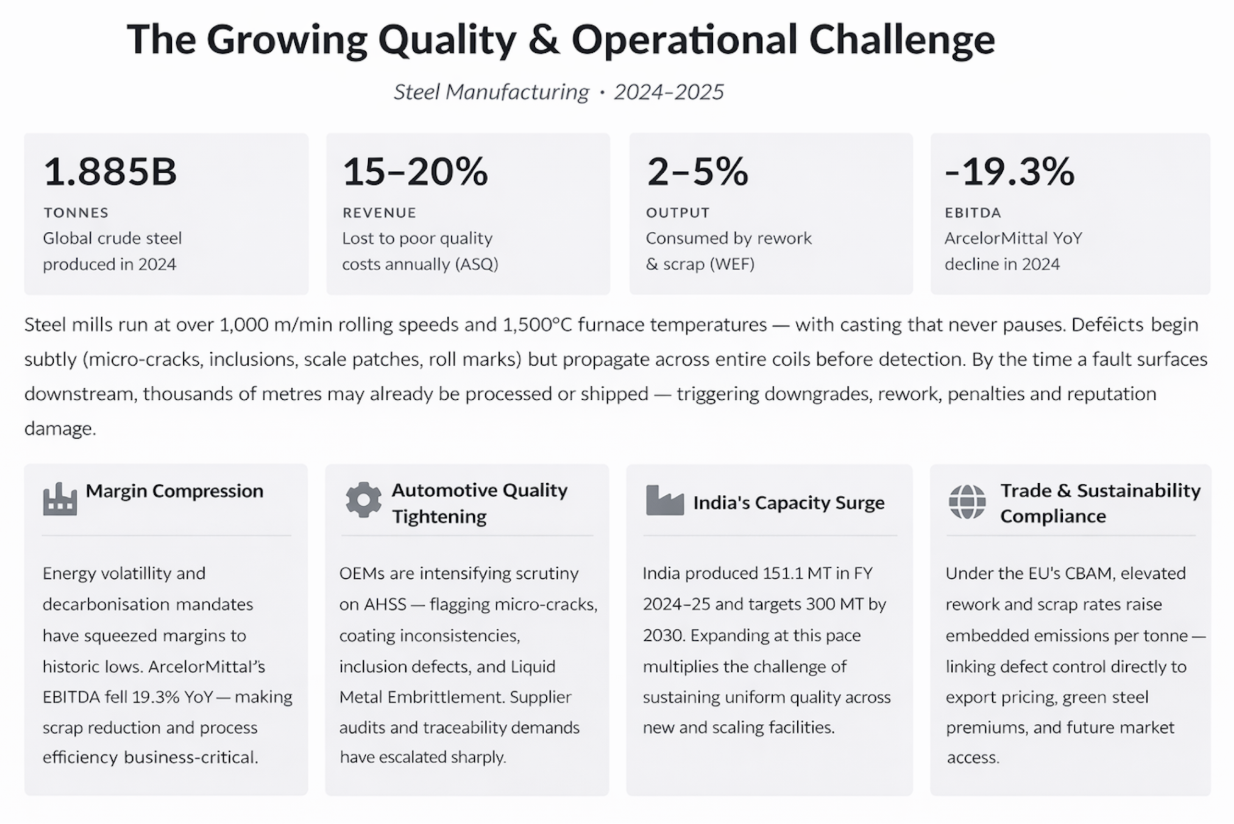
The core challenge is not merely defect visibility, it is early-stage deviation detection within a continuously evolving material system.
Limitations of Traditional Defect Detection Methods
Conventional inspection architectures include:
- Manual operator-based inspection
- Rule-based machine vision using edge detection and contrast thresholds
- Periodic metallurgical sampling
- Post-process laboratory validation
These systems exhibit structural constraints.
Temporal Fragmentation
Sampling introduces discontinuity in a continuous process. Between two inspection intervals, kilometers of strip may pass unmonitored.
At 20 m/s, a 60-second detection delay affects 1.2 kilometers of material.
Feature Rigidity
Rule-based vision systems depend on engineered features such as intensity gradients and geometric thresholds. These fail under:
- Variable reflectivity from scale formation
- Surface roughness variation across grades
- Illumination fluctuation in high-temperature zones
They lack adaptive feature learning.
Sensitivity to Environmental Disturbance
Dust, vibration, steam, and thermal radiation degrade image stability, reducing detection robustness.
Human Fatigue and Perceptual Limits
Industrial inspection studies indicate manual detection accuracy often declines below 75% in sustained high-speed operations, particularly for low-contrast anomalies.
These limitations create gaps between defect formation and detection, enabling propagation.
Current Realities in Steel Defect Detection
Many steel facilities continue operating with partially digitized quality systems:
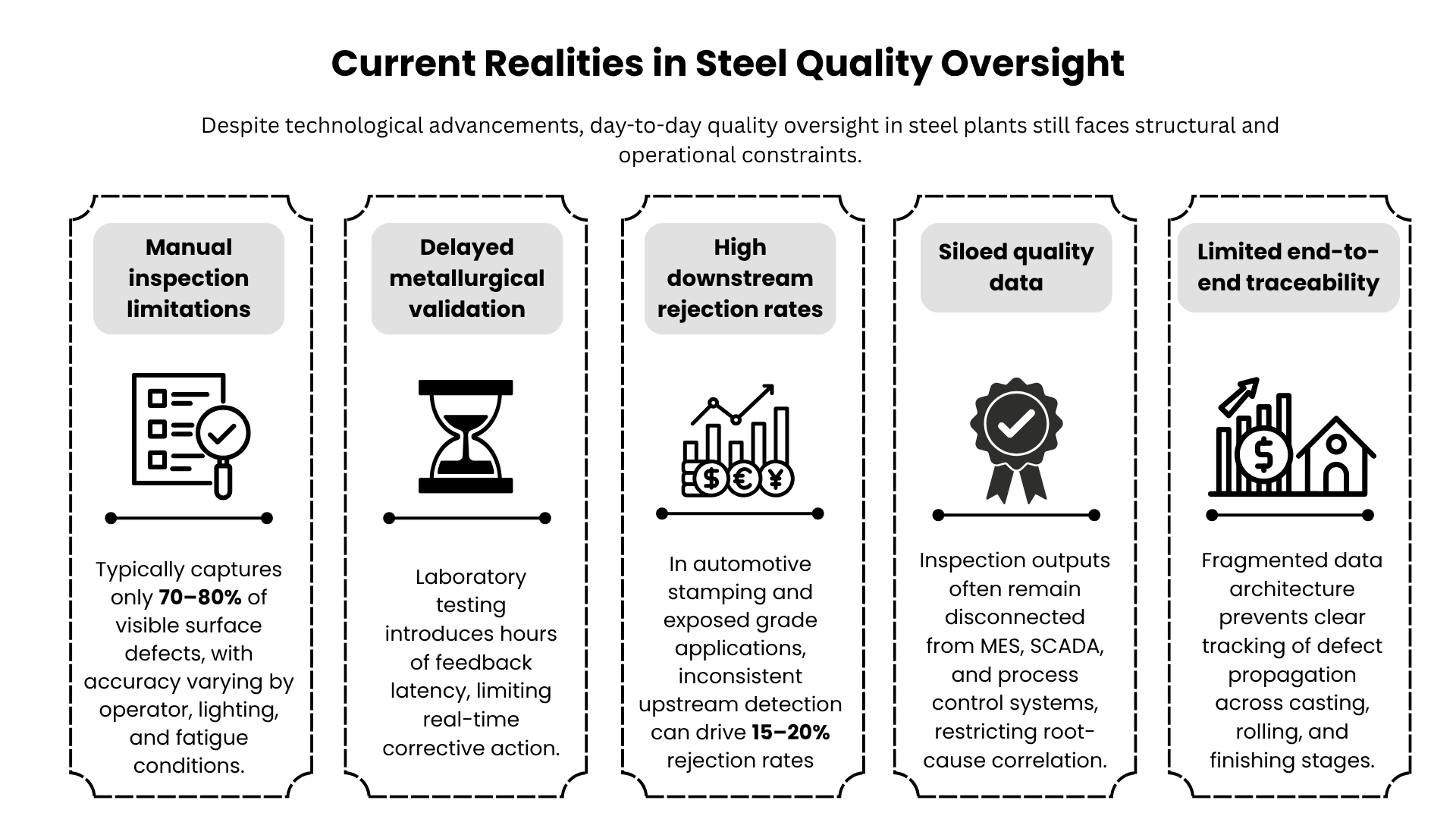
This fragmentation prevents systemic understanding of defect evolution across production stages.
Key Challenges for Modern Defect Detection
As plants pursue Industry 4.0 integration, deeper challenges emerge.
- Class Imbalance in Defect Data: Rare anomalies may occur in less than 0.1% of total throughput, complicating supervised model training.
- Process Variability: Changes in steel grade, surface finish, cooling rates, and rolling parameters introduce domain shift, impacting model stability.
- Latency Constraints: Inference systems must operate within millisecond windows to prevent downstream propagation at high line speeds.
- Infrastructure Compatibility: Legacy PLC, SCADA, and DCS architectures limit seamless deployment of high-compute inference engines.
- Traceability Requirements: Automotive and aerospace-grade steel mandates complete defect traceability aligned with ISO/TS standards.
How Vision AI Transforms Steel Defect Detection
AI-based defect detection replaces static rule thresholds with adaptive feature extraction and probabilistic classification.
Hierarchical Feature Learning
Convolutional Neural Networks (CNNs) extract multi-scale spatial features from fine-grain texture irregularities to macro-structural discontinuities enabling detection of subtle morphological deviations invisible to traditional systems.
Modern deployments report 95–99% detection accuracy with <1% false positive rates under optimized calibration.
Multi-Class and Severity Classification
Deep models classify 40–80+ defect categories, quantifying:
- Crack length and orientation
- Surface pit density
- Area affected by inclusions
- Edge deviation amplitude
- Edge-Based Low-Latency Processing
Industrial GPU-enabled edge devices execute inference locally, ensuring sub-second decision-making without cloud dependency.
Continuous Model Adaptation
Hybrid supervised–unsupervised learning frameworks detect anomalous patterns even when labeled defect datasets are limited. Continuous retraining pipelines mitigate model drift as process conditions evolve.
Correlation with Process Parameters
Defect maps can be synchronized with:
- Roll force signals
- Cooling temperature gradients
- Vibration signatures
- Line speed fluctuations
This enables causal analysis rather than surface-level identification.
Where Intelligent Defect Detection Matters
In automotive structural steel, micro-level inclusions can initiate fatigue cracks under cyclic loading conditions. In construction-grade steel, dimensional and surface integrity directly affect structural reliability and compliance standards.
Even a 1% scrap reduction in a 5 MTPA facility represents tens of thousands of tons of material preservation annually, with associated reductions in energy consumption and CO₂ emissions.
Early-stage detection limits defect propagation, preventing energy-intensive reprocessing cycles and downstream rejection.
How AI-Based Defect Detection Systems Work: The Process Flow
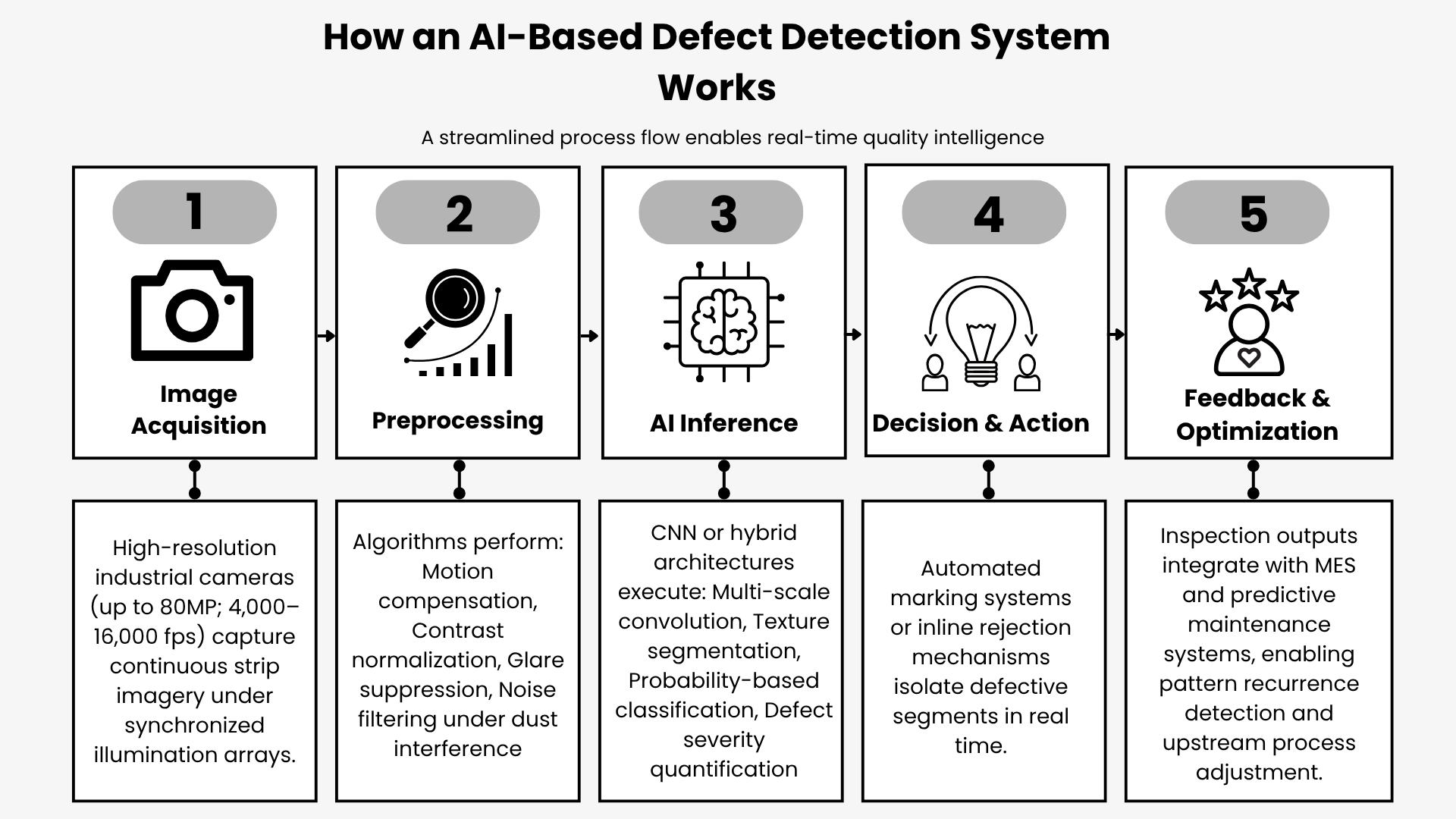
This establishes a closed-loop inspection-to-control framework.
Measurable Impacts of AI-Driven Defect Detection
Industrial case implementations indicate:
- Transition from sampling-based inspection to 100% inline coverage
- Detection improvements from ~70% manual rates to 98%+ system accuracy
- Defect-related downtime reduction of 15–20%
- Scrap reduction between 10–20% in optimized environments
These improvements derive from reduced propagation, earlier intervention, and integrated data visibility.
Platform Capabilities of Valiance Solutions for AI Defect Detection in Steel Manufacturing
Valiance Solutions provides industrial-grade computer vision and multi-modal AI platforms engineered for high-temperature, high-vibration manufacturing ecosystems.
Core capabilities include:
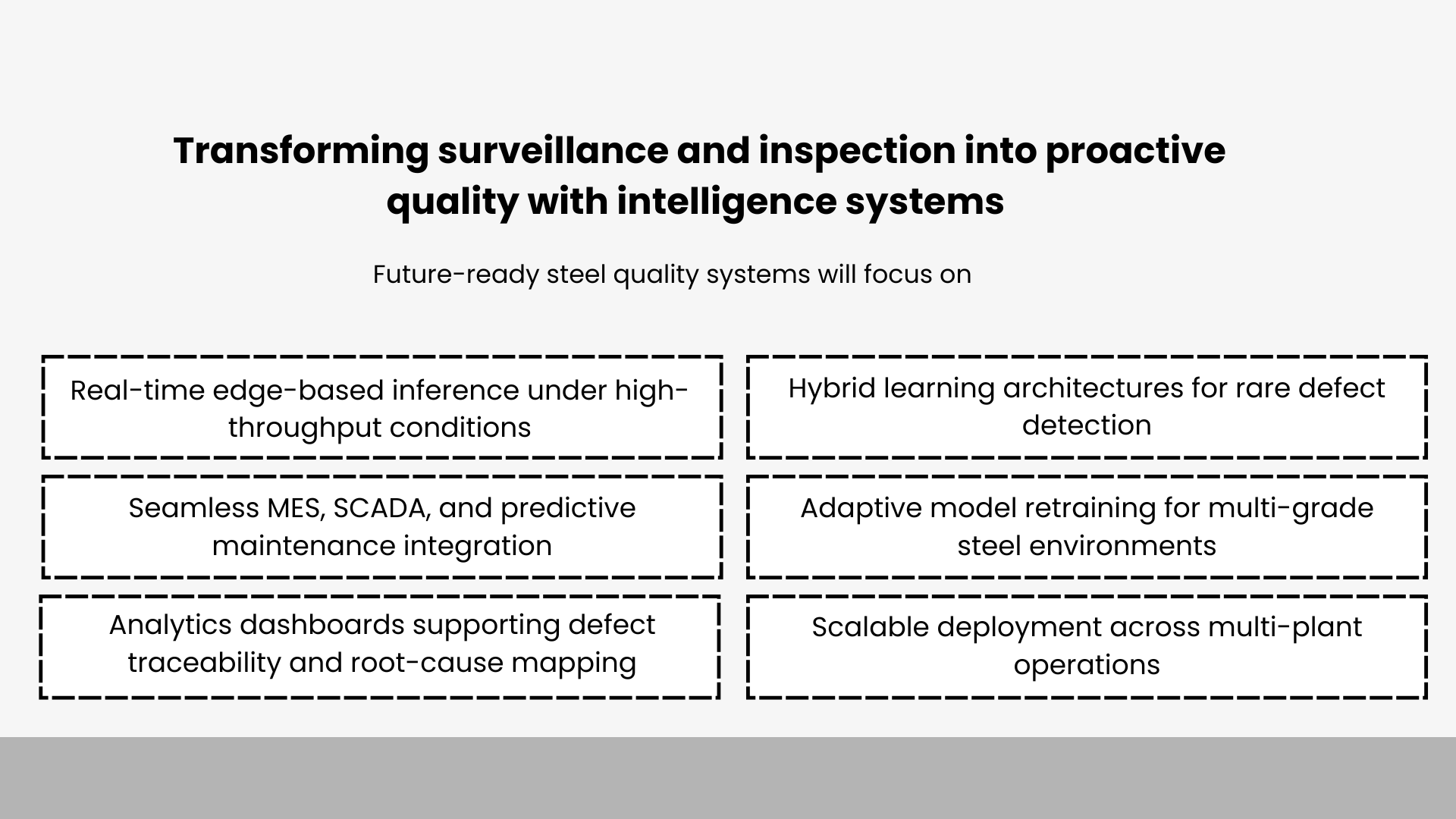
Such systems enable transition from reactive inspection toward process-integrated quality intelligence across steel production lifecycles.