

A factory doesn’t lose competitiveness in one dramatic moment.
It loses it quietly at the point of compliance.
In early 2026, an Indian manufacturer exporting to Europe was asked to submit verified emissions data under tightening EU Carbon Border Adjustment Mechanism (CBAM) norms. Production was stable. Orders were strong. But carbon data had to be manually compiled from energy logs and plant records. What should have been instant visibility turned into weeks of reconciliation.
The issue wasn’t output.
It was traceable.
As global markets begin tying trade access to verified carbon disclosure, productivity alone is no longer enough. For Indian manufacturers, competitiveness now depends on real-time, auditable sustainability intelligence not retrospective reporting.
This is the new industrial reality: scale without intelligence is risk.
The Growing Industrial Challenge: Scale vs Sustainability
India aims to grow manufacturing to $1 trillion by 2030, targeting ~25% contribution to GDP. At the same time, it has committed to reducing emissions intensity of GDP by 45% by 2030 (from 2005 levels) under its climate commitments.(https://www.pib.gov.in)
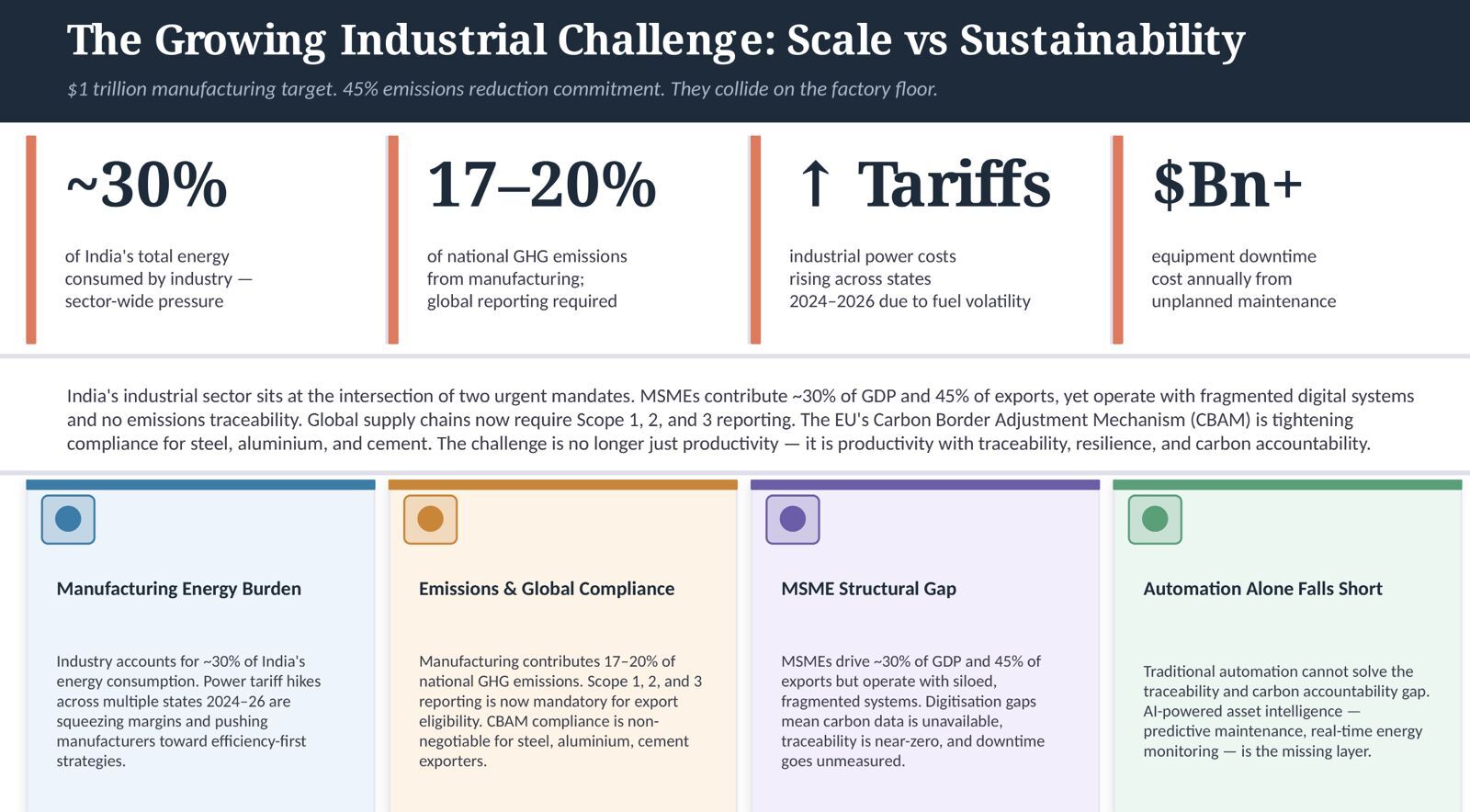
These goals are not separate. They collide directly on the factory floor.
The Pressure Is Real
- The industrial sector accounts for nearly 30% of India’s total energy consumption.(https://www.ibef.org/)
- Manufacturing contributes roughly 17–20% of national greenhouse gas emissions.
- India’s power tariffs for industrial users have increased across several states between 2024–2026 due to fuel volatility and grid balancing costs.(https://www.eesi.org/)
- Global supply chains now require Scope 1, 2, and increasingly Scope 3 emissions reporting for export eligibility.
- The EU’s Carbon Border Adjustment Mechanism (CBAM) has begun tightening compliance for carbon-intensive imports including steel, aluminum, and cement.
Meanwhile:
- MSMEs contribute ~30% of India’s GDP and 45% of exports, yet many operate with fragmented digital systems.(https://www.pib.gov.in/)
- Equipment downtime in Indian manufacturing is estimated to cost billions annually due to unplanned maintenance and inefficient asset utilization.
The challenge is no longer just productivity.
It is productivity with traceability, resilience, and carbon accountability.
And traditional automation alone cannot solve this.
Where Traditional Industry Falls Short
Industry 4.0 digitized operations but digitization is not cognition.
Common structural gaps include:
- Data in Silos: Machine logs, energy systems, ERP platforms, and quality systems rarely speak contextually to one another.
- Reactive Waste Management: Scrap and rework are analyzed after production cycles not prevented mid-process.
- Static Planning Models: Production schedules rely on forecasts rather than dynamic operational and environmental inputs.
- Manual Carbon Estimation: Sustainability reporting remains spreadsheet-driven and retrospective.
- Limited Predictive Depth: Failures are often addressed after threshold breaches not through contextual pattern learning.
In simple terms: Factories measure output but they do not continuously optimize it.
This is where cognitive manufacturing becomes critical.
Current Realities: The Gap in India’s Manufacturing Today
India’s factories are rapidly adopting Industry 4.0, but most remain digitized, not cognitive. The challenge isn’t data it’s turning data into sustainable action:
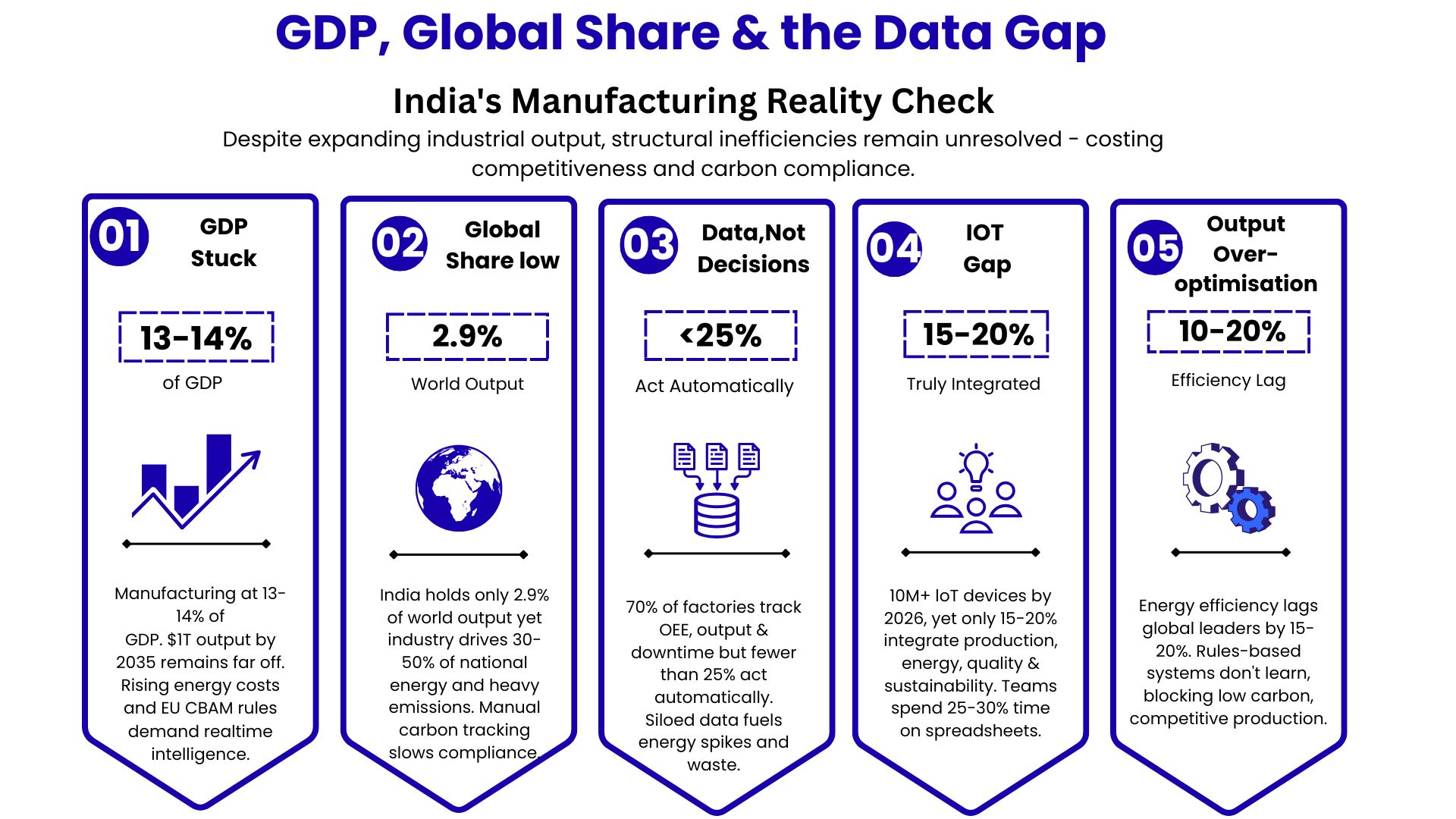
Automated and connected but not cognitive. Scale + sustainability demand cognitive manufacturing.
Key Challenges Without Cognitive Manufacturing
When intelligence is not embedded into operations, several challenges persist:
- Delayed Inefficiency Detection: Energy intensity rises gradually without immediate visibility.
- Escalating Scrap and Rework: Small deviations accumulate into significant material loss.
- Operational Strain on Teams: Engineering and sustainability teams spend extensive time reconciling disconnected datasets.
- Unidentified Risk Patterns: Repeated minor incidents across lines remain unlinked.
- Carbon Compliance Pressure: Export reporting becomes time-consuming and reactive rather than automated and verifiable.
Even small inefficiencies when multiplied across high-volume production significantly affect cost structures and emissions profiles.
These challenges are pushing the industry toward a more intelligent approach.
How Cognitive Manufacturing Supports Sustainable Industrial Growth
Cognitive manufacturing shifts factories from rule-based automation to adaptive intelligence.
Instead of asking: “Did we meet production targets?”
Organizations begin asking: “Why did energy intensity increase this week?”
“Which variables influenced scrap rates?”
“How will this scheduling decision affect emissions output?”
Cognitive systems enable:
- Connected Operations: IIoT-enabled assets stream real-time data across machines, utilities, and supply chains.
- Contextual Pattern Analysis: Operational, environmental, and demand variables are analyzed together to detect hidden inefficiencies.
- Predictive Optimization: Maintenance, yield, and energy modeling improve continuously through machine learning.
- AI-Guided Decision Intelligence: Scheduling, calibration, and resource allocation adjust dynamically based on predictive insights.
The shift is clear: From monitoring to interpreting, From reacting to anticipating, From reporting to optimizing
Where Cognitive Manufacturing Matters in Industrial Operations
Intelligent systems create impact across critical operational zones:
- Shop floor production lines
- Utilities and energy management systems
- Maintenance and asset performance monitoring
- Quality inspection environments
- Supply-chain traceability systems
- ESG and export compliance workflows
Even marginal improvements across these areas significantly enhance both profitability and sustainability.
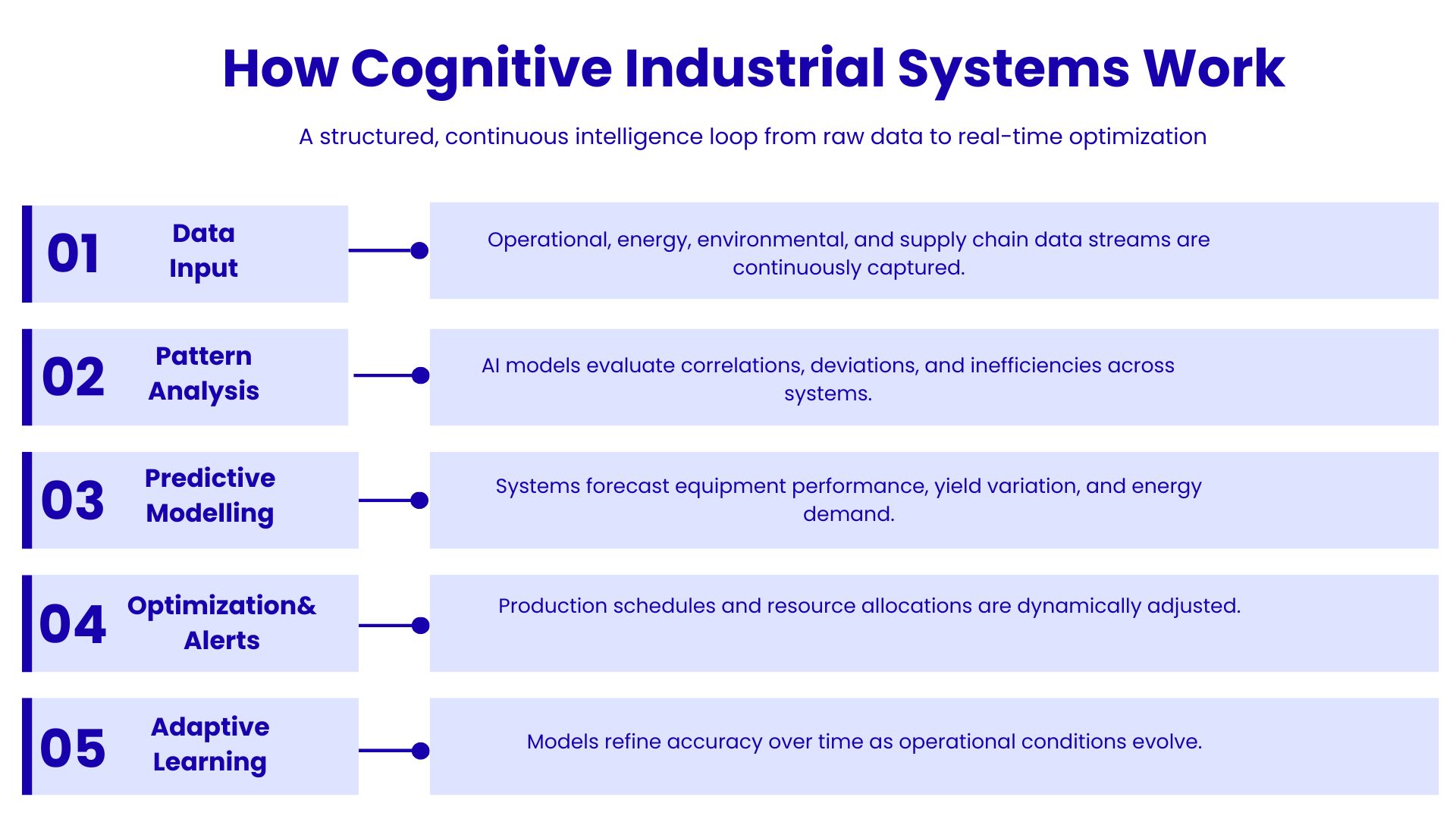
How Cognitive Manufacturing Systems Work
In a typical implementation, multiple processes work together:
- Data Input: Operational, energy, environmental, and supply-chain data streams are continuously captured.
- Pattern Analysis: AI models evaluate correlations, deviations, and inefficiencies across systems.
- Predictive Modeling: Systems forecast equipment performance, yield variation, and energy demand.
- Optimization & Alerts: Production schedules and resource allocations are dynamically adjusted.
- Continuous Learning: Models refine accuracy over time as operational conditions evolve.
Result: Factories move from static execution to adaptive performance.
Valiance Solutions: Cognitive Manufacturing Intelligence Platform
Valiance Solutions enables manufacturers to transform existing production and monitoring infrastructure into intelligent, self-optimizing industrial ecosystems through AI-powered cognitive manufacturing.
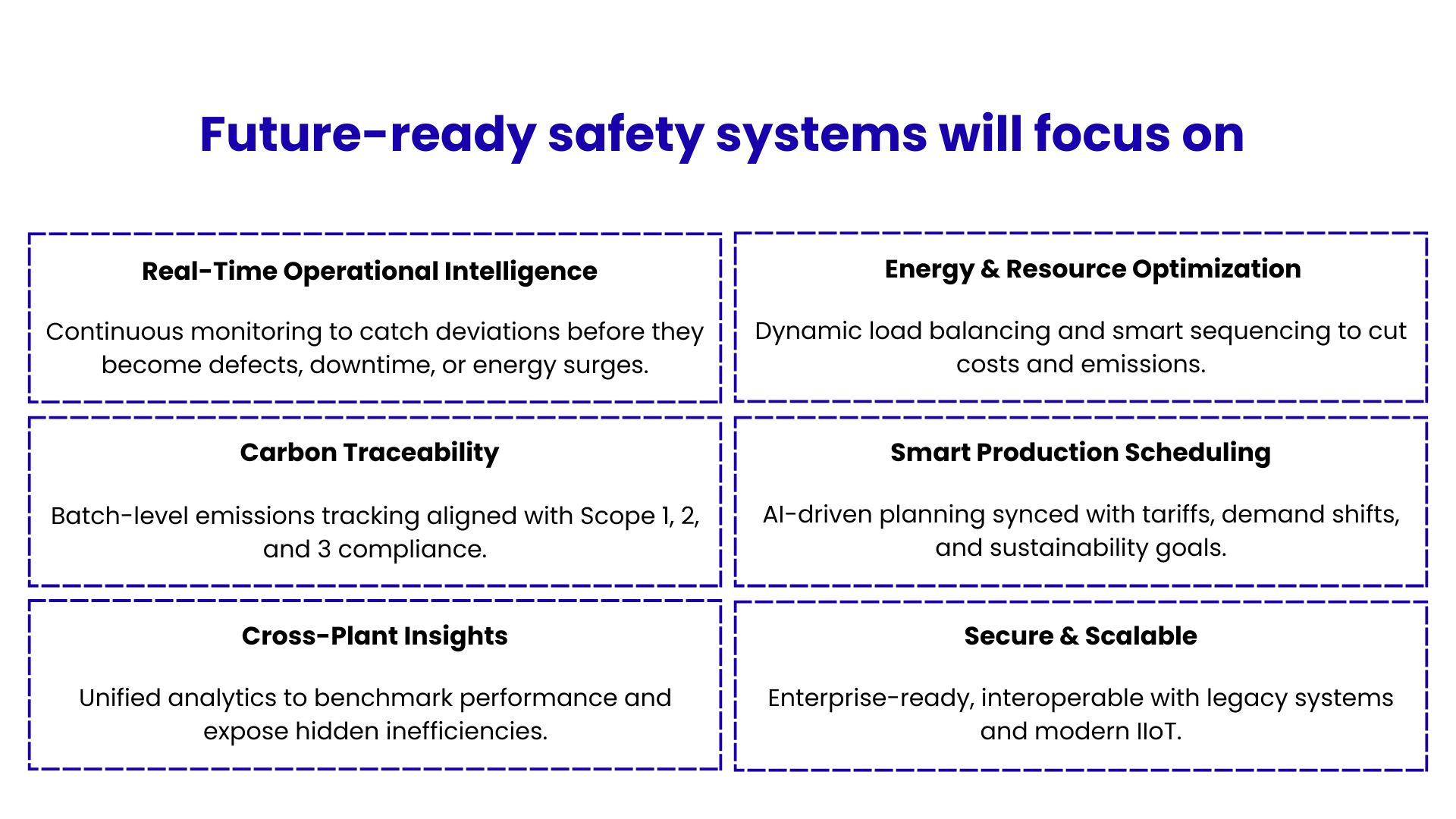
The platform is designed for deployment across discrete and process industries, multi-plant environments, MSME clusters, and export-driven manufacturing ecosystems.
Core Capabilities
- Real-Time Operational Intelligence: Continuous monitoring of machine, utility, and process data to detect deviations before they escalate into defects, downtime, or energy spikes.
- Energy & Resource Optimization Engine: Dynamic adjustment of energy loads, production sequencing, and resource allocation to reduce cost per unit and lower emissions intensity.
- Carbon Visibility & Traceability Framework: Batch-level emissions modeling aligned to Scope 1, 2, and 3 reporting requirements, enabling export-ready carbon compliance.
- Context-Aware Production Scheduling: AI-supported planning that integrates operational constraints, energy tariffs, demand variability, and sustainability targets.
- Cross-Plant Performance Analytics: Unified intelligence across distributed facilities to surface hidden inefficiencies and benchmark performance.
- Secure & Scalable Architecture: Enterprise-grade, interoperable deployment compatible with legacy equipment and modern IIoT ecosystems.
India’s industrial ecosystems are expanding. Sustainability expectations are tightening. Global compliance standards are evolving.